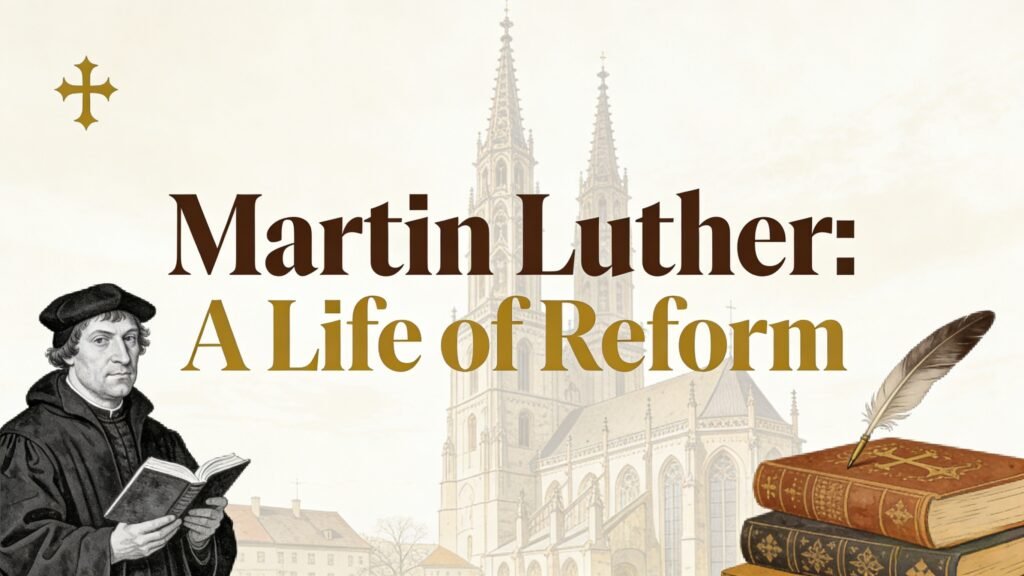
Martin Luther: A Life of Reform
1. The Life and Legacy of Martin Luther
Martin Luther stands as one of the most transformative figures in Western civilization, whose theological insights and courageous actions reshaped the course of Christian and European history. Born on November 10, 1483, in Eisleben, Saxony (now Germany), he would grow to become the catalyst for the Protestant Reformation, fundamentally challenging the established authority of the Roman Catholic Church and inspiring a religious revolution that would divide Western Christendom. Martin Luther’s life’s work encompasses not only theological innovation but also profound social, political, and cultural transformation, making him one of the most influential figures in the last millennium. Martin Luther’s significance extends far beyond his role as a religious leader. As a German theologian, Augustinian monk, and professor of biblical studies, he developed a theological framework that challenged centuries of Catholic doctrine, particularly regarding salvation, the authority of the pope, and the interpretation of Scripture. Martin Luther’s famous Ninety-Five Theses, posted on October 31, 1517, were initially intended as an academic debate on the sale of indulgences but would inadvertently spark a movement that would forever change the religious landscape of Europe. This comprehensive examination of his life, theological contributions, and lasting impact aims to provide a detailed understanding of how his convictions and actions fundamentally altered the trajectory of Western Christianity. Through careful analysis of his major theological works, key historical events, and the complex web of political and religious circumstances that shaped his era, we can appreciate both the revolutionary nature of his contributions and the enduring questions his legacy continues to raise about faith, authority, and religious reform.
Christianity, as a faith, had remained largely unified under the Roman Catholic Church for over a millennium before the 16th century. However, growing discontent with corruption within the Church, the sale of indulgences, and the perceived distance between the clergy and the laity created a fertile ground for reform. It was within this context that Martin Luther emerged, a man whose deep piety and scholarly dedication led him to question the very foundations of the Church’s teachings. Martin Luther’s willingness to challenge the status quo, even in the face of excommunication and death, made him a symbol of resistance and a voice for those seeking a more authentic expression of Christian faith. Unlike many reformers who came before him, he had the advantage of the printing press, which allowed his ideas to spread rapidly throughout Europe, reaching a far broader audience than would have been possible just decades earlier. This combination of personal conviction, scholarly rigor, and technological innovation ensured that his message would not be silenced, but would instead spark a movement that would redefine Christianity for centuries to come.
2. Martin Luther’s Early Life and Education
2.1 Martin Luther’s Family Background and Childhood
Martin Luther’s early life was marked by the strong influence of his parents, particularly his father Hans Luther, whose ambitious plans for his son would ultimately be redirected by a dramatic religious experience. Born into a modest mining family in Eisleben, he was baptized the day after his birth on November 11, the feast day of St. Martin of Tours, from whom he received his name. His family soon moved to Mansfeld, where his father operated copper mines and served as a town councilor, eventually achieving a position of relative prosperity and civic importance. Hans Luther harbored significant aspirations for his son, envisioning him as a successful lawyer who would bring further prestige and financial security to the family. This parental ambition led the young man to attend schools in Mansfeld, Magdeburg, and Eisenach, where he received a classical education grounded in Latin grammar and rhetoric. He demonstrated considerable academic promise, excelling in his studies and progressing through the educational system with remarkable speed. Hans Luther’s determination to provide his son with the best possible education reflected the family’s social ambitions and their belief in the transformative power of learning.
Childhood for the future reformer was not without hardship. Martin Luther’s parents were strict, believing that discipline was essential for his moral and intellectual development. This strict upbringing would later shape his views on morality and responsibility, though he would eventually reject the idea that human effort alone could earn salvation. In Eisenach, he lived with a family of weavers for a time, an experience that exposed him to the lives of ordinary people and their struggles. This exposure would later influence his decision to translate the Bible into German, making it accessible to those who could not read Latin. It was during these early years that he first began to develop a love for learning and a curiosity about the world, traits that would serve him well in his later scholarly pursuits. Little did anyone know at the time that this young boy, born to a mining family in a small German town, would one day change the course of Western history through his actions and ideas.
2.2 Martin Luther’s Academic Journey and Religious Conversion
Martin Luther’s academic career began at the University of Erfurt in 1501, where he initially pursued a Master of Arts degree, studying philosophy, logic, and the liberal arts. His educational experience was deeply influenced by the nominalist tradition of the time, particularly the teachings of William of Ockham, which would later prove significant in shaping his theological perspectives. Following his master’s degree in 1505, he enrolled in the university’s law school, dutifully following his father’s wishes for his professional future. However, his life took an unexpected turn on July 17, 1505, when he was caught in a violent thunderstorm while traveling. Terrified by the storm’s intensity and fearing for his life, he cried out to St. Anne, vowing to become a monk if he survived. True to his promise, he immediately abandoned his legal studies and entered the Augustinian monastery in Erfurt, much to the dismay of his father. This dramatic conversion experience would mark the beginning of his religious vocation and set him on a path that would fundamentally challenge the established religious order of his time.
The decision to become a monk was not one taken lightly. It represented a complete rejection of his father’s plans and a commitment to a life of poverty, chastity, and obedience. For the young man, this decision was driven by a deep sense of guilt and a desire to earn God’s favor. He believed that by dedicating himself to the monastic life, he could achieve the holiness necessary for salvation. However, his time in the monastery would prove to be a period of intense spiritual struggle. Despite his best efforts to live a life of perfection, he was plagued by doubts about his own worthiness and fears that he could never do enough to satisfy God’s justice. It was during this time that he began to study the Bible more deeply, seeking answers to his spiritual questions. This intensive study would eventually lead him to a new understanding of salvation, one that would challenge everything he had been taught by the Church.
2.3 Martin Luther’s Monastic Life and Theological Development
Life as an Augustinian monk was characterized by rigorous discipline, prayer, and theological study. He took his vows in 1506 and was ordained as a priest in 1507, beginning his ministry with the celebration of his first Mass. His superiors quickly recognized his intellectual abilities and dedication to scholarship, leading to his transfer to the Augustinian monastery in Wittenberg in 1508, where he continued his theological education at the newly established University of Wittenberg. The University of Wittenberg, founded in 1502, provided him with a unique academic environment that emphasized biblical studies and the original languages of Scripture. Martin Luther’s theological development was profoundly influenced by his study of the Bible, particularly the letters of Paul, and by the guidance of his mentor, Johann von Staupitz, the vicar-general of the Augustinian order. Staupitz encouraged his scholarly pursuits and his deep engagement with Scripture, fostering the young monk’s growing understanding of grace and justification through faith.
Martin Luther’s academic progress was remarkable, as he completed the requirements for both the baccalaureate in Bible and the Sententiarius degree in just one year of study. He continued his doctoral studies, though they were interrupted by his appointment to represent the German Augustinian monasteries in Rome in 1510-1511. This journey to Rome proved to be a pivotal experience, as he was shocked by what he perceived as the corruption and worldliness of the papal court, further fueling his growing disillusionment with the institutional church. He was particularly disturbed by the sale of indulgences in Rome, where pilgrims were encouraged to pay money in exchange for the forgiveness of sins. This practice seemed to contradict everything he had been studying in Scripture, and it planted a seed of doubt that would eventually grow into a full-blown challenge to the Church’s authority.
Upon his return from Rome, he resumed his studies at Wittenberg and received his doctorate in theology in the fall of 1512. He immediately assumed a professorship in biblical studies at the university, a position that would allow him to develop and articulate his theological insights while fulfilling his duties as a monk and priest. Martin Luther’s teaching responsibilities included courses on the Psalms, Romans, and other biblical books, and it was through this intensive engagement with Scripture that he began to formulate the theological ideas that would eventually challenge the foundations of Catholic doctrine. It was during his study of Romans 1:17, which states that “the righteousness of God is revealed through faith for faith,” that he experienced a profound spiritual breakthrough. He realized that salvation was not something that could be earned through good works or penance, but was a free gift from God, received through faith alone. This insight would become the cornerstone of his theological teachings and the driving force behind the Protestant Reformation he initiated. Martin Luther’s breakthrough marked a turning point not just in his own spiritual life, but in the history of Christianity itself.
3. Martin Luther’s Protestant Reformation: Key Events and Developments
3.1 Martin Luther’s Ninety-Five Theses and Their Impact
The catalyst for the Protestant Reformation was the composition and posting of the Ninety-Five Theses on October 31, 1517, a document that would fundamentally challenge the Catholic Church’s practice of selling indulgences—authored by Martin Luther. Martin Luther’s action was prompted by his growing concern over the preaching of Johann Tetzel, a Dominican friar who was traveling throughout Germany selling indulgences with the promise that they could reduce the time souls spent in purgatory. This practice particularly troubled him, as he believed it distorted the nature of grace and salvation. The Ninety-Five Theses were written in Latin as a formal academic disputation, with his intention being to engage in scholarly debate about the theological implications of indulgences. He dispatched copies to several church officials, including Archbishop Albert of Mainz, Tetzel’s superior, requesting that the extravagant preaching be stopped. Contrary to popular belief, he did not nail the theses to the church door as an act of rebellion but rather as a standard academic practice, since the castle church served as the university’s bulletin board for scholarly announcements.
The content of the theses challenged not only the practice of selling indulgences but also fundamental assumptions about the nature of penance, grace, and the authority of the pope—ideas central to his emerging theology. He argued that true repentance and faith, not monetary payment, were essential for salvation, and that the pope had no power to release souls from purgatory. The document quickly spread throughout Germany, thanks to the recent invention of the printing press, and was soon translated into German—making his ideas accessible to a broader audience. This widespread dissemination of his ideas was crucial to the success of the Reformation, as it allowed ordinary people to engage with his arguments and form their own opinions about the Church’s teachings. The Ninety-Five Theses marked the beginning of a public debate that would eventually split Western Christendom and lead to the establishment of Protestantism as a distinct branch of Christianity—all sparked by his courage to speak his truth. Martin Luther’s theses, though initially academic, would go on to reshape the religious landscape of Europe.
Martin Luther’s Ninety-Five Theses were not the first critique of the Catholic Church’s practices, but they were the first to gain widespread traction and spark a sustained reform movement. Previous reformers, such as John Wycliffe and Jan Hus, had made similar arguments but had been silenced by the Church. What made his message different was his combination of scholarly rigor and accessibility. He wrote in a clear, direct style that resonated with ordinary people, while also grounding his arguments in Scripture and theological tradition. This made his message both credible and compelling, appealing to both scholars and the general public. The theses also struck a chord with many German nobles, who were growing increasingly resentful of the Church’s wealth and influence in their territories. This political support would later prove crucial in protecting him from the Church’s wrath and allowing the Reformation to flourish under his guidance.
3.2 Martin Luther’s Excommunication and the Diet of Worms
The publication of the Ninety-Five Theses initiated a series of events that would lead to Martin Luther’s excommunication from the Catholic Church. In 1518, Pope Leo X issued a decree ordering him to appear in Rome for trial, but the intervention of Frederick III, the Elector of Saxony, resulted in the proceedings being moved to Augsburg. At the subsequent hearing, he refused to recant his positions, maintaining that he could only be convinced by Scripture or clear reason. The theological controversy continued to escalate, with his writings becoming increasingly critical of the papacy and Catholic doctrine. In 1520, Pope Leo X issued the papal bull “Exsurge Domine,” which condemned 41 of his propositions as heretical and gave him 60 days to recant or face excommunication. Martin Luther’s response was dramatic: he publicly burned the papal bull and other church documents on December 10, 1520, symbolically rejecting papal authority and declaring his separation from the Catholic Church.
The following year, he was summoned to appear before the Diet of Worms, an imperial assembly convened by Emperor Charles V. On April 17, 1521, he faced his accusers, who demanded that he recant his writings. In what would become one of the most famous moments in religious history, he refused to retract his statements unless convinced by Scripture or reason, famously declaring: “Here I stand. I cannot do otherwise. God help me. Amen.” This bold declaration was a defining moment for the Reformation, as it demonstrated his unwavering commitment to his beliefs and his willingness to face persecution rather than compromise his principles. Following the Diet of Worms, Charles V declared him an outlaw and heretic, issuing the Edict of Worms that banned his writings and authorized his capture. However, Frederick III arranged for him to be “kidnapped” and taken to the Wartburg Castle, where he would remain in hiding for nearly a year. This period of seclusion would prove to be remarkably productive, as he began his translation of the New Testament into German, making Scripture more accessible to the common people. Martin Luther’s courage at the Diet of Worms solidified his role as the leader of the growing reform movement.
The Diet of Worms was a turning point in his life and in the history of the Reformation. It marked the moment when he officially broke with the Catholic Church and became a symbol of religious resistance. Martin Luther’s refusal to recant inspired thousands of people throughout Europe to question the Church’s authority and embrace his ideas. The Edict of Worms, which was intended to silence him, instead served to martyr him in the eyes of many and spread his message even further. The fact that he was able to escape capture and continue his work was due in large part to the political support he received from Frederick III and other German nobles. These nobles saw the Reformation as an opportunity to reduce the Church’s influence in their territories and increase their own power. This alliance between religious reformers and political leaders would prove to be a key factor in the success of the Reformation throughout Europe—all thanks to his unyielding resolve.
3.3 Martin Luther’s Wartburg Period and Biblical Translation
During his time at the Wartburg Castle, he adopted the disguise of a knight named Junker Jörg and devoted himself to intense theological reflection and writing. This period of isolation provided him with the opportunity to develop his theological ideas more fully and to begin what would become one of his most significant contributions to German culture: the translation of the Bible into the vernacular. Martin Luther’s translation of the New Testament into German was a monumental undertaking that would have far-reaching cultural and religious implications. Prior to this translation, the Bible was primarily available in Latin, which was accessible only to the educated elite. By translating Scripture into German, he made it possible for ordinary people to read and interpret the Bible for themselves, fundamentally challenging the Church’s monopoly on religious authority—one of his core goals. Martin Luther’s Bible translation remains one of his most enduring legacies, shaping both German culture and Protestant faith.
The translation process was not merely a linguistic exercise but a theological one, as his understanding of grace and justification through faith shaped his interpretation of key passages. Martin Luther’s work was characterized by its clarity and accessibility, using language that resonated with the German people and contributing to the development of a standardized German language. The New Testament translation was completed in 1522 and was followed by translations of the Old Testament books over the next several years under his direction. This translation would become known as the Luther Bible, and it remains one of the most important works of German literature. It not only made Scripture accessible to ordinary people but also helped to unify the German language, which was fragmented into numerous dialects at the time. The Luther Bible would go on to influence generations of German writers and thinkers, and it remains a cornerstone of German cultural identity—all thanks to his dedication.
Martin Luther’s Bible translation was more than just a religious text; it was a political and cultural statement. By translating the Bible into the vernacular, he was asserting the right of ordinary people to access God’s Word without the mediation of the Church. This was a radical idea at the time, as the Church had long maintained that only ordained clergy had the authority to interpret Scripture. Martin Luther’s translation challenged this monopoly and empowered individuals to form their own understanding of faith, a central tenet of his teachings. The process of translation was also a scholarly achievement, as he drew on his knowledge of Hebrew and Greek to ensure the accuracy of the text. He worked tirelessly to make the language clear and engaging, using idioms and expressions that were familiar to ordinary Germans. This commitment to accessibility ensured that his translation would be widely read and cherished, and it played a crucial role in spreading the ideas of the Reformation throughout Germany and beyond.
3.4 Martin Luther’s Return to Wittenberg and Church Reforms
In March 1522, he secretly returned to Wittenberg, concerned that the reform movement he had initiated was becoming too radical and violent. He wrote to Frederick III, expressing his anxiety: “During my absence, Satan has entered my sheepfold, and committed ravages which I cannot repair by writing, but only by my personal presence and living word.” Martin Luther’s return marked a crucial turning point in the Reformation, as he sought to provide leadership and guidance to the movement he had inadvertently sparked. Upon his return, he preached a series of eight sermons in which he emphasized the importance of nonviolence and the need for orderly reform. He declared that reforming the church should be accomplished through preaching and teaching rather than through force, seeking to distance himself from more radical elements who were advocating for revolutionary change. This stance reflected his belief that religious reform should be a spiritual movement, not a political or social one. Martin Luther’s return to Wittenberg helped steer the Reformation back to its theological roots, avoiding the chaos of radical upheaval.
The reforms implemented in Wittenberg during this period included changes to worship practices, the establishment of a more simplified liturgy, and the development of German hymns for congregational singing—all spearheaded by him. He also worked to reorganize the church community, establishing systems for the election of pastors, the creation of common chests for charitable purposes, and the development of schools for religious education. These reforms would serve as a model for other communities seeking to implement Protestant practices inspired by his work. One of the most significant reforms introduced was the abolition of clerical celibacy, which he argued was not supported by Scripture. This reform allowed pastors to marry and have families, which he believed would make them more connected to the people they served. He himself would later marry Katharina von Bora, a former nun, setting an example for other Protestant pastors following his lead.
Martin Luther’s return to Wittenberg also marked the beginning of a period of intense theological debate within the reform movement. As his ideas spread, different groups emerged with their own interpretations of his teachings, leading to divisions and conflicts. He was forced to defend his views against both Catholic critics and more radical Protestants, such as the Anabaptists, who advocated for a complete separation of church and state and the rejection of infant baptism. Despite these challenges, he remained committed to his core theological principles and worked tirelessly to unify the reform movement under his guidance. Martin Luther’s leadership during this period was crucial in ensuring that the Reformation did not fragment into a collection of isolated sects but instead evolved into a coherent religious movement with a clear theological identity shaped by his ideas.
4. Martin Luther’s Theological Contributions and Doctrinal Revolution
4.1 Martin Luther’s Doctrine of Justification by Faith Alone
Central to Martin Luther’s theological revolution was his doctrine of justification by faith alone (sola fide), which he considered to be “the chief article of the whole Christian doctrine, which comprehends the understanding of all godliness.” This doctrine represented a fundamental departure from the prevailing Catholic understanding of salvation, which emphasized the cooperation between human effort and divine grace in achieving justification. Martin Luther’s understanding of justification emerged from his intensive study of the Bible, particularly the letter of Paul to the Romans. In his meditation on Romans 1:17, where Paul writes about “the righteousness of God is revealed through faith for faith,” he experienced what he described as a profound illumination. He later wrote that this experience was “as if the very gates of heaven had opened before me,” as he came to understand that salvation is entirely a work of divine grace rather than human achievement—a key insight of his theology.
The doctrine of justification by faith alone taught that sinners are declared righteous before God not through their own good works or merits but through faith in Jesus Christ alone—core to his theological framework. He emphasized that salvation is a free gift from God, received through faith rather than earned through human effort. This understanding challenged the Catholic Church’s emphasis on penance, good works, and the sacraments as means of achieving salvation, suggesting instead that faith in Christ’s redemptive work on the cross was sufficient for justification. This doctrine was revolutionary because it shifted the focus of salvation from human action to divine grace, empowering individuals to trust in God’s mercy rather than their own abilities—all a result of his theological insights. It also emphasized the importance of a personal relationship with God, rather than adherence to institutional rules and rituals, a key tenet of his teachings.
Martin Luther’s doctrine of justification by faith alone had far-reaching implications for Christian theology and practice. It redefined the nature of salvation, making it accessible to all people, regardless of their social status or moral perfection. It also challenged the authority of the Catholic Church, which had long maintained that it was the sole mediator between God and humanity. By asserting that individuals could be justified through faith alone, he removed the Church’s role as an intermediary and empowered individuals to connect directly with God. This doctrine would become one of the defining features of Protestantism, distinguishing it from Catholicism and Eastern Orthodoxy—all thanks to his groundbreaking work. It would also influence the development of other Protestant denominations, such as Calvinism and Anglicanism, which would build on his ideas while adding their own theological insights. Martin Luther’s emphasis on faith alone remains a cornerstone of Protestant theology to this day.
4.2 Martin Luther’s Authority of Scripture (Sola Scriptura)
Another fundamental principle of his theology was the doctrine of sola scriptura (Scripture alone), which asserted that the Bible is the sole authority in matters of faith and practice—a principle championed by Martin Luther. This principle challenged the Catholic Church’s teaching that both Scripture and tradition were sources of religious authority, with the pope and church councils having the final authority to interpret them. Martin Luther’s emphasis on sola scriptura reflected his belief that the Bible contains all that is necessary for salvation and that it should be the ultimate standard for Christian doctrine and practice. He argued that the church had strayed from the teachings of Scripture through the addition of human traditions and innovations, particularly those that seemed to contradict biblical teaching about grace and salvation—arguments central to his reform efforts.
The principle of sola scriptura had significant practical implications for the reform movement he led. It meant that Christians were encouraged to read and interpret the Bible for themselves, rather than relying solely on the interpretation of the church hierarchy. This emphasis on individual biblical interpretation, combined with his translation of the Bible into German, empowered ordinary Christians to engage directly with Scripture and to form their own understanding of God’s Word. He believed that the Bible was clear and accessible to all who read it with an open heart and mind, and he encouraged his followers to study Scripture regularly. This emphasis on biblical literacy would become a key feature of Protestantism, leading to the establishment of schools and educational institutions designed to teach people to read and understand the Bible—all inspired by his vision.
Martin Luther’s commitment to sola scriptura also led him to reject many Catholic traditions that were not supported by Scripture, such as the worship of Mary and the saints, the use of indulgences, and the doctrine of purgatory. He argued that these traditions were human inventions that had no basis in God’s Word and that they distracted from the true message of the Gospel. While he respected the wisdom of the early church fathers, he maintained that their teachings should be evaluated in light of Scripture, not elevated to the same level of authority. This commitment to Scripture as the ultimate authority would shape the development of Protestant theology for centuries to come, ensuring that the Bible remained at the center of Christian faith and practice—all a testament to his unwavering dedication to truth.
4.3 Martin Luther’s Priesthood of All Believers
Martin Luther’s doctrine of the priesthood of all believers represented a radical challenge to the hierarchical structure of the Catholic Church, which maintained a clear distinction between clergy and laity—a doctrine developed by Martin Luther. This doctrine taught that all baptized Christians share equally in the priesthood of Christ, with no essential difference between clergy and laity in terms of their relationship with God or their access to divine grace. The concept of the priesthood of all believers was based on his reading of passages such as 1 Peter 2:9, which describes believers as “a chosen race, a royal priesthood, a holy nation, a people for his own possession.” He argued that this priesthood was not a hierarchical or institutional one but rather a spiritual reality that belonged to all believers through their baptism and faith in Christ—core to his theological framework.
This doctrine had profound implications for the structure and governance of the church, as envisioned by him. It challenged the Catholic Church’s teaching that the clergy held a special spiritual authority derived from their ordination and that the sacraments could only be administered by ordained priests. Martin Luther’s teaching suggested instead that all believers had equal access to God and that the role of pastors and teachers was to serve and edify the congregation rather than to exercise hierarchical authority over it. This led to the development of a more democratic church structure, where pastors were elected by the congregation and accountable to them—all a result of his revolutionary ideas. It also emphasized the importance of the laity in the life of the church, encouraging them to participate actively in worship, prayer, and service, a key component of his vision for the church.
Martin Luther’s doctrine of the priesthood of all believers also had social and political implications. By asserting that all believers were equal in the eyes of God, he challenged the social hierarchies of his time, which were based on birth and status. This doctrine would later influence the development of democratic ideals, as it emphasized the inherent worth and dignity of every individual—all traceable to his teachings. It also empowered women to play a more active role in the church, as it removed the barrier that had prevented them from serving in leadership positions. While he himself did not advocate for full gender equality in the church or society, his doctrine laid the groundwork for future movements that would seek to expand the rights and opportunities of women and other marginalized groups. Martin Luther’s focus on equality among believers was ahead of his time and continues to influence modern conceptions of justice and dignity.
4.4 Martin Luther’s Two Kingdoms Theory
Martin Luther’s political theology was grounded in his doctrine of the two kingdoms, which distinguished between the spiritual realm of God’s kingdom and the temporal realm of secular government—a theory developed by Martin Luther. This theory provided a framework for understanding the relationship between church and state and offered guidance on how Christians should relate to political authority. According to his understanding, the spiritual kingdom (regnum spirituale) is ruled by God through the Word and the Spirit and concerns matters of faith, conscience, and salvation. The temporal kingdom (regnum temporale), on the other hand, is ruled by secular authorities and is responsible for maintaining order, justice, and peace in society. He emphasized that these two kingdoms were distinct but not opposed to one another, with each having its own proper sphere of authority and responsibility—central to his political thought.
This doctrine had important implications for how he viewed the role of government and the relationship between church and state. He taught that Christians should be obedient to secular authorities as long as they did not command anything contrary to God’s Word, and that government had a legitimate role in maintaining order and justice in society. At the same time, he emphasized that the church’s authority was spiritual rather than temporal and that the state should not interfere in matters of conscience and faith. This separation of church and state was a radical idea at the time, as the Catholic Church had long been intertwined with political power. Martin Luther’s two kingdoms theory would later influence the development of modern concepts of religious freedom and the separation of church and state, which are foundational principles of many democratic societies.
Martin Luther’s two kingdoms theory also provided a framework for understanding the role of Christians in society, as taught by him. He taught that Christians should be active participants in the temporal kingdom, working to promote justice, peace, and the common good. However, he also emphasized that their primary allegiance was to the spiritual kingdom, and that they should not place their hope in earthly governments or institutions. This balance between engagement and detachment allowed Christians to work for social change while remaining focused on their spiritual mission. The two kingdoms theory would become a key feature of Protestant political theology, influencing how Protestants have engaged with political authority throughout history—all shaped by his theological insights.
5. Martin Luther’s Personal Life and Later Years
5.1 Martin Luther’s Marriage and Family Life
In a significant departure from his monastic vows and the Catholic Church’s teachings on clerical celibacy, he married Katharina von Bora on June 13, 1525. Katharina, a former nun who had fled her convent with several other nuns in 1523, had been staying in Wittenberg under the protection of his friend, Nicholas von Amsdorf. Martin Luther’s decision to marry was partly motivated by his desire to demonstrate the legitimacy of married life for Christians and partly by his growing affection for Katharina. Their marriage was a happy and productive one, with Katharina proving to be an intelligent and capable partner who managed their household and supported him in his work. His students affectionately nicknamed her “Dr. Katie” due to her intellectual abilities and her active participation in theological discussions with him and his circle. Together, they had six children: Hans, Elizabeth, Magdalena, Martin, Paul, and Margarete. Martin Luther’s marriage to Katharina von Bora was a public declaration of his rejection of clerical celibacy and a model for Protestant family life.
Martin Luther’s household in Wittenberg became a center of hospitality and intellectual activity, with many students, colleagues, and visitors from throughout Europe coming to discuss theology and share meals with him and his family. His letters to his children and his table talks, which were recorded by his students, reveal a warm and loving family life, with him demonstrating genuine affection for his wife and children. He was a devoted father who took an active interest in his children’s education and spiritual development. He often wrote letters of advice and encouragement to his children, urging them to grow in faith and virtue. Martin Luther’s marriage to Katharina also served as a model for other Protestant pastors, many of whom followed his example and married.
Martin Luther’s decision to marry was a radical act that challenged the Catholic Church’s teaching on clerical celibacy. The Church had long maintained that celibacy was a higher state of life and that priests should remain unmarried to focus fully on their spiritual duties. However, he argued that celibacy was not a requirement for pastors and that marriage was a legitimate and honorable state for Christians. He believed that marriage was a gift from God designed to provide companionship and mutual support, and that it could enhance rather than hinder a pastor’s ministry—views central to his teachings. Martin Luther’s marriage to Katharina von Bora would go on to become one of the most famous marriages in religious history, and it remains a symbol of the Protestant emphasis on the sanctity of marriage and family life, inspired by his example.
5.2 Martin Luther’s Health Decline and Final Years
Martin Luther’s health began to deteriorate significantly in the 1530s and 1540s, with various ailments including kidney stones, digestive problems, and fainting spells. Despite his declining health, he continued his extensive writing, preaching, and teaching ministry, maintaining a rigorous schedule that would have challenged even a much younger man. Martin Luther’s health problems may have been exacerbated by his intense work ethic and the stress of his role as a leader of the Reformation movement. During his later years, his theological writings became increasingly focused on defending and explaining the Protestant position against Catholic critics. He also became more involved in political matters, particularly as the conflict between Protestant and Catholic territories in Germany intensified. Martin Luther’s writings during this period included works on the sacraments, the Lord’s Supper, and the nature of the church, as well as more polemical works attacking the papacy and Catholic doctrine—all reflecting his unwavering commitment to his beliefs. Martin Luther’s dedication to his ministry remained unshakable even as his body weakened.
Martin Luther’s later years were also marked by growing controversy within the Protestant movement itself. He became increasingly critical of more radical reformers, particularly the Anabaptists, whom he viewed as threatening the stability and order of society. Martin Luther’s writings against the Anabaptists reflected his concern that the Reformation should proceed through peaceful means rather than through revolution or social upheaval. He also became involved in debates over the Lord’s Supper, clashing with other reformers such as Ulrich Zwingli and John Calvin over the nature of Christ’s presence in the sacrament. These debates would lead to divisions within the Protestant movement, with different groups adopting different interpretations of the sacrament—all while he remained steadfast in his own beliefs.
Despite these controversies, he remained committed to his core theological principles and worked tirelessly to promote unity within the Protestant movement. He continued to preach and teach until his final days, inspiring countless people with his message of grace and faith. Martin Luther’s health continued to decline, and by 1546, he was barely able to walk or speak. However, he refused to give up his ministry, and he traveled to Eisleben in February 1546 to mediate a dispute between two local noblemen. This would be his final journey, as he would die in Eisleben just a few weeks later.
5.3 Martin Luther’s Death and Burial
He died on February 18, 1546, at the age of 62, while traveling to his hometown of Eisleben to mediate a dispute between two local noblemen. His death occurred in the same house where he had been born, bringing his life full circle in a poignant manner. The circumstances of his death were marked by controversy, as some reports suggested that he had been poisoned, though modern historians generally attribute his death to natural causes related to his chronic health problems. His final words were reported to be “We are all beggars. That is true,” a simple yet profound statement that reflected his lifelong emphasis on grace and the inadequacy of human effort. Martin Luther’s death marked the end of an era, but his ideas would continue to shape the world for centuries.
Martin Luther’s body was returned to Wittenberg for burial, where he was laid to rest in the Castle Church, the same church where he had posted the Ninety-Five Theses nearly three decades earlier. Martin Luther’s funeral was attended by thousands of mourners, including many prominent figures from the Protestant movement inspired by him. Martin Luther’s death marked the end of an era, as the Reformation movement he had initiated continued to develop and spread throughout Europe under the leadership of his followers. His tomb in the Castle Church became a place of pilgrimage for Protestants from throughout Europe, and it remains a symbol of his enduring legacy.
Martin Luther’s death was a great loss to the Protestant movement, but his ideas continued to spread and flourish in the years following his passing. Martin Luther’s followers, known as Lutherans, continued to promote his theological teachings and to establish Protestant churches throughout Europe. His death also marked the beginning of a period of consolidation for the Reformation, as his followers worked to codify his teachings and to build a coherent Protestant identity. Today, his tomb in Wittenberg remains a powerful symbol of his life and work, and it continues to inspire people from all over the world to embrace the message of grace and faith that he spent his life proclaiming.
6. Martin Luther’s Historical Impact and Legacy
6.1 Martin Luther’s Theological and Religious Impact
Martin Luther’s theological contributions fundamentally transformed the landscape of Western Christianity, giving rise to Protestantism as a distinct branch of Christianity alongside Roman Catholicism and Eastern Orthodoxy—all thanks to Martin Luther. Martin Luther’s emphasis on justification by faith alone, the authority of Scripture, and the priesthood of all believers created a new theological framework that would inspire countless denominations and movements throughout the centuries. The Protestant Reformation he initiated led to the establishment of numerous Protestant churches and denominations, including Lutheranism, which remains one of the largest Protestant traditions in the world today. Martin Luther’s theological ideas spread rapidly throughout Europe, carried by his followers and through his extensive writings, which were widely distributed through the printing press. Martin Luther’s influence extended beyond Germany to countries such as Sweden, Denmark, Norway, and parts of Switzerland and France, where Protestant churches were established and flourished under his intellectual influence.
Martin Luther’s impact on Christian worship and practice was equally significant. Martin Luther’s emphasis on the use of vernacular languages in worship, his development of German hymnody, and his simplification of liturgical practices created new forms of Christian worship that emphasized the participation of the congregation and the centrality of Scripture. Martin Luther’s translation of the Bible into German not only made Scripture more accessible but also contributed to the development of German literature and culture. He also wrote numerous hymns, including “A Mighty Fortress Is Our God,” which remains one of the most beloved hymns in the Christian tradition. These hymns were designed to be sung by the congregation, allowing ordinary people to express their faith through music—all a reflection of his desire to make faith accessible to all. Martin Luther’s influence on Christian worship is still felt in Protestant churches around the world.
Martin Luther’s theological legacy also includes his emphasis on the importance of faith and grace in the Christian life. Martin Luther’s doctrine of justification by faith alone challenged the idea that salvation could be earned through good works, and it emphasized the importance of a personal relationship with God. This emphasis on personal faith would become a defining feature of Protestantism, distinguishing it from Catholicism and Eastern Orthodoxy. Martin Luther’s teachings also influenced the development of other Protestant denominations, such as Calvinism, Anglicanism, and Methodism, which would build on his ideas while adding their own theological insights. Today, his theological teachings continue to shape Christian thought and practice, and they remain a source of inspiration for millions of Christians around the world.
6.2 Martin Luther’s Social and Cultural Transformation
Beyond his religious impact, his influence extended into the social and cultural fabric of European society. Martin Luther’s emphasis on the importance of education and his belief that all Christians should be able to read and understand the Bible led to the establishment of schools and educational institutions throughout Protestant territories. This emphasis on universal education had profound long-term effects on European society, contributing to higher literacy rates and the development of more educated populations. He believed that education was essential for understanding Scripture and for living a moral and responsible life, and he worked tirelessly to promote education for both boys and girls. This commitment to education would later influence the development of public education systems throughout Europe and North America—all inspired by his vision. Martin Luther’s focus on education helped lay the groundwork for modern literacy and public schooling.
Martin Luther’s translation of the Bible into German had a particularly significant cultural impact, as it helped to standardize the German language and contributed to the development of a common German identity. Martin Luther’s use of simple, direct language in his translation and in his other writings helped to establish a German literary tradition that was accessible to ordinary people rather than limited to the educated elite. His writings, including his hymns and theological treatises, became foundational works of German literature, and they continue to be studied and celebrated today. The Luther Bible also played a crucial role in the development of the German language, as it provided a common linguistic reference point for speakers of different German dialects—all thanks to his linguistic and scholarly efforts.
The Reformation also had significant implications for the role of women in society, largely due to his teachings. Martin Luther’s own marriage to Katharina von Bora and his teaching that marriage was a legitimate and honorable state for Christians challenged the Catholic Church’s emphasis on clerical celibacy and the superiority of monastic life. This teaching helped to elevate the status of marriage and family life and provided a theological foundation for more egalitarian relationships between men and women within marriage. While he did not advocate for full gender equality, his doctrine laid the groundwork for future movements that would seek to expand the rights and opportunities of women. Martin Luther’s emphasis on the priesthood of all believers also meant that women were seen as equal in the eyes of God, which challenged traditional gender hierarchies.
6.3 Martin Luther’s Political and Economic Consequences
The Protestant Reformation initiated by him had far-reaching political and economic consequences that would reshape the political landscape of Europe for centuries to come. The conflict between Protestant and Catholic territories led to numerous wars and political upheavals, including the Thirty Years’ War (1618-1648), which devastated much of Germany and resulted in the deaths of millions of people. This war was one of the most destructive conflicts in European history, and it was largely fueled by religious tensions between Protestants and Catholics—tensions that began with Martin Luther’s challenge to the Catholic Church. However, the war also led to the Peace of Westphalia in 1648, which recognized the right of individual states to choose their own religion. This marked a significant shift in European politics, as it ended the idea of a unified Christian empire and laid the groundwork for the modern nation-state system—all a distant but direct consequence of his actions.
The Reformation also contributed to the development of modern concepts of religious freedom and tolerance, building on his teachings. As different religious groups competed for influence and power, political leaders increasingly recognized the practical benefits of allowing religious diversity within their territories. This recognition led to the development of concepts of religious liberty and the separation of church and state that would become foundational principles of modern democratic societies. Martin Luther’s two kingdoms theory, which emphasized the separation of spiritual and temporal authority, played a crucial role in shaping these concepts. Martin Luther’s teaching that the state should not interfere in matters of conscience and faith provided a theological foundation for religious freedom.
From an economic perspective, the Reformation had complex and varied effects, many of which can be traced back to his teachings. In some areas, the confiscation of church property by Protestant rulers led to significant economic changes and the redistribution of wealth. The Protestant emphasis on the dignity of work and the importance of economic productivity also contributed to the development of what Max Weber would later identify as the “Protestant work ethic,” which he argued was instrumental in the development of modern capitalism. He himself emphasized the importance of hard work and frugality, and he encouraged his followers to be responsible stewards of their resources. This emphasis on work and productivity would later influence the economic development of Protestant countries, leading to greater prosperity and economic growth—all inspired by his values. Martin Luther’s teachings indirectly shaped the economic systems of modern Western societies.
6.4 Martin Luther’s Modern Assessments and Interpretations
The historical assessment of his life and legacy has been complex and often controversial, reflecting the profound and lasting impact of his ideas and actions. In the centuries since his death, he has been variously celebrated as a hero of religious freedom and condemned as a divisive figure who contributed to religious conflict and intolerance. Modern scholars have sought to provide more nuanced assessments of his life and work, recognizing both the revolutionary contributions and his human limitations. His role in the development of anti-Semitic rhetoric, particularly in his later writings, has been a subject of particular concern and has led to ongoing debates about how to understand and evaluate his legacy. Some scholars have attempted to contextualize these writings within the historical and cultural context of his time, while others have argued that they represent a fundamental contradiction with his central theological teachings about grace and forgiveness. Martin Luther’s legacy, though complex, remains a defining part of Western history.
Despite these controversies, his importance as one of the most influential figures in Western history is widely acknowledged. Martin Luther’s theological innovations continue to shape Christian thought and practice, and his influence can be seen in the development of modern concepts of religious freedom, individual conscience, and the relationship between church and state. Whether viewed as a reformer, a revolutionary, or a complex historical figure with both strengths and weaknesses, he remains a central figure in understanding the development of modern Western civilization. His life and work continue to be studied and debated by scholars, theologians, and historians, and his message of grace and faith remains relevant to contemporary discussions about religion and spirituality.
Martin Luther’s legacy is also reflected in the numerous Protestant denominations that bear his name or have been influenced by his teachings. Lutheranism remains one of the largest Protestant traditions in the world, with millions of adherents in Europe, North America, and around the globe. Martin Luther’s teachings have also influenced other Protestant denominations, such as Methodism, Presbyterianism, and Baptists, which have adopted many of his core theological principles. In addition, his emphasis on the authority of Scripture and the priesthood of all believers has influenced the development of evangelical Christianity, which has become a major force in contemporary religious life. Martin Luther’s influence extends far beyond the denomination that bears his name, touching nearly all aspects of Protestantism.
7. Conclusion: The Enduring Significance of Martin Luther
Martin Luther stands as one of the most transformative figures in Western history, a man whose theological insights and courageous actions reshaped the course of Christianity and laid the groundwork for modern Western civilization. His life’s work was marked by a deep commitment to the truth of Scripture and a willingness to challenge the established order in pursuit of a more authentic expression of Christian faith. His doctrine of justification by faith alone redefined the nature of salvation, making it accessible to all people through God’s grace. His emphasis on the authority of Scripture empowered individuals to engage directly with God’s Word, and his doctrine of the priesthood of all believers challenged the hierarchical structure of the Catholic Church, asserting the equality of all believers in the eyes of God.
The Protestant Reformation he initiated was not just a religious movement; it was a cultural, social, and political revolution that transformed every aspect of European society. Martin Luther’s translation of the Bible into German made Scripture accessible to ordinary people, contributing to higher literacy rates and the development of a common German identity. Martin Luther’s emphasis on education laid the groundwork for modern public education systems, and his teachings on marriage and family life elevated the status of the family as a sacred institution. His two kingdoms theory provided a framework for understanding the relationship between church and state, influencing the development of modern concepts of religious freedom and the separation of church and state.
Despite his human limitations and the controversies that surrounded him, his legacy endures. Martin Luther’s message of grace and faith continues to inspire millions of Christians around the world, and his theological teachings remain a cornerstone of Protestant thought. His life demonstrates the power of individual conviction and the potential for one person to change the course of history through unwavering commitment to their beliefs. As we reflect on his life and work, we are reminded of the importance of challenging injustice, seeking truth, and living a life of faith and integrity. Martin Luther’s example of courage and conviction continues to inspire people of all faiths and backgrounds.
In today’s world, where religious division and intolerance continue to plague society, his message of grace and forgiveness is more relevant than ever. Martin Luther’s emphasis on the authority of Scripture and the equality of all believers provides a foundation for unity within the Christian faith, while his commitment to religious freedom offers a model for how people of different faiths can coexist in harmony. Martin Luther’s life and work remind us that true reform comes not through violence or coercion, but through love, compassion, and a commitment to the truth. Martin Luther’s legacy is not just a part of Christian history; it is a part of the shared heritage of Western civilization, and it continues to shape our world today.
As we conclude this comprehensive examination of his life and legacy, we are left with a deep appreciation for the profound impact that he had on the world. Martin Luther’s courage to stand up for what he believed in, even in the face of overwhelming opposition, serves as an inspiration to all who seek to make a difference. Martin Luther’s commitment to Scripture and his unwavering faith in God’s mercy continue to resonate with people of all backgrounds, making him a timeless figure whose influence will endure for centuries to come. In every aspect of Western civilization—from religion and education to politics and culture—his mark is unmistakable, a testament to the power of one individual’s dedication to truth and justice. Martin Luther’s life and work will forever be remembered as a turning point in human history, one that continues to shape our understanding of faith, freedom, and justice.