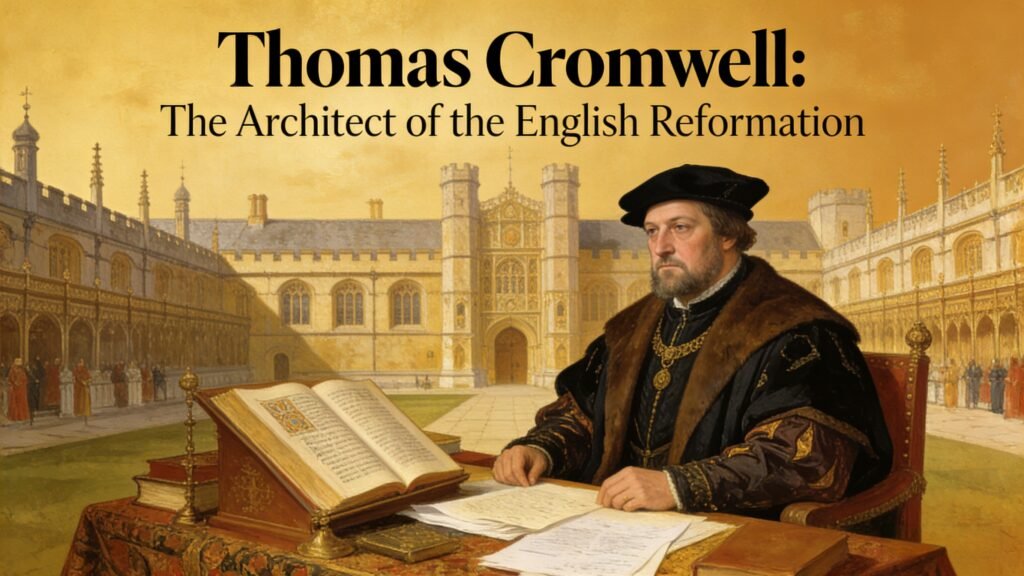
Thomas Cromwell: The Architect of the English Reformation
Thomas Cromwell stands as one of the most influential yet controversial figures in English history, serving as the principal adviser to King Henry VIII from 1532 to 1540. Born around 1485 in Putney, near London, Thomas Cromwell rose from modest beginnings to become one of the most powerful men in England, responsible for establishing the Reformation in England, dissolving monasteries, and fundamentally restructuring the English government . His remarkable career trajectory from a commoner to the Earl of Essex exemplifies both the opportunities and dangers of political life in the Tudor period.
The life of Thomas Cromwell offers a compelling study in power, ambition, and the complexities of religious and political transformation. As a Christian statesman who served a king determined to break from the Roman Catholic Church, Cromwell found himself at the center of one of the most significant religious upheavals in European history . His policies and actions not only reshaped the religious landscape of England but also established precedents for governmental administration that would endure for centuries.
This comprehensive examination of Thomas Cromwell’s life explores his humble origins, his rapid rise to power, his pivotal role in the English Reformation, his personal tragedies, and ultimately his dramatic fall from grace. Through careful analysis of historical records and contemporary accounts, we can understand how this remarkable man shaped the course of English history and left a lasting imprint on the development of the modern state.
1. Thomas Cromwell’s Early Life and Humble Origins
1.1 Family Background and Childhood
Thomas Cromwell was born around 1485 in Putney, near London, to Walter Cromwell and Katherine née Meverell. He was the youngest of three children in a family that owned a brewery but engaged in several other occupations to make ends meet . His father Walter was known to have worked as a blacksmith, fuller, and innkeeper, suggesting a family of modest means that required multiple sources of income .
The early life of Thomas Cromwell remains somewhat obscure, but historical records indicate that he left home at an early age and embarked on a period of extensive travel. It appears that he went abroad and spent time in Italy, and for several years after 1510, he was resident in the Low Countries, where he seems to have been closely connected with the London Merchant Adventurers . This period of his life, though poorly documented, likely provided him with valuable international experience and business acumen that would later serve him well in his political career.
1.2 Education and Early Career
The exact nature of Thomas Cromwell’s education is uncertain, but his later accomplishments as a lawyer and statesman suggest that he received some formal training. By 1520, he had entered the service of Thomas Cardinal Wolsey as his solicitor, marking the beginning of his documented career . Under Wolsey’s patronage, Cromwell demonstrated exceptional abilities in legal matters and administrative work, earning the cardinal’s trust and rising to become his confidential adviser.
Wolsey employed Cromwell in 1525 in the dissolution of some lesser monasteries, a task that earned him considerable dislike but also demonstrated his efficiency and determination . This early experience with ecclesiastical matters would prove particularly significant in his later role as the architect of the English Reformation. When Wolsey fell from grace in 1529, Cromwell entered Parliament, where his remarkable abilities quickly attracted the notice of King Henry VIII .
2. Thomas Cromwell: From Commoner to King’s Right Hand
2.1 Service Under Cardinal Wolsey
Thomas Cromwell’s career trajectory began in earnest when he entered the service of Cardinal Thomas Wolsey, one of the most powerful figures in early 16th-century England. Working as Wolsey’s solicitor and later his confidential adviser, Cromwell developed a deep understanding of the workings of the royal court and the complexities of English government . His service to Wolsey provided him with invaluable experience in handling state affairs, managing complex negotiations, and navigating the treacherous politics of Henry VIII’s court.
During his time with Wolsey, Cromwell demonstrated remarkable skill in managing the cardinal’s extensive properties and affairs. Thomas Cromwell’s ability to handle complex legal matters and his shrewd business sense made him an indispensable asset to Wolsey. However, when Wolsey’s influence with the king began to wane following his failure to secure an annulment of Henry VIII’s marriage to Catherine of Aragon, Cromwell faced an uncertain future.
2.2 Entering Royal Service
When Wolsey fell from grace in 1529, Cromwell made a strategic decision to enter Parliament, where his exceptional abilities immediately distinguished him. For nearly three years, he worked his way up in royal favor, demonstrating his intelligence, loyalty, and administrative skills to the king . Thomas Cromwell’s persistence and political acumen paid off when he finally entered Henry VIII’s service in early 1530.
Cromwell’s rise through the ranks of government was remarkably swift. He was sworn into the king’s council toward the end of 1530 and reached the inner circle of confidential advisers just a year later . All the while, he was establishing his ascendancy in the House of Commons, where his influence and reputation continued to grow. This period marked the beginning of what would become one of the most influential political careers in English history.
2.3 Rapid Promotions and Offices Held
Thomas Cromwell’s career advancement under Henry VIII was nothing short of extraordinary. In April 1532, Henry awarded Cromwell his first formal office as master of the jewels, which required regular visits to the jewel house at the Tower of London . This appointment was merely the beginning of a series of rapid promotions that would bring Cromwell great riches as well as immense power.
The offices and titles that Cromwell accumulated over the next several years demonstrate the extent of his influence and the king’s trust. In 1533, he became chancellor of the exchequer, and in 1534, he was appointed principal secretary and master of the rolls . By 1535, he had become secretary of state, and most importantly, he was appointed to the highest office in the church as vicar-general in ecclesiastical affairs, a title that was later changed to vicegerent .
In 1536, Cromwell received a peerage and took the title of Lord Cromwell of Wimbledon, combining his administrative role with noble status . The following year, he was further elevated when he was created Earl of Essex and appointed lord great chamberlain in April 1540, just months before his fall from power . This remarkable series of promotions in such a short period of time reflects not only Cromwell’s exceptional abilities but also the crucial role he played in implementing Henry VIII’s policies, particularly those related to the break with Rome.
3. Thomas Cromwell: Cromwell’s Religious Revolution
3.1 The Break with Rome
Thomas Cromwell’s most significant contribution to English history was his pivotal role in establishing the Reformation in England. When Cardinal Wolsey failed to obtain an annulment from Pope Clement VII for Henry VIII’s marriage to Catherine of Aragon, Cromwell succeeded by authoring the Act of Supremacy, which made Henry VIII head of the Church of England . This legislation ushered in Britain’s Protestant Reformation, severing ties with the Catholic Church in Rome and establishing the foundation for the independent Church of England.
Cromwell’s policy consisted of making a reality of some large and vague claims to supreme power that Henry had uttered at intervals. He proposed to destroy Rome’s power in England and replace it with royal supremacy in the church . This ambitious plan required not only political skill but also a comprehensive understanding of ecclesiastical law and practice. Cromwell was behind the first attacks on the papacy in 1532 and the act against the payment by bishops of their first year’s revenue to Rome .
3.2 Establishing Royal Supremacy
The establishment of royal supremacy required a systematic approach to restructuring the English church. Cromwell secured the submission of the clergy to the king in matters of legislation and, in 1533, he secured the passage of the Act in Restraint of Appeals to Rome, preventing appeals to Rome in matrimonial and testamentary cases . The preamble to this act embodied his political theory of the sovereign national state, establishing the principle that the king’s authority in Parliament was supreme in all matters, including religious affairs.
In 1534, Cromwell completed the erection of royal supremacy with the passage of the Act of Supremacy, which formally recognized Henry VIII as the supreme head of the Church of England . This act was accompanied by the Treason Act, which made it treason to deny the king’s supremacy, effectively criminalizing any opposition to the new religious order. These measures established the legal framework for the English Reformation and created the institutional foundation for the Church of England as an independent entity.
3.3 The Dissolution of the Monasteries
One of the most controversial aspects of Cromwell’s role in the Reformation was his implementation of the dissolution of the monasteries. Because political and financial reasons made expedient an attack on the monasteries, Cromwell was appointed the king’s vicar general with powers to visit and reform all monastic institutions . Despite serious opposition, especially in the north, the task was carried out relentlessly.
During 1536-40, the surrender of the greater houses was obtained by pressure and persuasion, and by 1540, all monastic institutions had ceased to exist and their property had been vested in the crown . The dissolution of the monasteries had far-reaching consequences, providing the crown with vast amounts of wealth and land while fundamentally altering the social and religious landscape of England. Cromwell and other crown officials obtained valuable grants as rewards, but while the minister lived, the new wealth was not squandered .
The dissolution of the monasteries was not merely a financial exercise but also a means of eliminating potential centers of opposition to the new religious order. By confiscating monastic lands and suppressing religious houses, Cromwell effectively removed a significant source of resistance to the king’s religious policies. This process, though controversial and often harsh, contributed to the consolidation of royal power and the establishment of the Protestant Church in England.
4. Personal Life and Family of Thomas Cromwell
4.1 Marriage to Elizabeth Wyckes
Thomas Cromwell’s personal life was marked by a single significant marriage and a profound personal tragedy. Around 1515, he married Elizabeth Wyckes, a cloth merchant’s daughter and the wealthy widow of Thomas Williams . Elizabeth came from London’s merchant class, her father Henry Wyckes dealing in cloth, the trade that built Tudor England’s wealth . When her first husband died, Elizabeth found herself a widow with modest means but solid connections in the capital’s merchant community.
The marriage to Elizabeth Wyckes proved to be both successful and strategically advantageous for Cromwell. They lived in Fenchurch, an area popular with merchants, and the marriage anchored Cromwell among London’s merchant class rather than nobility . While other ambitious men sought wives with aristocratic bloodlines, Cromwell chose substance over status. Elizabeth brought respectability and commercial connections, assets that would prove valuable as her husband’s career accelerated.
4.2 Children and Family Life
Thomas and Elizabeth Cromwell had three children: Gregory, who would carry the family name, and daughters Anne and Grace . Gregory Cromwell, born around 1520, would later become the 1st Baron Cromwell and play a role in the political life of the country . The family life of the Cromwells appeared to be stable and loving, with Cromwell demonstrating genuine affection for his children throughout his life.
Cromwell’s letters reveal a man capable of deep family affection, suggesting emotional bonds stronger than mere political calculation . When Gregory came of age, Cromwell arranged his marriage to Elizabeth Seymour, sister of Henry VIII’s third queen, Jane Seymour. This match was the height of Cromwell’s strategic brilliance, as it provided his son with connections to the royal family while avoiding the political complications that might have come from a more ambitious alliance .
4.3 The Tragedy of 1529
The year 1529 brought devastating tragedy to the Cromwell household. Elizabeth, Anne, and Grace all died within months of each other, possibly from the sweating sickness, a mysterious and deadly disease that periodically swept through Tudor England . The timing of this tragedy proved cruelly ironic, as it occurred just as Cardinal Wolsey’s power crumbled and Cromwell prepared to serve Henry VIII directly.
The loss of his wife and two daughters left Cromwell deeply grieved. Letters from this period hint at profound grief, though Cromwell’s habitual reserve keeps his deepest emotions hidden from history . The widower who emerged from this tragedy never sought another wife, which was unusual for a man of his rising status in Tudor society. Widowers of his position typically found new wives within years, if not months, as marriage meant alliances, heirs, and household management, practical necessities for successful men.
4.4 The Decision to Remain Unmarried
Cromwell’s refusal to remarry after 1529 defied Tudor convention and has puzzled historians ever since. Several factors may have contributed to this decision. First, he already had an heir in Gregory, which reduced the pressure for additional children . Second, political caution may have influenced his choice; marriage alliances could become dangerous liabilities in Henry VIII’s volatile court. A wife’s family might drag Cromwell into factional disputes or create conflicts of loyalty.
Perhaps most significantly, genuine grief and attachment to Elizabeth’s memory may have kept him single. Thomas Cromwell’s letters reveal a man capable of deep family affection, and the loss of his wife and daughters may have created a lasting emotional wound . In a court notorious for sexual intrigue and romantic scandal, Thomas Cromwell’s personal life remained remarkably clean. No contemporary sources suggest mistresses, inappropriate attachments, or romantic scandals. Thomas Cromwell’s enemies, and he accumulated many, never attacked him for sexual impropriety, a common weapon in Tudor political warfare .
5. Thomas Cromwell: Political Enemies and Accusations
5.1 The Anne of Cleves Affair
The beginning of Thomas Cromwell’s downfall can be traced to his role in arranging Henry VIII’s marriage to Anne of Cleves. In early October 1539, the king finally accepted Cromwell’s suggestion that he should marry Anne of Cleves, the sister of Duke Wilhelm of Cleves, partly on the basis of a portrait that Hans Holbein had painted of her . Cromwell had hoped that this marriage would strengthen England’s alliances with the German princes and provide political advantages in the ongoing religious conflicts in Europe.
However, the marriage was a disaster from the beginning. The couple met on New Year’s Day 1540, and the king was not impressed, famously declaring “I like her not!” . While the marriage took place on January 6, 1540, it was never consummated . Henry found Anne unattractive and was reluctant to proceed with the marriage, but political considerations forced him to go through with the ceremony.
5.2 Accusations of Heresy and Treason
The failure of the Anne of Cleves marriage provided Cromwell’s enemies at court with the opportunity they had been waiting for. In 1539, Cromwell had made the mistake of trying to force the king to his side by compelling him to marry Anne of Cleves . By February 1540, it was clear that the alliance with the German princes that Anne represented was unnecessary, and Cromwell’s enemies at court were quick to take advantage of the misstep.
Early in June 1540, Cromwell’s enemies persuaded Henry that his vicegerent was a heretic and a traitor . The specific charges against Cromwell included corruption, heresy, and treason . He was accused of various offenses, including having maintained evil opinions and supporting those who held unorthodox religious views. Many had slandered him and reported that he had been a bearer of such as had maintained evil opinions, which he would later deny in his final speech .
5.3 Arrest and Imprisonment
Cromwell was arrested on June 10, 1540, and taken to the Tower of London . From the Tower, he wrote to Henry VIII, attempting to defend himself and plead for mercy. In these letters, he expressed his loyalty to the king and denied the charges against him, but the king did not heed his words . Cromwell was condemned to death without a trial, lost all his titles and property, and was held in prison awaiting execution .
The speed of Cromwell’s fall from grace was remarkable, coming just months after his elevation to the Earldom of Essex and the position of lord great chamberlain in April 1540 . Thomas Cromwell’s enemies at court, including the Howard family and other nobles who resented his rise from commoner to power, had finally succeeded in turning the king against him. The charges against him, while serious, were likely exaggerated or fabricated, as was often the case in the political struggles of Henry VIII’s court.
6. Thomas Cromwell: A Dramatic End to a Turbulent Life
6.1 Thomas Cromwell’s Final Day
On the morning of July 28, 1540, Thomas Cromwell was led from his apartments in the Tower to the scaffold on Tower Hill . The execution took place on the same day that Henry VIII married his fifth wife, Catherine Howard, making the timing of Cromwell’s death particularly poignant . It was a warm July day when Cromwell stood on the scaffold, prepared to meet his fate .
Before he knelt at the block, Cromwell made a remarkable speech to the assembled crowd. Thomas Cromwell’s final words provide insight into his character, his religious beliefs, and his acceptance of his fate. “I am come hether to dye, and not to purge my self, as maie happen, some thynke that I will, for if I should do so, I wer a very wretche and miser: I am by the Lawe comdempned to die, and thanke my lorde God that hath appoynted me this deathe, for myne offence” .
6.2 Thomas Cromwell’s Final Speech
Cromwell’s final speech was a carefully crafted statement that addressed both his religious beliefs and his political career. He acknowledged that he had lived a sinner and asked God for forgiveness, saying, “For sithence the tyme that I have had yeres of discrecion, I have lived a synner, and offended my Lorde God, for the whiche I aske hym hartely forgevenes” . He also asked forgiveness from the king, recognizing that he had offended his prince.
Most significantly, Cromwell declared his religious faith in his final moments. “And now I praie you that be here, to beare me record, I die in the Catholicke faithe, not doubtyng in any article of my faith, no nor doubtyng in any Sacrament of the Churche” . This declaration of Catholic faith has been the subject of much historical debate, as it seems contradictory to his role in establishing the Protestant Reformation in England.
6.3 Thomas Cromwell’s Execution Itself
The execution of Thomas Cromwell was reportedly horrific. It took several blows of the axe to kill him, making it a particularly gruesome end to a remarkable life . After his death, his body was reportedly buried in an unmarked grave, and his head was displayed on a spike on London Bridge as a warning to others who might oppose the king’s will.
The execution of Thomas Cromwell marked the end of an era. Thomas Cromwell’s fall did not end the Reformation, but it marked the end of competent government and purposeful policy in Henry VIII’s reign . The king later expressed regret at having lost his great minister, acknowledging that the charges against Cromwell had been false . This posthumous recognition of Cromwell’s value suggests that Henry VIII may have been manipulated by his enemies into ordering the execution.
7. Thomas Cromwell’s Historical Legacy and Impact
7.1 Thomas Cromwell’s Political Innovations
Thomas Cromwell’s most enduring contribution to English history lies in his political and administrative innovations. The basis of Cromwell’s thought was the notion of the sovereign national state that he established by the expulsion of the papacy . In his conception of the English state and monarchy, his central idea was that of the supremacy and omnipotence of statute, or as it came to be called, the legislative sovereignty of the king in Parliament .
Cromwell’s work in Parliament—managing elections, drafting statutes, piloting legislation—makes him the first of a long line of English parliamentary statesmen . He demonstrated an awareness of the need to provide practical management of a new kind, and no minister before him had exercised such pervasive influence over every detail of administration . Thomas Cromwell’s administrative reforms created a more efficient and centralized system of government that would serve as a model for future generations.
7.2 Thomas Cromwell’s Administrative Reforms
Cromwell began and to a large extent carried through a reconstruction that replaced administration by the king’s household with a national administration divorced from the person of the king and dependent on civil service departments . This aspect of his work endured through many reforms until the great changes of the 19th century. Thomas Cromwell’s administrative innovations included the establishment of new government departments, the standardization of procedures, and the creation of a more professional bureaucracy.
The dissolution of the monasteries, while controversial, also had lasting administrative consequences. By transferring vast amounts of land and wealth from the church to the crown, Cromwell created a new source of royal revenue and established the precedent for state control over religious institutions. The lands confiscated from the monasteries were often sold to wealthy commoners, creating a new class of landowners who had a stake in the success of the new religious order.
7.3 Thomas Cromwell’s Religious Transformation
Cromwell’s role in establishing the English Reformation had consequences that extended far beyond his own lifetime. By making Henry VIII the head of the Church of England, he created a religious settlement that would shape English history for centuries to come. The break with Rome established the principle of royal supremacy in religious matters, a principle that would be challenged and reaffirmed through various religious conflicts in the centuries that followed.
The religious policies implemented under Cromwell’s guidance created a distinctively English form of Protestantism that combined elements of Catholic tradition with Protestant theology. This settlement was not without its challenges, and the religious landscape of England would continue to evolve through the reigns of Henry’s successors. However, the institutional framework established by Cromwell provided the foundation for the Church of England as it exists today.
7.4 Thomas Cromwell’s Cultural and Literary Impact
Thomas Cromwell’s life and career have had a significant impact on English literature and culture. In the early 21st century, popular interest in Cromwell was sparked with the release of Wolf Hall (2009), Hilary Mantel’s voluminous fictional narrative depicting Cromwell’s rise . The novel was lauded for its impressive scope and complex portrayal of its subject, winning the Booker Prize and becoming an international bestseller.
A sequel, Bring Up the Bodies (2012), which focuses more narrowly on Cromwell’s role in the downfall of Anne Boleyn, won the Booker Prize as well as the top honor of the Costa Book Awards . The two novels were adapted as stage plays and a 2015 television miniseries featuring Mark Rylance in a BAFTA-winning turn as Cromwell . In 2020, Mantel published the final installment in the trilogy, The Mirror & the Light, which chronicles Cromwell’s fall from power and his execution, and it too spawned a miniseries adaptation released in 2024 .
8. Thomas Cromwell: The Cromwell Dynasty
8.1 Thomas Cromwell’s Gregory Cromwell’s Career
Following his father’s execution, Gregory Cromwell faced an uncertain future. However, he managed to survive the political upheaval and even thrive in the changing political landscape. Gregory had been carefully prepared for a political career by his father, who had arranged his marriage to Elizabeth Seymour, sister of Jane Seymour, Henry VIII’s third queen . This strategic alliance proved to be beneficial after Thomas Cromwell’s fall.
Gregory Cromwell was created Baron Cromwell in 1540, shortly after his father’s execution, and he served in various political capacities during the reigns of Henry VIII’s successors . He was appointed chancellor of the duchy of Lancaster in 1568 under Elizabeth I and died in 1587, reportedly as the “richest commoner in England” . This remarkable achievement by the son of an executed traitor demonstrates both Gregory’s own abilities and the changing political climate in England.
8.2 Thomas Cromwell’s Cromwell Family Line
The Cromwell family line continued through Gregory’s descendants, though they never achieved the same level of political power as Thomas Cromwell. Gregory had several children, including a son named Henry who inherited the barony. The family maintained their wealth and social position through the centuries, though they never again played a significant role in national politics.
The legacy of Thomas Cromwell lived on through his administrative reforms and political innovations rather than through his family line. Thomas Cromwell’s descendants, while wealthy and respected, were more notable for their contributions to local society and culture than for their roles in national affairs. This is perhaps fitting for a man whose greatest achievements were institutional rather than personal.
8.3 Thomas Cromwell’s Historical Memory and Reputation
Thomas Cromwell’s reputation has undergone significant changes over the centuries. In his own time, he was viewed with a mixture of admiration and fear, respected for his abilities but hated for his ruthless methods. After his execution, his reputation was largely negative, with many viewing him as a villain who had contributed to the religious upheaval and social disruption of the Reformation period.
However, in more recent times, historians have begun to reassess Cromwell’s role in English history. Modern scholars recognize him as a visionary statesman who created the foundations of the modern English state. Thomas Cromwell’s administrative reforms, religious policies, and political innovations are seen as crucial steps in the development of constitutional government and the modern nation-state.
9. Conclusion: Thomas Cromwell’s Enduring Significance
9.1 The Man and Thomas Cromwell’s Times
Thomas Cromwell’s life exemplifies the possibilities and perils of political power in the Tudor period. Born to modest circumstances, he rose to become one of the most powerful men in England through a combination of intelligence, ambition, and extraordinary abilities. Thomas Cromwell’s career demonstrates how an individual with the right skills and opportunities could transform the course of history, even in an age when social mobility was limited.
Cromwell’s role in the English Reformation makes him one of the most significant figures in British history. Thomas Cromwell’s policies and actions fundamentally transformed the religious, political, and social landscape of England, creating changes that would endure for centuries. The establishment of the Church of England, the dissolution of the monasteries, and the centralization of government all bear his imprint.
9.2 Thomas Cromwell’s Historical Assessment
Modern historians generally view Thomas Cromwell as a complex figure whose achievements outweigh his faults. Thomas Cromwell’s administrative reforms created a more efficient and centralized system of government that provided the foundation for the modern state. Thomas Cromwell’s religious policies, while controversial, established a religious settlement that allowed England to navigate the religious conflicts of the 16th century without the devastating wars that plagued other European countries.
Cromwell’s personal qualities—his intelligence, determination, and administrative skills—made him an exceptional statesman. Thomas Cromwell’s ability to manage complex political situations, implement far-reaching reforms, and maintain the king’s confidence for nearly a decade demonstrates his extraordinary talents. Even his enemies acknowledged his abilities, though they deplored his methods and resented his rise from commoner to power.
9.3 Lessons for the Modern Era
The life and career of Thomas Cromwell offer valuable lessons for understanding the nature of political power and the challenges of implementing major reforms. Thomas Cromwell’s story illustrates both the potential for individuals to shape history and the dangers of depending too heavily on the favor of a single ruler. Cromwell’s rise and fall demonstrate how quickly political fortunes can change and how important it is to build institutions that can survive the loss of individual leaders.
Cromwell’s administrative innovations, particularly his emphasis on efficient government and the rule of law, remain relevant to modern governance. His conception of the sovereign national state and the legislative sovereignty of Parliament established principles that continue to shape modern democratic government. His work in creating a professional bureaucracy and standardized administrative procedures provides a model for modern public administration.
9.4 Final Reflection
Thomas Cromwell’s life was a remarkable journey from obscurity to power and back to oblivion. Thomas Cromwell’s achievements as a statesman, his role in the English Reformation, and his administrative innovations have secured his place in history as one of the most influential figures in British history. Though his methods were often ruthless and his enemies many, his vision for a strong, centralized state and his commitment to reforming government and society left a lasting legacy.
The execution of Thomas Cromwell on July 28, 1540, marked the end of an era and the loss of one of England’s most talented statesmen. However, his legacy lived on through the institutions he created and the reforms he implemented. Today, we recognize Thomas Cromwell not as a villain or a hero but as a complex historical figure whose life and work continue to fascinate and instruct us. Thomas Cromwell’s story reminds us that great achievements often come with great costs and that the individuals who shape history are rarely simple figures of good or evil but rather complex human beings who must navigate the challenges of their time as best they can.
Thomas Cromwell’s enduring significance lies not only in what he accomplished but in what he represents: the power of human ambition, the complexity of political change, and the lasting impact that one individual can have on the course of history. Thomas Cromwell’s life serves as a reminder that history is made by real people facing real challenges, and that understanding their stories helps us better understand our own place in the ongoing drama of human affairs.