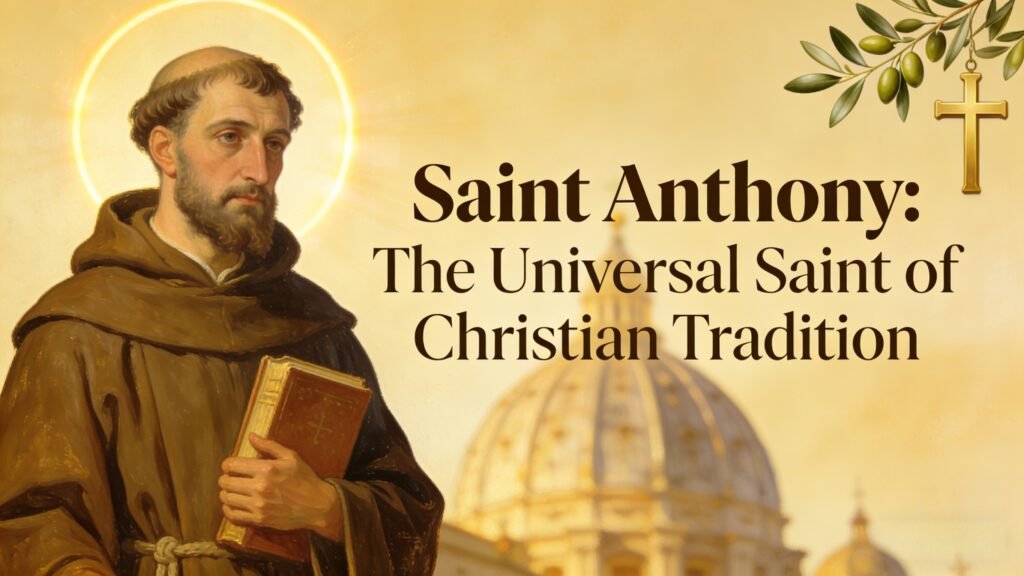
Saint Anthony: The Universal Saint of Christian Tradition
1. The Legacy of Saint Anthony
Saint Anthony stands as one of the most revered figures in the Christian tradition, whose life and legacy continue to inspire millions across denominational boundaries. Born Fernando Martins de Bulhões in Lisbon, Portugal in 1195, Saint Anthony would become known as the “hammer of heretics,” the “evangelical doctor,” and the patron saint of the poor, travelers, and lost items . His remarkable journey from a privileged background to a life of evangelical poverty, his powerful preaching ministry, and his profound theological contributions have established him as a universal saint venerated not only in the Roman Catholic Church but also among Eastern Catholics and some Orthodox communities .
The significance of Saint Anthony extends far beyond his historical role as a Franciscan friar and preacher. Canonized by Pope Gregory IX in 1232, less than a year after his death, his feast day on June 13 is celebrated worldwide with elaborate festivals, pilgrimages, and charitable traditions . In 1946, Pope Pius XII proclaimed him a Doctor of the Church, bestowing upon him the title “Doctor Evangelicus” in recognition of the profound spiritual teaching contained in his sermons .
This comprehensive examination of Saint Anthony’s life, teachings, and lasting influence explores his dual identity as both a historical figure of the 13th century and a contemporary spiritual guide for believers across diverse Christian traditions. Through an analysis of his early formation, apostolic ministry, theological legacy, and modern devotional practices, we will uncover why Saint Anthony continues to be regarded as one of the most beloved saints in the entire Christian Church.
1.1 Historical Context and Religious Significance
The 13th century witnessed a period of significant religious upheaval and renewal within Christianity, marked by the rise of new religious orders and the challenge of heretical movements. It was against this backdrop that Saint Anthony emerged as a pivotal figure in the development of Franciscan spirituality and the defense of Catholic doctrine. The century saw the establishment of the Franciscan Order by Saint Francis of Assisi in 1206, just 13 years before Anthony’s birth .
The religious landscape of Anthony’s time was characterized by the growing influence of heretical movements, particularly the Albigensians in southern France and northern Italy, who challenged fundamental Christian teachings about the nature of God and creation . These movements posed a serious threat to the unity and orthodoxy of the Church, necessitating articulate defenders of the faith who could effectively communicate Catholic doctrine through both theological argument and spiritual witness.
Saint Anthony’s canonization in 1232 represents one of the fastest in Church history, a testament to the profound impact he had during his lifetime and the numerous miracles attributed to his intercession . His rapid elevation to sainthood reflects not only the extraordinary nature of his life and ministry but also the urgent need for spiritual leaders who could guide the faithful through a period of theological and social transformation.
1.2 Saint Anthony in Catholic and Orthodox Traditions
Saint Anthony occupies a unique position in Christian tradition as a saint who is venerated across multiple denominational boundaries. While he is primarily recognized as a Roman Catholic saint, his influence extends far beyond the boundaries of Roman Catholicism. Eastern Catholics and some Orthodox communities also honor him, creating a bridge between different branches of Christianity .
In the Roman Catholic Church, Saint Anthony holds the distinction of being one of only 37 Doctors of the Church, a title conferred in 1946 by Pope Pius XII in recognition of his exceptional theological contributions . The designation “Doctor Evangelicus” (Evangelical Doctor) reflects the Church’s recognition of the unique way in which the freshness and beauty of the Gospel emerges from his writings .
The Eastern Orthodox Church, while not formally canonizing him, acknowledges his spiritual significance, particularly among certain Eastern Catholic communities and some Orthodox jurisdictions . This 跨 denominational recognition is particularly notable given the historical schism between Eastern and Western Christianity. Saint Anthony’s popularity among Eastern Christians may be attributed in part to his association with Saint Anthony of Egypt, the father of monasticism, whom he honored by taking the name Anthony when he joined the Franciscan Order .
1.3 Overview of Key Themes and Contributions
Saint Anthony’s life and ministry encompass several key themes that continue to resonate with believers today. His commitment to evangelical poverty, his role as a powerful preacher and defender of orthodoxy, his profound devotion to the Eucharist, and his compassionate ministry to the poor and marginalized all contribute to his enduring appeal.
As a theologian and preacher, Saint Anthony is best known for his two major collections of sermons: the “Sunday Sermons” (Sermones Dominicales) and the “Sermons on the Saints” (Sermones de Sanctis), written between 1227 and 1231 . These works, containing over 6,000 biblical citations, represent a comprehensive treatment of Christian doctrine presented in the form of sermons designed to instruct and inspire .
His ministry as a preacher earned him the title “hammer of heretics” for his effectiveness in refuting false doctrines and reconciling those who had strayed from the faith . His most famous miracle, the sermon to the fish, demonstrates his profound commitment to preaching the Gospel even when human audiences were unwilling to listen .
Saint Anthony’s role as a patron saint encompasses a wide range of concerns, from the recovery of lost items to the spiritual and material needs of the poor . His intercession is sought for countless petitions, making him one of the most approachable and accessible saints in the Christian tradition.
2. Saint Anthony Early Life and Formation
2.1 Birth and Family Background
Saint Anthony was born Fernando Martins de Bulhões on August 15, 1195, in Lisbon, Portugal, to a noble and wealthy family . His father, Vicente Martins (also recorded as Martin de Bulhões), served as a captain in the royal army of King Afonso II of Portugal, while his mother, Teresa Pais Taveira (also known as Teresa de Tavera), came from a prominent Portuguese family .
The Bulhões family’s social status provided young Fernando with access to the finest education available in 13th-century Portugal. Raised in a devout Catholic household, he received his early education under the guidance of the canons of Lisbon Cathedral . From an early age, Fernando demonstrated both exceptional intellectual abilities and profound religious devotion, characteristics that would later distinguish his life as a scholar and spiritual leader .
The circumstances of Fernando’s birth and upbringing in a privileged environment would later serve as a striking contrast to his eventual choice of a life of evangelical poverty as a Franciscan friar. His family’s wealth and social connections could have ensured him a comfortable life in the service of the Church or the state, yet he chose instead to embrace the radical poverty and simplicity exemplified by Saint Francis of Assisi and his followers.
2.2 Education and Early Religious Formation
At the age of fifteen, Fernando made a significant decision that would shape the course of his life: he entered the religious order of St. Augustine, joining the Canons Regular of the Holy Cross at the Abbey of Saint Vincent on the outskirts of Lisbon . This early commitment to religious life reflected his deep spiritual sensitivity and his desire to dedicate himself entirely to God’s service.
Life in the Augustinian monastery was challenging for the young Fernando. His old friends from his noble background continued to visit him, engaging in lively political discussions that disrupted the contemplative atmosphere of the monastery . Recognizing the need for a more conducive environment for prayer and study, Fernando requested a transfer after two years. His superiors granted his request, and he was sent to the Abbey of Santa Cruz in Coimbra, Portugal’s former capital and a renowned center of learning .
At Coimbra, Fernando embarked on nine years of intense theological study in the Augustinian tradition . The Augustinians at Coimbra maintained an excellent school of biblical studies, and Fernando immersed himself in the history, language, and interpretation of Scripture . His academic formation was comprehensive, encompassing not only the Bible but also the works of the Church Fathers, particularly the writings of Saint Augustine, whose theological insights would later influence his own preaching and teaching .
During his time at Coimbra, Fernando was ordained to the priesthood and appointed as the abbey’s guest master, a position of responsibility that allowed him to develop his pastoral skills while continuing his scholarly pursuits . By the time he completed his studies, he had become an accomplished scholar and preacher, well-versed in the theological debates of his day and capable of articulating complex doctrinal concepts with clarity and conviction .
2.3 Conversion to the Franciscan Order
Fernando’s life took a dramatic turn in 1220 when the remains of the first five Franciscan martyrs were brought to Coimbra. These friars had traveled to Morocco as missionaries, preaching the Gospel in Muslim territories, where they were eventually martyred for their faith . Their bodies were returned to Portugal and carried in solemn procession to the very monastery where Fernando lived, accompanied by a huge crowd that included the queen .
This powerful event had a profound impact on the young Augustinian canon. The story of these martyrs inspired in Fernando a burning desire to follow their example and pursue a life of radical discipleship . He approached the Franciscan friars with a fervent request: “I would gladly put on the habit of your order if you would promise to send me as soon as possible to the land of the Saracens, that I may gain the crown of the holy martyrs” .
After obtaining permission to leave the Augustinian order—a decision that involved painful farewells to his confreres—Fernando joined the Franciscans at the Convent of St. Anthony near Coimbra in 1220 . In honor of Saint Anthony of Egypt, the father of monasticism and the patron saint of the Franciscan monastery, he took the name Anthony . This choice of name would prove prophetic, as Saint Anthony would himself become one of the most influential spiritual leaders in Christian history.
2.4 Journey to Morocco and Divine Providence
True to their promise, the Franciscans allowed Anthony to embark on his missionary journey to Morocco in 1221, where he hoped to share the Gospel with Muslims and potentially suffer martyrdom for Christ . However, divine providence had other plans for the young friar. Shortly after his arrival in Morocco, Anthony fell gravely ill, a sickness that persisted throughout the winter and left him unable to fulfill his missionary duties .
Recognizing that he was unable to regain his health in Morocco, Anthony made the difficult decision to return to Portugal in the spring of 1221 . His journey home would prove to be another pivotal moment in his life. During the voyage, his ship encountered violent storms and high winds that drove it far off course . The tempestuous seas pushed the vessel eastward across the Mediterranean, eventually forcing it to seek refuge on the coast of Sicily .
Landing at Messina, Sicily, Anthony was received by the Franciscan friars of the island, who provided him with shelter and care as he recovered from his illness . Little did he know that this unexpected detour would redirect his entire life’s mission from martyrdom in Morocco to a ministry of preaching and teaching that would transform the course of Christian history.
3. Apostolic Ministry and Preaching of Saint Anthony
3.1 Discovery of Preaching Gifts at Forlì
After his recovery in Sicily, Anthony was sent to Assisi to participate in the famous “Chapter of the Mats” in May 1221, where he had the opportunity to meet Saint Francis of Assisi himself . Despite his theological education and priestly ordination, Anthony initially sought a life of quiet contemplation and asked to be assigned to a hermitage in northern Italy, where he could live a life of prayer and penance .
His superiors granted his request, and Anthony was sent to a small hermitage near Forlì in the Romagna region of Italy. For nine months, he served as chaplain to the hermits, content to occupy himself with the lowliest duties of the kitchen and convent while practicing rigorous interior and exterior mortification . During this time, his fellow friars had no idea of his academic background or theological expertise, assuming him to be an uneducated brother suited only for manual labor.
The dramatic revelation of Anthony’s preaching gifts occurred during a priestly ordination ceremony in Forlì. When the scheduled preacher fell ill, the local superior urgently sought a replacement among the attending friars. Each one made excuses, claiming unpreparedness, until finally Anthony was asked to give “just something simple” . Reluctantly, he began to speak in a reserved manner, but soon the Holy Spirit descended upon him, and he spoke with such eloquence, learning, and unction that everyone present was amazed .
The power and depth of his sermon revealed a theological mind of extraordinary caliber. His knowledge of Scripture was profound, his arguments were logically compelling, and his delivery was marked by a passionate conviction that could only come from deep spiritual experience. Word of this remarkable event reached Saint Francis, who immediately recognized Anthony’s gifts and reassigned him from the hermitage to a life of public preaching .
3.2 Ministry in Italy and France
Following his dramatic debut at Forlì, Anthony embarked on an intensive apostolic ministry that would take him throughout Italy and southern France. His preaching mission was characterized by extraordinary energy and effectiveness, as he traveled tirelessly to proclaim the Gospel and refute heretical teachings .
In Italy, Anthony preached primarily in the northern regions, focusing particularly on areas where heretical movements such as the Cathars and Albigensians had gained significant influence . His approach was not confrontational but rather aimed at presenting the beauty and truth of Catholic doctrine in a way that would naturally draw people back to the faith. He preferred to win people to the truth through positive presentations of Christian teaching rather than by simply proving them wrong .
Anthony’s preaching ministry in France was equally significant, particularly his work against the Albigensians in southern France in 1224 . The Albigensians, who taught a dualistic philosophy that viewed the material world as evil and the spiritual world as good, posed a serious threat to orthodox Christianity . Anthony’s sermons were instrumental in bringing many of them back to the Catholic Church.
What made Anthony’s preaching particularly effective was his ability to communicate complex theological concepts in a way that was accessible to both scholars and common people. His sermons were marked by extensive biblical knowledge, citing the views of the godfather and philosophers,and a profound understanding of human nature . He was known to preach in Italian with perfect fluency in Italy and in flawless French in France, despite never having formally learned these languages—a gift of tongues that enhanced his apostolic effectiveness .
3.3 The Famous Sermon to the Fish
One of the most enduring legends associated with Saint Anthony is the miracle of the sermon to the fish, which occurred during his ministry in Rimini, Italy. According to the account, Anthony had traveled to Rimini to preach to a population heavily influenced by heretical teachings . When he began to proclaim the Gospel, the people not only refused to listen but began to mock and ridicule him .
In a dramatic gesture, Anthony walked down to the seashore, where the river met the sea, and addressed the fish, saying: “Because you show yourself unworthy of God’s word, behold, I turn to the fishes so that your unbelief may be shown up more clearly” . As he began to speak about God’s care for all creatures, a remarkable phenomenon occurred: a large shoal of fish swam near the shore, thrusting their heads out of the water as if listening intently to his words .
The fish remained motionless throughout the entire sermon, and when Anthony had finished, he blessed them, and they swam away in an orderly fashion . The impact on the onlookers was immediate and profound. Many rushed back to the city, imploring their friends and neighbors to come and witness this miracle, while others fell to their knees in tears, asking for forgiveness for their unbelief . Through this extraordinary sign, the city of Rimini was purged of heresy, and many souls were reconciled to the Catholic Church .
3.4 Theological Teaching and Academic Contributions
In 1223, recognizing Anthony’s exceptional theological gifts, Saint Francis appointed him as the first professor of theology for the Franciscan Order . This appointment was of great significance for the development of Franciscan spirituality and theology. Anthony became the first teacher of theology to receive the special approval and blessings of Saint Francis himself .
As a theological educator, Anthony made several important contributions to the development of Franciscan thought. He is credited with introducing the theology of Saint Augustine into the Franciscan Order, thereby establishing a theological foundation that would be further developed by later Franciscan scholars such as Saint Bonaventure and Blessed Duns Scotus .
Anthony’s teaching method was innovative for his time. He emphasized the importance of understanding Scripture through the four senses of biblical interpretation: the literal or historical, the allegorical or Christological, the tropological or moral, and the anagogical, which directs the reader toward eternal life . This approach allowed for a rich and multidimensional understanding of sacred Scripture that would influence generations of theologians.
His academic work was not limited to formal teaching. Between 1227 and 1231, during a relatively calm period in his life, Anthony produced his two major collections of sermons . These works were written specifically to provide his fellow friars with tools for preaching and for the formation of Christian life . The sermons are characterized by their extensive use of Scripture—containing over 6,000 biblical citations—and their incorporation of patristic and medieval interpretations .
3.5 Role as “Hammer of Heretics”
Saint Anthony’s ministry as a defender of orthodoxy earned him the title “hammer of heretics” (malleus hereticorum), a designation that reflects his effectiveness in combating false teachings and reconciling those who had strayed from the faith . His approach to dealing with heresy was multifaceted, combining theological argument, spiritual witness, and pastoral compassion.
Anthony’s primary targets were the various heretical movements that threatened the unity of the Church in the 13th century. These included the Cathars, Albigensians, Waldensians, and others who taught variations of a dualistic philosophy that rejected the goodness of creation and the Incarnation . These groups, united in their attempt to revive ancient Manichean teachings, posed a serious threat to the orthodox understanding of God, creation, and salvation .
What distinguished Anthony’s approach from that of many other defenders of the faith was his emphasis on winning hearts and minds through the positive presentation of Christian truth rather than through confrontation and condemnation. His sermons rarely engaged in direct refutation of heretical teachings but instead focused on the beauty, truth, and goodness of Catholic doctrine . This approach proved remarkably effective, as evidenced by the large numbers of conversions he facilitated among both the wealthy and the poor, the noble and the common .
The title “hammer of heretics” was not merely a rhetorical flourish but a recognition of Anthony’s instrumental role in preserving the unity and orthodoxy of the Church during a critical period in its history. His ministry demonstrated that the most effective way to combat error is not through force or coercion but through the persuasive power of truth presented with love and wisdom.
4. Theological Legacy and Writings of Saint Anthony
4.1 The “Sunday Sermons” and “Sermons on the Saints”
Saint Anthony’s most significant theological contribution lies in his two major collections of sermons, which represent a comprehensive treatment of Christian doctrine presented in a form accessible to both clergy and laity. The “Sunday Sermons” (Sermones Dominicales) and the “Sermons on the Saints” (Sermones de Sanctis) were written between 1227 and 1231, during the final years of his life.
The “Sunday Sermons” were created during a relatively calm period in Anthony’s life, allowing him to develop a systematic approach to Christian teaching . These sermons follow the liturgical calendar, providing homilies for Sundays and major feast days throughout the year. They cover a wide range of theological topics, including the nature of God, the person and work of Christ, the role of the Church, and the moral life of the Christian.
The “Sermons on the Saints” focus on the lives and virtues of various biblical and Church figures, using their examples to illustrate Christian doctrine and spiritual practice. These sermons were designed to provide both spiritual inspiration and theological instruction, demonstrating how the principles of the faith are lived out in concrete human situations.
Both collections share certain characteristics that reflect Anthony’s theological method and spiritual vision. They are marked by extensive use of Scripture—containing over 6,000 biblical citations—along with frequent references to the Church Fathers, theologians, philosophers, and even pagan poets . This eclectic approach demonstrates Anthony’s broad learning and his ability to synthesize various sources of wisdom in service of Christian truth.
4.2 Biblical Interpretation and Hermeneutical Method
Saint Anthony’s approach to biblical interpretation was shaped by the medieval understanding of the four senses of Scripture: the literal or historical, the allegorical or Christological, the tropological or moral, and the anagogical, which directs the reader toward eternal life . This method allowed for a rich and multidimensional understanding of sacred Scripture that went beyond simple literal interpretation.
In his sermons, Anthony demonstrates a profound familiarity with the Bible, not merely as a collection of proof texts but as a unified narrative of God’s saving work in history. His use of Scripture is characterized by a deep Christological focus, seeing in every page of the Old Testament a foreshadowing of Christ and his redemptive mission. This approach is evident in his frequent use of typology, drawing connections between Old Testament figures and events and their fulfillment in Christ.
Anthony’s hermeneutical method also emphasizes the practical application of biblical teaching. His sermons are not merely intellectual exercises but are designed to transform the lives of his hearers. He consistently draws out the moral and spiritual implications of biblical texts, showing how they apply to the concrete circumstances of daily life. This approach reflects his conviction that the purpose of biblical interpretation is not merely to understand the text but to be transformed by it.
The influence of Saint Augustine is particularly evident in Anthony’s biblical interpretation, especially in his emphasis on the spiritual meaning of Scripture and his understanding of the relationship between faith and love. Anthony’s introduction of Augustinian hermeneutical principles into the Franciscan tradition would have a lasting impact on the development of Franciscan theology.
4.3 Theological Themes and Doctrinal Contributions
Saint Anthony’s theological writings address a wide range of doctrinal topics, but certain themes recur throughout his work. Central to his theology is the person and work of Jesus Christ, whom he presents as the culmination of all divine revelation and the source of all spiritual blessings. His Christology is thoroughly biblical, drawing extensively from both the Gospels and the epistles to develop a comprehensive understanding of Christ’s divinity, humanity, and redemptive mission.
The Eucharist occupies a special place in Anthony’s theology. His sermons reveal a profound devotion to the Blessed Sacrament, and he frequently emphasizes the real presence of Christ in the Eucharist and the spiritual benefits that flow from worthy reception of this sacrament. His famous miracle of the mule, which knelt in adoration before the Blessed Sacrament, demonstrates his conviction about the true presence of Christ in the Eucharist .
The role of the Blessed Virgin Mary is another important theme in Anthony’s theology. He frequently invokes her as “Mother of God” and emphasizes her unique role in the plan of salvation. His sermons on Mary reveal a deep Marian devotion that is both theologically sophisticated and pastorally sensitive.
The concept of charity (love) is central to Anthony’s theological system. He writes that “charity is the soul of faith, it gives it life; without love, faith dies” . This emphasis on love reflects both his Franciscan spirituality and his Augustinian heritage, and it permeates all aspects of his teaching about the Christian life.
4.4 Theological Method and Sources
Saint Anthony’s theological method is characterized by its synthetic approach, drawing on multiple sources of authority and wisdom. His primary source, of course, is Sacred Scripture, which he quotes extensively and interprets according to the fourfold method described above. In addition to Scripture, he makes frequent use of the Church Fathers, particularly Saint Augustine, whose influence is evident throughout his work.
Anthony also incorporates insights from medieval philosophy, particularly the works of Aristotle, whom he references frequently in his discussions of natural theology and ethics. His use of philosophical concepts demonstrates his conviction that reason and faith are not opposed but are complementary ways of approaching truth.
The influence of his Franciscan spirituality is evident in his emphasis on poverty, humility, and the imitation of Christ. His theology is not abstract speculation but is grounded in the lived experience of faith. This practical orientation is reflected in his choice of sermon topics and in his consistent focus on how theological truths should shape Christian behavior.
One of the distinctive features of Anthony’s theological method is his use of allegory and symbolic interpretation. He frequently finds spiritual meanings in biblical texts that go beyond their literal sense, drawing out lessons for the spiritual life from even the most seemingly mundane passages. This approach, while characteristic of medieval exegesis, is particularly well-developed in Anthony’s work and contributes to the rich spiritual content of his sermons.
4.5 Canonization as a Doctor of the Church
In 1946, Pope Pius XII proclaimed Saint Anthony a Doctor of the Church, bestowing upon him the title “Doctor Evangelicus” (Evangelical Doctor) . This recognition came over 700 years after his death and represents the Church’s highest acknowledgment of his theological contributions.
The designation “Doctor of the Church” is reserved for those saints whose teachings have made a significant contribution to the understanding and formulation of Christian doctrine. Only 37 men and women have received this honor, making it one of the most prestigious titles in the Catholic Church. The title “Doctor Evangelicus” was specifically chosen to reflect the unique way in which the freshness and beauty of the Gospel emerges from Anthony’s writings .
Pope Pius XII’s decision to declare Anthony a Doctor of the Church was based on a thorough examination of his theological works and their impact on the development of Catholic doctrine. The Pope noted that the spiritual teaching contained in Anthony’s sermons was so profound and so clearly rooted in Scripture that it merited this special recognition .
The canonization as a Doctor of the Church confirms Saint Anthony’s place among the greatest theologians in Church history. His sermons continue to be studied and appreciated not only for their theological insights but also for their spiritual depth and practical wisdom. The title “Doctor Evangelicus” is particularly fitting, as it captures the evangelistic character of his work and its continuing relevance for the proclamation of the Gospel in every age.
5. Miracles and Devotional Practices of Saint Anthony
5.1 The Miracle of the Mule and Eucharistic Devotion
Among Saint Anthony’s many miracles, the story of the mule and the Blessed Sacrament stands as a powerful testament to his profound devotion to the Eucharist and his ability to perform extraordinary signs. This miracle occurred during his ministry when he was preaching in defense of the Real Presence of Christ in the Eucharist against heretics who denied this fundamental doctrine of the faith.
According to the account, Anthony was traveling through a region where many people had been led astray by heretical teachings about the Eucharist. He came to a village where a mule driver, who was among the heretics, challenged Anthony to prove the truth of the Catholic teaching about the Blessed Sacrament. The man claimed that if the bread and wine truly became the body and blood of Christ, his mule—known for its stubbornness—would recognize this miracle and show reverence.
Accepting the challenge, Anthony prayed fervently and then placed the consecrated Host on the back of the mule. To the astonishment of all present, the normally stubborn animal immediately knelt in adoration before the Blessed Sacrament and refused to move until the Host was removed . This miracle was so powerful that it converted not only the mule driver but many others in the village who had been following the heretical teachings.
This miracle demonstrates several important aspects of Saint Anthony’s spiritual character. First, it reveals his deep devotion to the Eucharist, which was central to his spiritual life and ministry. Second, it shows his willingness to use extraordinary means to defend the truth of the faith and to bring souls back to the Church. Finally, it illustrates his confidence in the power of God to work miracles through his intercession for the benefit of the faithful.
5.2 The Lost Psalter and the Origin of Patronage
One of the most well-known stories associated with Saint Anthony concerns the loss and recovery of his beloved psalter, an incident that would establish his reputation as the patron saint of lost items. Anthony’s psalter was not merely a book of psalms but a precious manuscript containing his personal notes and comments that were invaluable for his teaching and preaching ministry .
The psalter was stolen by a novice who was leaving the Franciscan community. When Anthony discovered its loss, he was deeply distressed, not for the material value of the book but for the irreplaceable spiritual insights contained in his annotations. He prayed fervently to God, asking for the return of his precious possession.
In answer to his prayer, the novice who had stolen the psalter was overcome with remorse and immediately returned it to Anthony, begging for forgiveness. The story goes that Anthony not only forgave the young man but also thanked him for giving him the opportunity to demonstrate the power of prayer and the mercy of God .
This incident gave rise to the practice of invoking Saint Anthony’s intercession when items are lost or stolen. The tradition spread quickly, and soon people throughout Italy and beyond were praying to Saint Anthony when they misplaced something of value. This practice has continued for nearly 800 years and has made Saint Anthony one of the most popular saints in the Catholic Church.
5.3 Saint Anthony’s Bread: Charity and Miracles
The tradition of “St. Anthony’s Bread” has its origins in a miracle that occurred in 1263, just a few decades after the saint’s death. According to the story, a child fell into a boiling pot, and the mother, in her desperation, prayed to Saint Anthony, promising that if her child survived, she would give wheat equal to the child’s weight to the poor so that they might make bread .
Miraculously, the child was saved, and the mother kept her promise, distributing wheat to the poor. This act of gratitude and charity soon became a widespread practice, with people offering bread or money to the poor in thanksgiving for favors received through Saint Anthony’s intercession .
The tradition of St. Anthony’s Bread has evolved over the centuries. In medieval times, actual bread was distributed to the poor on Saint Anthony’s feast day and at other times of devotion. Today, since bread is not as central to the diet as it was in ancient times, the friars at the Basilica of Saint Anthony encourage the faithful to participate in this beloved tradition by giving alms to the poor .
The spiritual significance of St. Anthony’s Bread extends beyond simple charity. It represents the miracle of God’s providence, the power of prayer, and the call to share one’s blessings with those in need. The tradition continues to be practiced in many Catholic communities around the world, particularly in Italy, Portugal, and Spanish-speaking countries.
5.4 Modern Devotional Practices and Novenas
Saint Anthony’s popularity in the modern era is evident in the wide variety of devotional practices associated with him. The most common practice is the novena, a nine-day period of prayer that is traditionally prayed either in preparation for his feast day on June 13 or at any time when special intercession is needed.
One of the most distinctive features of devotion to Saint Anthony is the practice of praying novenas on thirteen consecutive Tuesdays. This tradition has its origins in the fact that Saint Anthony was buried on a Tuesday and that many miracles were reported at his tomb beginning on that day . The thirteen Tuesdays may also symbolize the thirteen years between Saint Anthony’s conversion to the Franciscan life and his death.
In New York City, the Shrine Church of St. Anthony in Greenwich Village celebrates his feast day with a traditional novena of prayers asking for his intercession on the 13 Tuesdays preceding his feast . This practice has become a beloved tradition in many Italian-American communities and has spread to other parts of the United States.
Modern devotional practices also include the use of prayer cards, statues, and religious articles associated with Saint Anthony. Many families keep a statue of Saint Anthony in their homes, often placing it in a prominent location where it can be easily seen and prayed to. The image of Saint Anthony holding the Child Jesus has become one of the most recognizable icons in Catholic devotional art .
5.5 Worldwide Celebrations and Cultural Impact
Saint Anthony’s feast day on June 13 is celebrated with great enthusiasm in many countries around the world, particularly in those with strong Catholic traditions. In his hometown of Lisbon, Portugal, the celebration begins several days before June 13 and includes neighborhood parties featuring fado music, dancing, street foods such as grilled sardines, and decorations of flowered garlands .
In Italy, the celebration is particularly elaborate, where the Basilica of Saint Anthony becomes the center of pilgrimage and celebration. The city hosts special Masses, processions, and cultural events throughout the week leading up to the feast day. The basilica itself receives millions of visitors each year, making it one of the most important pilgrimage sites in Italy .
The cultural impact of Saint Anthony extends far beyond religious observances. In many Latin American countries, particularly Brazil, Argentina, and Mexico, Saint Anthony is honored with elaborate festivals that combine religious devotion with cultural celebration. In Brazil, where he is known as São Antônio, his feast day is celebrated with street parties, music, and traditional foods.
The influence of Saint Anthony can also be seen in popular culture, where he is frequently depicted in art, literature, and music. His image holding the Child Jesus has become an icon of Christian art, and his story has inspired countless works of religious literature and devotional music. In the United States, many churches, schools, and hospitals bear his name, reflecting his continued importance in American Catholic life .
6. The Saint Anthony in Different Christian Traditions
6.1 Roman Catholic Church: Canonization and Titles
In the Roman Catholic Church, Saint Anthony enjoys a position of exceptional honor and reverence. His canonization by Pope Gregory IX on May 30, 1232, less than one year after his death, represents one of the quickest canonizations in Church history . This rapid canonization was due to the numerous miracles attributed to his intercession and the profound impact he had made on the Church during his lifetime.
Saint Anthony holds several prestigious titles within the Catholic Church. In addition to being a Doctor of the Church, he is recognized as the patron saint of many causes and groups. He is the patron saint of Portugal. He is also invoked as the patron saint of lost articles, the poor, travelers, sailors, fishermen, pregnant women, barren women, and the elderly .
The Church’s official recognition of Saint Anthony’s spiritual gifts and theological contributions extends beyond his canonization and designation as a Doctor of the Church. He is also honored with special liturgical celebrations, including a feast day on June 13 and a memorial on other occasions throughout the liturgical year. The Church encourages the faithful to invoke his intercession, particularly for the recovery of lost items and for assistance in finding spiritual and temporal necessities.
Saint Anthony’s popularity in the Catholic Church is reflected in the numerous churches, shrines, and religious institutions dedicated to him throughout the world. The Basilica of Saint Anthony in Padua, Italy, is one of the most important pilgrimage sites in the Christian world, attracting millions of visitors annually . The basilica contains his incorrupt tongue, which is venerated as a relic and is considered a sign of his sanctified preaching .
6.2 Eastern Orthodox Church: Recognition and Veneration
The relationship between Saint Anthony and the Eastern Orthodox Church is complex and multifaceted. While the Orthodox Church has not formally canonized him, he is nevertheless venerated by many Eastern Christians, particularly those in Eastern Catholic Churches and some Orthodox jurisdictions .
The Orthodox Church’s recognition of Saint Anthony is likely influenced by his association with Saint Anthony of Egypt, the father of monasticism, whom he honored by taking the name Anthony when he joined the Franciscan Order . This connection to a saint who is universally venerated in both Eastern and Western Christianity may have facilitated the acceptance of Saint Anthony in some Eastern Christian communities.
In the Holy Land, where various Christian communities coexist, Saint Anthony’s feast day is sometimes celebrated ecumenically. The Custody of the Holy Land, which oversees Catholic sites in the region, often invites representatives of other Christian communities, including Greek Orthodox, Armenian, Coptic, Syrian, and Romanian Christians, to share in the celebration of Saint Anthony’s feast . This practice demonstrates the ecumenical potential of devotion to Saint Anthony.
Some Eastern Catholic Churches, particularly those in communion with Rome, have adopted the Western celebration of Saint Anthony’s feast day and incorporate his veneration into their liturgical life. In these communities, Saint Anthony is often invoked alongside other saints in both Eastern and Western traditions, creating a unique synthesis of spiritual practices.
6.3 Eastern Catholic Churches: Special Devotions
Eastern Catholic Churches, while maintaining their distinct liturgical traditions and spiritual practices, have wholeheartedly embraced the veneration of Saint Anthony. These churches, which are in full communion with the Pope while preserving their Eastern rites, have developed their own unique devotional practices associated with the saint.
In the Maronite Church, which has a strong presence in Lebanon and the Middle East, Saint Anthony is particularly venerated. Many Maronite churches and monasteries are dedicated to him, and his feast day is celebrated with special liturgies that combine Eastern and Western elements. The Maronite devotion to Saint Anthony reflects the church’s historical connections to both Eastern and Western Christianity.
The Melkite Greek Catholic Church, which uses the Byzantine Rite, has also incorporated devotion to Saint Anthony into its spiritual life. In some Melkite communities, Saint Anthony is invoked as a patron of families and is particularly honored during family celebrations and feasts. The church’s liturgical calendar includes special prayers and hymns in honor of Saint Anthony.
The Syriac Catholic Church has a long tradition of venerating Saint Anthony, particularly in communities where the saint’s intercession is sought for healing and protection. In these communities, Saint Anthony is often depicted in Eastern iconographic styles, combining traditional Eastern artistic elements with Western subject matter.
6.4 Ecumenical Dimensions and Interfaith Dialogue
The veneration of Saint Anthony across different Christian traditions has created opportunities for ecumenical dialogue and cooperation. His universal appeal transcends denominational boundaries and provides a common ground for Christians of various backgrounds to come together in prayer and fellowship.
In recent years, there have been several initiatives to promote the study of Saint Anthony’s life and teachings in ecumenical settings. Academic conferences and symposia have brought together scholars from different Christian traditions to discuss his theological contributions and spiritual legacy. These events have helped to foster greater understanding and appreciation for the saint among Christians of various backgrounds.
The ecumenical potential of devotion to Saint Anthony is particularly evident in regions where different Christian communities live side by side. In many parts of the world, particularly in the Middle East and Eastern Europe, Christians of various denominations participate together in celebrations of Saint Anthony’s feast day, creating opportunities for interfaith dialogue and mutual understanding.
Saint Anthony’s role as a patron of the poor and his emphasis on charity and social justice also provide a foundation for ecumenical cooperation in addressing social issues. Many ecumenical organizations have adopted his charitable works as a model for their own social outreach programs, recognizing in his ministry a common Christian commitment to serving those in need.
6.5 Regional Variations in Devotion
The devotion to Saint Anthony varies significantly across different regions and cultures, reflecting the diverse ways in which local communities have incorporated the saint into their spiritual and cultural life. These regional variations often combine traditional Catholic practices with local customs and beliefs, creating unique expressions of devotion.
In Latin America, particularly in Brazil and Argentina, devotion to Saint Anthony has been deeply influenced by indigenous and African spiritual traditions. In these countries, Saint Anthony is often associated with local spiritual practices and is invoked for both spiritual and material needs. The celebration of his feast day in these regions often includes elements of indigenous and African religious traditions.
In the Philippines, where Spanish colonial influence was strong, devotion to Saint Anthony is particularly widespread. The saint is known as San Antonio and is honored with elaborate celebrations that combine Spanish and Filipino cultural elements. Many Filipino families have statues of Saint Anthony in their homes and invoke his intercession for various needs.
In the United States, devotion to Saint Anthony is particularly strong in Italian-American and Portuguese-American communities. These communities have preserved traditional devotional practices while adapting them to American cultural contexts. Many parishes in these communities have special devotionals to Saint Anthony and organize annual festivals in his honor .
In some regions, particularly in rural areas, devotion to Saint Anthony has incorporated elements of folk religion and local superstition. While the Church does not officially endorse these practices, it recognizes that they often reflect genuine spiritual needs and provides pastoral guidance to help people develop a more mature understanding of their faith.
7. Legacy and Modern Relevance of Saint Anthony
7.1 The Basilica of Saint Anthony in Padua
The Basilica of Saint Anthony in Padua, Italy, stands as a testament to the enduring legacy of the saint and his continuing influence on Christian devotion. Built shortly after his death in 1231, the basilica was begun in 1232 and has undergone numerous additions and renovations over the centuries . The basilica’s architecture is a fascinating blend of styles, incorporating Romanesque, Gothic, Byzantine, and Renaissance elements, creating a unique and visually striking structure .
The basilica contains the mortal remains of Saint Anthony, which were placed in a magnificent tomb in 1263 . The saint’s tongue, jaw, and vocal cords are preserved in a separate reliquary and are considered incorrupt, a sign of his sanctified preaching . These relics attract millions of pilgrims each year who come to venerate the saint and seek his intercession.
The basilica complex includes several chapels, each dedicated to different aspects of Saint Anthony’s life and ministry. The Chapel of the Saint contains his tomb, while other chapels commemorate his famous miracles, including the sermon to the fish and the miracle of the mule. The basilica also houses a museum containing numerous works of art depicting scenes from Saint Anthony’s life and ministry.
Modern visitors to the basilica can participate in various devotional practices, including Masses, prayer services, and opportunities for confession. The basilica also offers guided tours that provide visitors with insights into the history and significance of the various elements of the complex. For many pilgrims, a visit to the basilica represents a life-changing spiritual experience.
7.2 Global Impact and Cultural Influence
The global impact of Saint Anthony extends far beyond his role as a religious figure. His influence can be seen in art, architecture, literature, music, and popular culture throughout the world. The image of Saint Anthony holding the Child Jesus has become one of the most recognizable icons in Christian art, inspiring countless paintings, sculptures, and other works of art .
In architecture, numerous churches, cathedrals, and religious buildings throughout the world bear the name of Saint Anthony. In the United States alone, there are hundreds of churches dedicated to him, including the Saint Anthony Cathedral Basilica in Beaumont, Texas, which was dedicated in 1907 . These buildings not only serve as places of worship but also as cultural landmarks and centers of community life.
Saint Anthony’s influence on literature is evident in numerous works of religious and secular literature. His life story has been the subject of countless biographies, devotional works, and even fictional treatments. His teachings have been incorporated into theological treatises and spiritual guides that continue to influence Christian thought and practice.
In music, Saint Anthony has inspired numerous hymns, masses, and other religious compositions. His feast day is celebrated with special musical performances in many churches and cathedrals throughout the world. Traditional hymns in honor of Saint Anthony are still sung in many Catholic communities, and new compositions continue to be written in his honor.
7.3 Contemporary Religious Practices and Devotions
In contemporary Catholic practice, devotion to Saint Anthony continues to be one of the most popular forms of popular piety. The saint is invoked for a wide variety of needs and concerns, from the recovery of lost items to spiritual guidance and healing. His intercession is sought by people of all ages and backgrounds, making him one of the most accessible and approachable saints in the Church.
Modern technology has expanded the ways in which people can engage with devotion to Saint Anthony. There are numerous websites, apps, and social media pages dedicated to the saint, providing information about his life and teachings, offering prayers and devotions, and sharing stories of answered prayers. These digital platforms have made devotion to Saint Anthony more accessible than ever before, particularly for younger generations.
The tradition of St. Anthony’s Bread continues to be practiced in many communities, though it has evolved to meet modern needs. In some communities, actual bread is still distributed to the poor, while in others, monetary donations are collected and given to charitable organizations. Many parishes organize annual “St. Anthony’s Bread” drives to support local food banks and other charitable organizations.
Novena prayers to Saint Anthony are widely available in print and digital formats, making it easy for people to participate in this traditional form of devotion. Many churches offer regular novena services in honor of Saint Anthony, providing opportunities for communal prayer and fellowship.
7.4 Social Justice and Charitable Works
Saint Anthony’s legacy as a champion of the poor and marginalized continues to inspire social justice initiatives and charitable works throughout the world. His emphasis on caring for the poor and his example of radical poverty have influenced countless social welfare programs and charitable organizations.
In many cities, organizations dedicated to serving the poor and homeless bear Saint Anthony’s name. These organizations provide food, shelter, clothing, and other necessities to those in need, following the saint’s example of compassion and service. Many of these organizations also offer spiritual support and guidance to those they serve.
The tradition of St. Anthony’s Bread has evolved into various forms of charitable giving. In some communities, food banks and soup kitchens are operated under Saint Anthony’s patronage, providing meals to those who are hungry. In other communities, educational programs and job training initiatives are offered in his name, helping people to achieve self-sufficiency.
Saint Anthony’s example has also inspired social justice movements that work to address the root causes of poverty and inequality. Organizations inspired by his teachings work to promote fair wages, affordable housing, access to healthcare, and educational opportunities for all. These initiatives reflect the saint’s belief that true charity involves both meeting immediate needs and working to create lasting solutions to social problems.
7.5 Future Prospects for Saint Anthony’s Veneration
The future of devotion to Saint Anthony appears bright, as new generations discover his relevance and appeal. His universal themes of compassion, charity, and faith continue to resonate with people of all ages and backgrounds. As the world faces new challenges, including economic inequality, social unrest, and environmental crisis, Saint Anthony’s message of hope and service becomes increasingly relevant.
The ecumenical potential of devotion to Saint Anthony continues to be explored and developed. As different Christian traditions seek to overcome historical divisions and work together for the common good, the saint’s universal appeal provides a foundation for cooperation and dialogue. His role as a bridge between different Christian communities may become increasingly important in the years ahead.
Technological advances continue to expand the ways in which people can engage with devotion to Saint Anthony. Virtual reality tours of the basilica in Padua, online prayer communities, and digital devotional resources are making the saint’s legacy more accessible than ever before. These innovations may help to introduce Saint Anthony to new audiences and to keep his memory alive in an increasingly digital world.
The saint’s relevance to contemporary social issues, including poverty, inequality, and social justice, ensures that his legacy will continue to inspire action and change. As the Church and society grapple with these challenges, Saint Anthony’s example of radical compassion and service provides a model for Christian response. His message of hope and his promise of intercession continue to comfort and inspire those who seek his help.
8. Conclusion: The Enduring Legacy of Saint Anthony
Saint Anthony’s legacy as one of the most beloved and influential figures in Christian history is firmly established through his remarkable life, profound teachings, and continuing impact on millions of believers worldwide. His journey from a privileged nobleman to a Franciscan friar, his powerful preaching ministry, his theological contributions, and his enduring role as a patron saint of the poor and lost have made him an enduring symbol of Christian faith and service.
The saint’s rapid canonization in 1232, less than a year after his death, attests to the extraordinary impact he made during his lifetime. His designation as a Doctor of the Church in 1946, over seven centuries later, confirms his place among the greatest theologians in Church history. The title “Doctor Evangelicus” perfectly captures the unique way in which the Gospel message shines through his writings and continues to inspire generations of believers .
Saint Anthony’s universal appeal transcends denominational boundaries, making him a bridge between different Christian traditions. While primarily venerated in the Roman Catholic Church, he is also recognized and honored by Eastern Catholics and some Orthodox communities, creating opportunities for ecumenical dialogue and cooperation . His association with Saint Anthony of Egypt provides a link to the ancient monastic tradition that is respected throughout Christianity.
The saint’s role as a patron saint of diverse causes—from the recovery of lost items to the spiritual and material needs of the poor—has made him one of the most approachable and accessible saints in the Christian tradition. His intercession is sought for countless petitions, reflecting the deep trust that believers place in his compassion and power to intercede with God on their behalf .
The tradition of St. Anthony’s Bread, the miracle of the mule and the Eucharist, and the story of the lost psalter continue to inspire acts of charity, devotion, and faith. These stories, passed down through generations, remind us of the power of prayer, the importance of charity, and the transforming grace of God’s love.
The Basilica of Saint Anthony in Padua stands as a lasting monument to the saint’s legacy, attracting millions of pilgrims each year who come to venerate his relics and seek his intercession. The preservation of his incorrupt tongue serves as a powerful symbol of his sanctified preaching and the continuing influence of his words .
In the modern world, Saint Anthony’s relevance remains undiminished. His teachings on poverty, charity, and social justice continue to inspire Christian response to contemporary challenges. His example of radical compassion and service provides a model for addressing issues of inequality, hunger, and social injustice. His message of hope and his promise of intercession offer comfort and strength to those facing 困难和 uncertainty.
As we look to the future, Saint Anthony’s legacy continues to inspire new forms of devotion and service. The use of technology to spread his message, the development of ecumenical initiatives in his name, and the application of his teachings to contemporary social issues all point to the enduring vitality of his spiritual legacy.
The enduring popularity of Saint Anthony across cultures, generations, and Christian traditions testifies to the universal appeal of his message of love, compassion, and service. His life and teachings continue to inspire believers to follow Christ more closely, to serve those in need, and to trust in God’s providence. As we continue to face the challenges of our time, Saint Anthony’s example of faith, hope, and charity remains as relevant and inspiring as it was in the 13th century.
In conclusion, Saint Anthony stands as a powerful reminder of what it means to be a faithful disciple of Christ in every age. His legacy challenges us to live lives of radical compassion, to speak the truth with love, and to trust in God’s providence even in the midst of difficulty. His intercession continues to bring comfort to the troubled, hope to the despairing, and healing to the broken. As we honor his memory and seek his intercession, we are reminded that the saints are not distant figures of the past but living members of the Church who continue to inspire and guide us on our journey of faith. Saint Anthony, pray for us.