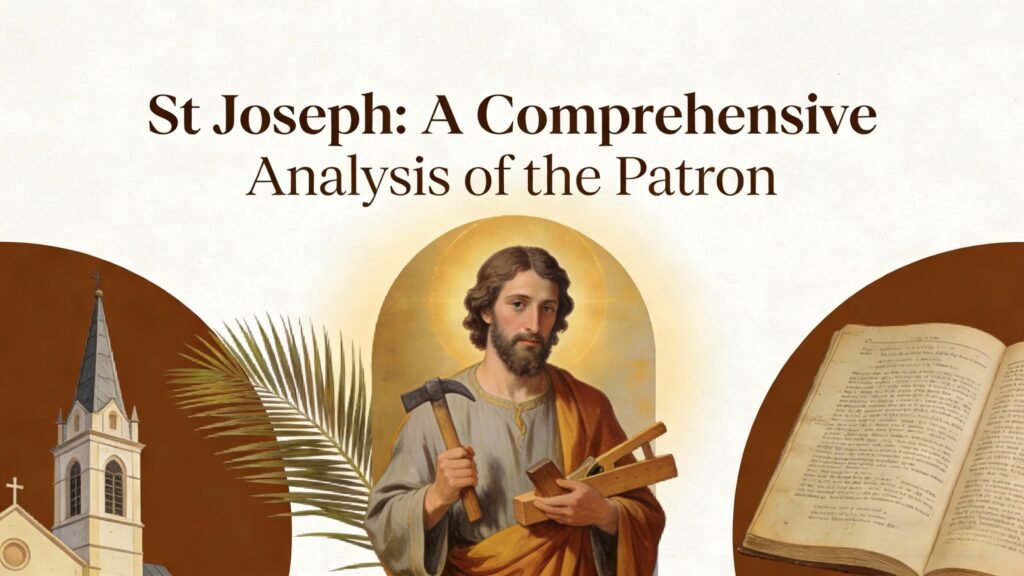
St Joseph: A Comprehensive Analysis of the Patron
1. The Universal Significance of St Joseph
Saint Joseph stands as one of the most revered figures in Christianity, serving as a bridge between the Old and New Testaments, and embodying the highest ideals of fatherhood, faith, and service. In the United States, where approximately 19% of adults identify as Catholic and nearly 1% as Orthodox Christian , Saint Joseph holds a special place in the religious landscape. This comprehensive analysis examines Saint Joseph’s biblical origins, his evolving role in Christian tradition, his cultural impact across centuries, and his contemporary relevance in American religious life.
The significance of Saint Joseph extends far beyond his biblical appearances. As the foster father of Jesus Christ and spouse of the Blessed Virgin Mary, he occupies a unique position in salvation history. The Gospels of Matthew and Luke, which reveal the most about him, portray Joseph as a “righteous man” and descendant of King David . His life, marked by profound faith and silent obedience, has made him a model for millions seeking to live lives of virtue and service.
In the United States, Saint Joseph’s influence is particularly evident in the numerous churches, schools, and institutions bearing his name. From the Cathedral Basilica of St. Joseph in San Jose, California, to the St. Joseph Shrine in Detroit, these establishments serve as reminders of his enduring presence in American religious life . The celebration of St. Joseph’s Day on March 19 has become a cultural tradition, especially in communities with strong Italian and Sicilian heritage, where elaborate St. Joseph’s Day tables honor the saint’s intercession during times of famine .
2. Biblical Foundations and Early Church Tradition of St Joseph
2.1 St Joseph in the Gospels: Matthew’s Account
The Gospel of Matthew presents Joseph as a central figure in the Nativity narrative, portraying him as a righteous man who receives divine guidance through dreams. Matthew’s account begins with Joseph’s discovery that Mary, his betrothed, was pregnant by the Holy Spirit. Initially planning to divorce her quietly to spare her dishonor, Joseph was visited by an angel in a dream who instructed him to take Mary as his wife, saying: “Joseph, son of David, do not fear to take Mary your wife, for that which is conceived in her is from the Holy Spirit” .
Matthew’s gospel records an angel visiting Joseph in a dream on no less than three occasions: encouraging him not to divorce Mary, warning him to flee with his family to Egypt in the middle of the night, and instructing him to return to Israel after Herod’s death . A fourth dream warned him not to take his family back to Judea, prompting him to settle in Nazareth instead . These dreams demonstrate Joseph’s role as a divinely guided protector of the Holy Family.
The Gospel describes Joseph as a carpenter (tekton) from Nazareth who was betrothed to Mary . After Jesus’ birth in Bethlehem, Joseph protected the infant Messiah from King Herod’s murderous intent by fleeing with Mary and Jesus to Egypt, where they remained until Herod’s death. Matthew’s account emphasizes Joseph’s obedience to God’s will, even in the face of uncertainty and danger.
2.2 Luke’s Narrative and the Annunciation to Mary
The Gospel of Luke provides a complementary account of Joseph’s role, though from a different perspective. Luke’s narrative focuses primarily on Mary’s experience, describing the angel Gabriel’s annunciation to her and her subsequent visit to Elizabeth. While Joseph appears less prominently in Luke’s account, his presence is nevertheless crucial to the story.
Luke’s gospel reveals that Joseph and Mary traveled from Nazareth to Bethlehem for the census, where Jesus was born in a stable due to lack of room in the inn . Luke also describes the Presentation of Jesus in the Temple, where Joseph and Mary offered “two turtledoves or two young pigeons,” the offering prescribed for those who could not afford a lamb, indicating their modest economic circumstances .
The final biblical mention of Joseph occurs in Luke’s account of the finding of Jesus in the Temple when he was twelve years old. Joseph and Mary had lost track of the boy during their pilgrimage to Jerusalem and found him three days later in the Temple, engaged in discussion with the teachers. This episode reveals that Joseph was still alive when Jesus was twelve years old and remained an active presence in the Holy Family .
2.3 Early Church Fathers’ Perspectives on St Joseph
The early Church Fathers approached Joseph with a certain degree of theological caution, primarily motivated by their desire to defend the Virgin Birth and the perpetual virginity of Mary. This concern led many patristic writers to minimize Joseph’s role in order to magnify Mary’s unique position .
Epiphanius, bishop of Salamis, in his work the Panarion (AD 374-375), proposed that Joseph became the father of James and his three brothers (Joses, Simeon, Judah) and two sisters (Salome and Mary or Salome and Anna) with James being the eldest sibling . This interpretation, which suggested Joseph was a widower with children from a previous marriage, was influential in the Eastern Church and provided a solution to the “brothers of the Lord” problem.
However, the early Church’s approach to Joseph was characterized more by silence than by detailed theological reflection. There is not a single listing for St. Joseph in the saints’ index to Migne’s Patrologiae Latina, a 221-volume collection of Church writings up to 1216 . This absence reflects the general neglect of Joseph in early Christian literature.
The Greek Protevangelium of James, one of the most influential apocryphal gospels, portrayed Joseph unfavorably as a timid, elderly widower with grown children who initially hesitated to marry young Mary. This negative portrayal, though condemned by popes in the West, influenced Eastern Christian tradition and contributed to Joseph’s relatively minor role in Eastern Orthodox devotion .
2.4 The Evolution of St Joseph’s Role in Christian Theology
The transformation of Joseph’s status from a marginal figure to one of the most venerated saints in Christianity represents a fascinating development in religious history. This evolution began gradually in the medieval period and accelerated dramatically from the 14th century onward.
The turning point came during the turbulent 14th century, marked by unprecedented famine, the Hundred Years’ War, civil unrest, and the Black Death that killed a quarter of Europe’s population. Reform-minded French theologian Jean Gerson (d. 1429), chancellor of the University of Paris, turned the spotlight on St. Joseph as the ideal family model and protector. Gerson’s 2,957-line poem about St. Joseph, the Josephina, promoted the saint and his virtues across Western Europe .
Gerson’s contemporary, St. Bernardine of Siena, a spellbinding preacher and reformer of the Franciscan order, further developed the theology of St. Joseph. Together, they rejected the elderly Joseph of tradition and declared that the saint must have been a strong young man, well able to care for the Holy Family. They also taught that Joseph was a virgin, not a widower, and had been cleansed from original sin before birth to be a fit spouse for Mary .
This theological revolution gained momentum through the 15th and 16th centuries, particularly in Spain, where St. Teresa of Avila became Joseph’s greatest advocate. She credited his intercession with healing her from paralysis and referred to him as her “father and lord” . By the 16th century, devotion to St. Joseph was flourishing throughout the Spanish Empire, and the first religious order dedicated to him, the Congregation of St. Joseph, was founded in Le Puy, France, in 1650 .
3. St Joseph in Catholic Tradition and Doctrine
3.1 Papal Encyclicals and Official Church Teaching
The Catholic Church’s official recognition of Saint Joseph’s importance reached its zenith in 1870 when Blessed Pope Pius IX declared him “Patron of the Catholic Church” . This declaration, made during a period of intense anti-Catholic persecution, was a deliberate act of spiritual warfare against the forces threatening the Church.
Pope Leo XIII’s 1889 encyclical Quamquam Pluries marked another milestone in papal teaching on Saint Joseph. In this document, Leo XIII invoked Joseph against the religious and social crises of his day, asking the poor to take St. Joseph, not socialists, as their guide in seeking justice . The encyclical established Joseph as the patron of fathers and workers, roles that would become central to his modern devotion.
The 20th century witnessed further developments in papal teaching on Saint Joseph. In 1955, Pope Pius XII instituted the feast of St. Joseph the Worker on May 1, specifically to counter the secular celebration of International Workers’ Day and to emphasize the dignity of human labor . Pope John XXIII, in 1962, took the unprecedented step of adding Joseph’s name to the Canon of the Mass, a recognition of his unique role in salvation history .
Most recently, Pope Francis proclaimed a “Year of Saint Joseph” from December 8, 2020, to December 8, 2021, marking the 150th anniversary of his declaration as patron of the universal Church. In his apostolic letter Patris Corde, Francis reflected on Joseph’s role as a model father, writing: “With a father’s heart: that is how Joseph loved Jesus, whom all four Gospels refer to as ‘the son of Joseph'” .
3.2 Theological Interpretations of Joseph’s Role
Theological interpretations of Joseph’s role in salvation history have evolved significantly over time, reflecting deeper understanding of his unique position in the Holy Family. Catholic theology emphasizes that Joseph’s marriage to Mary was a true and valid sacramental union, despite its unique nature. The Council of Trent confirmed that consent, not consummation, is the essential element of marriage, thus establishing the legitimacy of Joseph and Mary’s relationship .
Saint Paul VI provided a particularly profound theological interpretation of Joseph’s fatherhood, noting that he “concretely expressed his fatherhood by making his life a sacrificial service to the mystery of the incarnation and its redemptive purpose.” Paul VI emphasized that Joseph employed his legal authority over the Holy Family to devote himself completely to them, turning his human vocation to domestic love into a “superhuman oblation of himself, his heart and all his abilities” .
Theologians have long debated Joseph’s death and its circumstances. Tradition holds that Joseph died before Jesus began his public ministry, with Mary and Jesus at his side, which is why he is invoked as the patron of a happy death . This belief has led to special devotions to St. Joseph during times of illness and at the hour of death.
3.3 Feast Days and Liturgical Celebrations
The Catholic Church celebrates several feast days in honor of Saint Joseph, each highlighting different aspects of his character and mission. The principal feast day is March 19, the Solemnity of Saint Joseph, which celebrates his role as spouse of the Blessed Virgin Mary. This feast was established by Pope Gregory XV in 1621, though earlier celebrations in his honor during the month of March date back to the year 800 .
The Feast of St. Joseph the Worker on May 1 was established by Pope Pius XII in 1955 to emphasize Joseph’s role as a patron of workers and to sanctify the dignity of human labor . This feast day has special significance in the United States, where labor rights and the dignity of work remain important social issues.
In 2013, Pope Francis authorized the addition of Joseph’s name to Eucharistic Prayers II, III, and IV in the Roman Missal, placing it immediately after the name of the Blessed Virgin Mary . This change, implemented on May 1, 2013, represents the most recent major liturgical recognition of Joseph’s importance in Catholic worship.
3.4 Marian Devotions and St Joseph’s Relationship to Mary
Saint Joseph’s relationship with Mary forms the cornerstone of his theological significance. As the spouse of the Blessed Virgin Mary, Joseph occupies a unique position in the Church’s Marian theology. The Catholic Church teaches that Mary’s perpetual virginity in no way diminishes the reality of her marriage to Joseph or the legitimacy of their relationship.
The Church’s understanding of Joseph’s role in the Holy Family has evolved to emphasize his unique position as the only man who could have been the spouse of the Mother of God. He is often referred to as the “most chaste spouse” of Mary, a title that reflects not only his physical continence but also his spiritual purity and selfless love .
In popular devotion, Joseph is frequently invoked alongside Mary as a powerful intercessor. The litany of St. Joseph, which includes titles such as “terror of demons,” “pillar of families,” and “comforter of the afflicted,” reflects the deep spiritual confidence Catholics place in his protection and intercession .
4. St Joseph in Orthodox Christianity
4.1 Eastern Orthodox Teachings on St Joseph
The Eastern Orthodox Church’s approach to Saint Joseph differs significantly from the Catholic tradition in both emphasis and practice. While Orthodox Christians honor Joseph as the foster father of Jesus and spouse of Mary, they generally view him as one of the holy ancestors of Christ rather than according him independent cult status .
In the Orthodox Church, Saint Joseph bears the distinctive title “the Betrothed,” reflecting his role as the one who was betrothed to the Virgin Mary . This title emphasizes the sacred nature of their relationship while maintaining the Church’s teaching on Mary’s perpetual virginity. The Orthodox Church teaches that Joseph was a righteous man who fulfilled God’s will in accepting Mary as his spouse and caring for the infant Jesus.
The Orthodox Church’s liturgical calendar includes Joseph in the celebration of the Nativity of Christ, where he is found in every icon of the Nativity scene. His feast day falls on the Sunday after Christmas, and there are various hymns called for at all services on that weekend which refer to him as well as the other ancestors of the Lord .
4.2 Theological Differences Between Catholic and Orthodox Perspectives
The theological differences between Catholic and Orthodox perspectives on Saint Joseph reflect broader doctrinal and cultural variations between the two traditions. The Orthodox Church places greater emphasis on Joseph’s role as the earthly guardian of the Christ child rather than his role as a worker or patron of specific causes .
One significant difference lies in the Orthodox Church’s use of the Deuterocanonical book “Joseph the Carpenter,” which sets out what the East has always believed about Joseph . This text provides additional details about Joseph’s life and death that are not found in the canonical Gospels.
The Orthodox Church also maintains a more reserved approach to the veneration of saints compared to Catholicism. While both traditions honor Mary and the saints, the way they are venerated and the significance placed on their intercession differs . In Orthodox practice, Joseph is remembered primarily during the Nativity season and on the feast of the Meeting of the Lord in the Temple (February 2), rather than having multiple feast days throughout the year.
4.3 Orthodox Iconography and Liturgical Practices
Orthodox iconography presents a distinctive portrayal of Saint Joseph that reflects the Church’s theological understanding of his role. In Orthodox icons, Joseph is typically depicted as an elderly man with a white beard, in contrast to the more youthful depictions common in Western art. This portrayal reflects the traditional Orthodox interpretation of Joseph as an older man chosen by God to be Mary’s protector.
The Akathist Hymn to Saint Joseph is an important part of Orthodox liturgical tradition, though it is not as widely used as similar Marian hymns. This hymn praises Joseph for his obedience to God and his role in protecting the Holy Family .
In Orthodox churches throughout the United States, Joseph is honored through icons, liturgical hymns, and special prayers. The St. Joseph Orthodox Church in Houston, Texas, and similar parishes across the country maintain the Orthodox tradition of venerating Joseph as the Betrothed of Mary and foster father of Jesus .
5. St Joseph Cultural Impact and Artistic Representation
5.1 St Joseph in Western Art: From Medieval to Modern
The artistic representation of Saint Joseph has undergone a remarkable transformation from his early marginalization to his central role in Christian art. Medieval art typically portrayed Joseph as an elderly, subordinate figure, often overshadowed by Mary and the infant Jesus. In the 15th-century English mystery play “Joseph,” he was depicted as a querulous codger who feared he had been cuckolded .
The 16th century marked a turning point in Joseph’s artistic representation. Under the influence of theologians like Jean Gerson and St. Bernardine of Siena, artists began portraying Joseph as a strong, youthful man capable of protecting the Holy Family. Italian Renaissance painters such as Raphael, in his “Betrothal of the Virgin” (1504), emphasized the religious significance of matrimony, portraying Joseph as a model husband dutifully marrying in a Church ceremony .
The Baroque period saw further developments in Joseph’s artistic representation, particularly in Spain and Spanish-influenced regions. Artists like El Greco and Zurbarán painted strong, black-bearded St. Josephs walking hand in hand with the Holy Child, a motif that captured the saint’s fatherly love for Jesus . Zurbarán’s “Coronation of St. Joseph” (1636) depicts the risen Christ crowning his foster father with a floral wreath of glory, symbolizing his special place in heaven.
In American art, Saint Joseph’s representation has evolved to reflect the nation’s diverse cultural heritage. The Museum Collection at Saint Joseph’s University boasts a collection of paintings, prints, and sculptures from various parts of Asia, including Japanese woodblock prints and Buddhist thangka paintings . This diverse collection demonstrates how Saint Joseph’s image has been adapted across different cultural contexts.
5.2 Architecture and Church Dedications in the United States
The United States is home to numerous churches, cathedrals, and shrines dedicated to Saint Joseph, reflecting his significant presence in American religious architecture. These buildings range from historic structures dating back to the 19th century to contemporary designs that incorporate modern architectural principles.
The Cathedral Basilica of St. Joseph in San Jose, California, represents one of the most impressive examples of St. Joseph architecture in the United States. Founded in 1877 and dedicated in 1990, this historic Catholic church serves as the cathedral for the Diocese of San Jose and holds the distinction of being a minor basilica . The cathedral’s copper dome and elaborate interior decoration make it a landmark in downtown San Jose.
The St. Joseph Shrine in Detroit, completed in 1873, stands as a landmark center of Catholic faith in Detroit’s historic Eastern Market district . This shrine represents one of the earliest dedicated St. Joseph worship spaces in the United States and continues to serve as a center of devotion for the local Catholic community.
The Cathedral of Saint Joseph in Hartford, Connecticut, designed by architects Eggers & Higgins, represents a more modern approach to St. Joseph architecture. Completed in 1962, this 284-foot high structure features an international style interpretation of the Gothic style, maintaining the verticality of traditional cathedral design while incorporating contemporary materials and techniques .
5.3 St Joseph’s Literature and Popular Culture
Saint Joseph’s influence extends beyond visual arts and architecture into literature and popular culture. The Polish writer Jan Dobraczyński’s novel “The Shadow of the Father” presents Joseph’s life in novel form, using the evocative image of a shadow to define Joseph’s relationship with Jesus . In this interpretation, Joseph was the earthly shadow of the heavenly Father, watching over and protecting Jesus without ever overshadowing him.
In American popular culture, Saint Joseph appears in various forms, from religious literature to holiday celebrations. The celebration of St. Joseph’s Day on March 19 has become particularly popular in communities with strong Italian and Sicilian heritage. These celebrations often feature elaborate St. Joseph’s Day tables, where bread shaped into crosses, staffs, or crowns represents life, faith, and gratitude, while fava beans symbolize survival .
The tradition of the St. Joseph’s Day table originated in Sicily, where St. Joseph is credited with saving the island from a medieval drought and famine. As Sicilians immigrated to the United States, they brought these traditions with them, establishing St. Joseph’s Day celebrations in cities like New Orleans, where stores decorate their windows with tributes to St. Joseph and the city holds an annual parade in his honor .
5.4 Folk Traditions and Devotional Practices
Saint Joseph’s folk traditions in the United States reflect the diverse ethnic and cultural backgrounds of American Catholics. In many Hispanic communities, St. Joseph is particularly revered as the patron of workers and families. The tradition of burying a St. Joseph statue upside down in the yard when selling a house, which originated in Mexico, has become widespread in American real estate culture.
The practice of creating St. Joseph altars or tables has become a significant cultural tradition, especially in Italian-American communities. These elaborate displays, which can include religious statues, flowers, candles, and traditional foods, serve as a way to honor the saint while providing a meal for the poor. The foods served at these celebrations often have symbolic meaning, with each dish representing aspects of faith, gratitude, and sacrifice.
In American religious education, Saint Joseph serves as a model for children learning about virtues such as obedience, humility, and service. Many Catholic schools and parishes have special programs and activities dedicated to St. Joseph, helping young people understand his role in salvation history and his relevance to their own lives.
6. St Joseph’s Role in Modern Society
6.1 Social Justice and Worker Advocacy
Saint Joseph’s role as the patron of workers has gained renewed significance in contemporary American society, where issues of labor rights, economic justice, and the dignity of work remain pressing concerns. Pope Francis, in his apostolic letter Patris Corde, emphasized that “work is a means of participating in the work of salvation, an opportunity to hasten the coming of the Kingdom, to develop our talents and abilities, and to put them at the service of society and fraternal communion” .
The feast of St. Joseph the Worker, established by Pope Pius XII in 1955, continues to serve as a reminder of the Church’s teaching on the dignity of human labor. In the United States, where unemployment rates have fluctuated significantly, especially during economic crises and the recent pandemic, St. Joseph’s example as a hardworking carpenter who provided for his family offers hope and inspiration to those seeking employment or struggling to make ends meet.
Saint Joseph’s commitment to honest work is particularly relevant in an era of economic inequality and technological disruption. His example challenges both employers and employees to uphold the dignity of work and to ensure that all people have access to meaningful employment that provides for their families and contributes to the common good.
6.2 St Joseph’s Family Values and Fatherhood
Saint Joseph’s role as the model of fatherhood has profound implications for American society, where traditional family structures face numerous challenges. Pope Francis emphasized that “fathers are not born, but made. A man does not become a father simply by bringing a child into the world, but by taking up the responsibility to care for that child” .
In the United States, where approximately 40% of children are born to unmarried mothers and many families lack stable father figures, Saint Joseph’s example offers a powerful alternative model. His quiet strength, his willingness to sacrifice for his family, and his faithful protection of Mary and Jesus provide a template for responsible fatherhood that transcends cultural and economic boundaries.
The title “most chaste father” given to Joseph reflects a particular understanding of fatherhood that emphasizes selflessness and service rather than possession or control. As Pope Francis explained, “Chastity is freedom from possessiveness in every sphere of one’s life. Only when love is chaste, is it truly love” . This teaching has important implications for modern parenting, encouraging fathers to foster their children’s independence while providing guidance and protection.
6.3 Immigration and Refugee Advocacy
Saint Joseph’s role as a refugee and immigrant has made him a powerful patron for the millions of immigrants and refugees in American society. The biblical account of Joseph fleeing with Mary and the infant Jesus to Egypt, where they lived as foreigners until Herod’s death, provides a powerful narrative for understanding the immigrant experience .
In the United States, where immigration policy remains one of the most contentious political issues, Saint Joseph offers a religious and moral framework for discussing the rights and dignity of immigrants. His experience as a stranger in a foreign land, dependent on the hospitality of others, challenges Americans to welcome and support newcomers rather than viewing them with suspicion or hostility.
The designation of Saint Joseph as the patron of immigrants reflects the Church’s teaching that all human beings are created in the image of God and deserve to be treated with dignity and respect, regardless of their national origin or immigration status. This teaching has become particularly important in American dioceses with large immigrant populations, where churches serve as advocates and resources for immigrant communities.
6.4 Environmental Stewardship and Care for Creation
While not traditionally associated with environmental issues, Saint Joseph’s role as a craftsman who worked with natural materials and his care for the Holy Family in the natural world have led to his recognition as a patron of environmental stewardship. His life as a carpenter who worked with wood, stone, and other natural materials offers a model for sustainable human interaction with the natural world.
In the United States, where environmental issues have become increasingly urgent, Saint Joseph’s example encourages Christians to care for creation as a sacred trust. His role as a guardian and protector extends metaphorically to the Earth itself, calling Christians to be responsible stewards of natural resources and to work toward environmental justice.
The connection between Saint Joseph and environmental stewardship reflects a broader trend in Catholic social teaching that emphasizes the integral relationship between human dignity and environmental protection. Just as Joseph provided for and protected the Holy Family, so too are we called to provide for and protect the Earth, our common home.
7. St Joseph Theological Analysis and Spiritual Significance
7.1 Christological Implications of St Joseph’s Role
The theological significance of Saint Joseph extends far beyond his human virtues to encompass profound implications for Christology—the study of the person and nature of Jesus Christ. The early Church’s insistence that Jesus was fully human as well as fully divine has important implications for our understanding of Joseph’s role in Jesus’ life.
Saint Joseph served as Jesus’ primary human model of fatherhood. Since Jesus had a true human mind, Joseph would have been His main mental image for what fatherhood looks like . This understanding has profound implications for our understanding of Jesus’ relationship with God the Father. Whenever Jesus prayed to His heavenly Father throughout His life, including when He cried out from the Cross, “Father, into thy hands I commit my spirit!” (Lk 23:46), He likely drew upon His experience of Joseph’s fatherly love and protection.
The relationship between Joseph and Jesus also provides insight into the nature of divine-human relationships. Joseph’s willingness to accept Jesus as his son, despite the unusual circumstances of His conception, demonstrates the power of faith to transform human relationships. His obedience to God’s will, even when it led to uncertainty and hardship, offers a model for Christian discipleship.
7.2 Marian Theology and St Joseph’s Spousal Relationship
Saint Joseph’s relationship with Mary provides important insights into Marian theology—the study of the role of Mary in Christian faith. The Church’s teaching on Mary’s perpetual virginity does not diminish the reality of her marriage to Joseph but rather elevates it as a unique and holy union.
The theological significance of Joseph’s role as Mary’s spouse extends beyond the physical to encompass spiritual dimensions. Saint Teresa of Avila, who experienced a profound devotion to Saint Joseph, referred to him as her “father and lord,” recognizing in him a special authority and protection . This understanding of Joseph’s role suggests that his relationship with Mary was characterized by mutual respect, trust, and spiritual partnership.
The title “spouse of the Blessed Virgin Mary” reflects the Church’s teaching that Joseph’s marriage to Mary was a true sacramental union, even though it was unique in human history. This understanding has important implications for our understanding of marriage and family life, suggesting that the highest form of human love involves self-sacrifice, mutual support, and shared commitment to God’s will.
7.3 Eschatological and Apocalyptic Dimensions
Saint Joseph’s role in salvation history extends beyond his earthly life to encompass eschatological and apocalyptic dimensions. Tradition holds that Joseph died before Jesus began His public ministry, with Mary and Jesus at his side, making him the patron of a happy death . This belief has led to special devotions to St. Joseph during times of illness and at the hour of death.
The tradition of St. Joseph as the “patron of a happy death” reflects the Church’s teaching on the importance of dying in a state of grace, with the support of the sacraments and the prayers of the faithful. In American hospitals and hospice care facilities, St. Joseph is often invoked to provide comfort and protection to those approaching death.
Some theologians have also suggested that Joseph’s assumption into heaven, following the example of Mary, may be a legitimate theological speculation, though it is not officially defined doctrine. This belief reflects the Church’s understanding that those who have lived lives of exceptional holiness may be assumed body and soul into heaven, a teaching that offers hope and comfort to the faithful.
8. St Joseph Contemporary Relevance and Future Prospects
8.1 The Year of St Joseph (2020-2021) and Its Impact
Pope Francis’s proclamation of the Year of Saint Joseph (December 8, 2020, to December 8, 2021) marked a watershed moment in the Church’s modern devotion to Saint Joseph. This special year commemorated the 150th anniversary of Blessed Pope Pius IX’s declaration of Saint Joseph as patron of the universal Church . The timing of this celebration, coinciding with the global COVID-19 pandemic, gave it added significance as believers worldwide sought comfort and protection during a time of unprecedented uncertainty.
During the Year of Saint Joseph, the United States Conference of Catholic Bishops provided numerous resources to help parishes and individuals deepen their devotion to the saint. These included a Year of St. Joseph Novena to be prayed yearly from March 10-18, a consecration to St. Joseph program, and various catechetical materials designed to help Catholics understand and appreciate Joseph’s unique role in salvation history .
The impact of the Year of Saint Joseph extended beyond traditional Catholic devotion to reach broader audiences through social media, online prayer initiatives, and virtual parish events. This digital outreach helped to introduce Saint Joseph’s message of faith, hope, and protection to younger generations and to those who might not otherwise have been exposed to his teachings.
8.2 Ecumenical and Interfaith Dialogue of St Joseph
Saint Joseph’s role in Christian ecumenical dialogue has become increasingly important as different Christian traditions seek to find common ground. While Catholic and Orthodox traditions have historically emphasized different aspects of Joseph’s character and mission, there is growing recognition of his potential to serve as a bridge between these traditions.
The fact that Saint Joseph is venerated in Catholic, Eastern Orthodox, Oriental Orthodox, Anglican, and Lutheran traditions makes him a potentially powerful symbol of Christian unity. His role as a model of faith, obedience, and service transcends denominational boundaries, offering a common point of reference for Christians seeking to build relationships across traditional divisions.
In the United States, where religious diversity is increasing, Saint Joseph’s interfaith potential is also being explored. His role as a patron of families, workers, and immigrants makes him relevant to people of various faith backgrounds who share these values and concerns. This broader appeal suggests that Saint Joseph’s influence may extend beyond Christian communities to become a symbol of common humanity and shared values.
8.3 Technological and Digital Media Influence
The digital revolution has created new opportunities for Saint Joseph’s message to reach global audiences. Social media platforms, mobile applications, and online communities have made it possible for people around the world to share their devotion to Saint Joseph, exchange prayers and stories, and participate in virtual celebrations of his feast days.
In the United States, various Catholic organizations have developed smartphone applications dedicated to St. Joseph, offering daily prayers, devotionals, and information about his life and teachings. These digital resources have proven particularly popular among younger Catholics who are more comfortable with technology-based spiritual practices.
The use of virtual reality and augmented reality technologies is also beginning to transform the way people experience religious devotion to Saint Joseph. Digital pilgrimages to St. Joseph shrines around the world, virtual St. Joseph’s Day celebrations, and online prayer communities are creating new forms of religious expression that blend traditional faith with contemporary technology.
8.4 Social Media and Youth Engagement of St Joseph
Social media platforms have become powerful tools for engaging young people in discussions about Saint Joseph and his relevance to contemporary life. Hashtags like #SaintJoseph, #YearofSaintJoseph, and #GoToJoseph have helped to create online communities of young people sharing their experiences of devotion to the saint.
In the United States, where younger generations are increasingly secular, Saint Joseph’s message of service, family values, and the dignity of work resonates with many millennials and Gen Zers who are seeking meaning and purpose in a rapidly changing world. His example as a quiet, humble servant who made a profound difference through simple acts of obedience and love offers a compelling alternative to the more showy forms of success and achievement that dominate popular culture.
Youth groups and campus ministries across the United States have developed creative ways to engage young people with Saint Joseph’s message through music, art, drama, and social action projects. These initiatives help young people understand how Saint Joseph’s teachings can be applied to contemporary challenges such as climate change, social justice, and the search for meaningful relationships.
9. Conclusion: The Eternal Legacy of St Joseph
Saint Joseph’s journey from biblical obscurity to universal veneration represents one of the most remarkable stories in Christian history. From his brief appearances in the Gospels of Matthew and Luke, where he is portrayed as a “righteous man” and descendant of King David , Joseph has evolved into one of the most beloved and influential figures in Christianity. His transformation reflects not only changing theological understandings but also the deep human need for models of faith, fatherhood, and service.
The significance of Saint Joseph in contemporary American society extends far beyond religious devotion to encompass social, cultural, and political dimensions. As the patron of families, workers, immigrants, and the dying, he offers hope and inspiration to millions facing the challenges of modern life. His example as a quiet, faithful servant who made a profound difference through simple acts of obedience and love provides a compelling alternative to the more materialistic and individualistic values that often dominate American culture.
The Year of Saint Joseph, proclaimed by Pope Francis in 2020-2021, served as a powerful reminder of the saint’s enduring relevance. During a time of global pandemic, social unrest, and economic uncertainty, Saint Joseph’s message of faith, hope, and trust in God’s providence offered comfort and guidance to millions. His role as a protector and provider, exemplified in his care for the Holy Family, resonated particularly strongly with families struggling to navigate the challenges of the COVID-19 crisis.
Looking toward the future, Saint Joseph’s influence in American religious and cultural life appears likely to continue growing. His interfaith appeal, his relevance to contemporary social issues, and his ability to inspire young people suggest that his legacy will remain vital for generations to come. As the United States continues to grapple with issues of economic inequality, family stability, and social cohesion, Saint Joseph’s example of service, sacrifice, and faith offers a path forward that honors human dignity while building community.
The universal message of Saint Joseph—”Go to Joseph” (Ite ad Joseph)—remains as relevant today as it was when first proclaimed centuries ago. In a world often characterized by noise and distraction, Joseph’s quiet strength and steadfast faith offer a model for living lives of purpose and meaning. His legacy reminds us that true greatness lies not in wealth, power, or fame, but in faithful service to God and neighbor.
As we continue to face the challenges of the 21st century, Saint Joseph’s example offers hope and inspiration. His life teaches us that even the most ordinary among us can play extraordinary roles in God’s plan for salvation. Whether as parents, workers, neighbors, or citizens, we are all called to follow Joseph’s example of faith, obedience, and love. In doing so, we honor his memory and continue his mission of serving God and building His Kingdom on earth.
The eternal legacy of Saint Joseph is not merely historical or cultural, but deeply spiritual and transformative. His life challenges us to examine our own priorities, to strengthen our relationships with God and others, and to find meaning in service to the common good. As we look to the future, may we all find inspiration in Saint Joseph’s example and follow his counsel to “Go to Joseph”—to turn to God in faith, to serve others with love, and to trust in His providence even in the midst of uncertainty. In this way, we can ensure that Saint Joseph’s legacy continues to inspire and transform the world for generations to come.