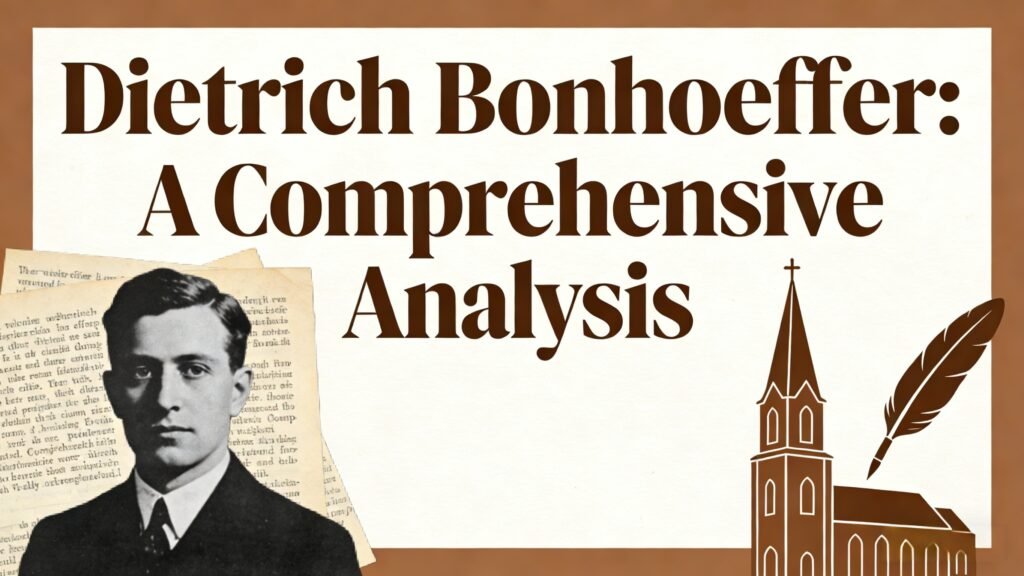
Dietrich Bonhoeffer: A Comprehensive Analysis
Dietrich Bonhoeffer stands as one of the most influential Christian theologians of the 20th century, whose life and work continue to inspire millions worldwide. Born on February 4, 1906, in Breslau, Germany (now Wrocław, Poland), Bonhoeffer emerged as a German Lutheran pastor, neo-orthodox theologian, and anti-Nazi dissident who became a key founding member of the Confessing Church . His unwavering commitment to Christian principles led him to oppose the Nazi regime, ultimately resulting in his execution on April 9, 1945, just weeks before the end of World War II .
This comprehensive analysis examines the life, theological contributions, and lasting legacy of Dietrich Bonhoeffer, exploring how his Christian faith shaped his resistance against tyranny and his profound theological insights. As one of the most significant figures in modern Christian history, Bonhoeffer’s writings on discipleship, community, and Christian ethics continue to resonate with believers and scholars alike. His journey from a privileged academic background to a martyr for justice exemplifies the intersection of faith and action in the face of evil.
1. Dietrich Bonhoeffer’s Early Life and Family Background
1.1 Dietrich Bonhoeffer’s Family Origins and Upbringing
Dietrich Bonhoeffer was born into a distinguished German family with strong intellectual and academic traditions. He was the sixth of eight children, born shortly before his twin sister Sabine . His father, Karl Bonhoeffer, served as a prominent professor of psychiatry and neurology, while his mother, Paula von Hase, was one of the few women of her generation to obtain a university degree . The Bonhoeffer household provided an environment conducive to intellectual growth and moral development, with his mother being the granddaughter of Protestant theologian Karl von Hase and painter Stanislaus von Kalckreuth .
The family’s move to Berlin in 1912 marked a significant transition in young Dietrich’s life . Growing up in the German capital exposed him to the intellectual and cultural currents of the early 20th century, setting the stage for his future academic and theological pursuits. His siblings also pursued distinguished careers: Karl Friedrich became a renowned chemist, Walter died in World War I, Klaus was executed for his role in the resistance against Hitler, and his sisters Ursula, Christine, Sabine, and Susanne each made their own contributions to society .
1.2 Dietrich Bonhoeffer’s Educational Journey and Early Theological Formation
Bonhoeffer’s academic journey began with his completion of gymnasium (secondary education) in 1923 . He then embarked on his theological studies at Tübingen University from 1923 to 1927, where he studied under prominent theologians including Adolf von Harnack, Hans Lietzmann, and Reinhold Seeberg . This formative period exposed him to diverse theological perspectives and laid the foundation for his own distinctive theological approach.
His doctoral dissertation, titled “Sanctorum Communio: A Theological Study of the Sociology of the Church,” was completed under the supervision of Reinhold Seeberg at the University of Berlin in 1927 . This work represented his early attempt to develop a theology of the person in society, particularly within the church context . The dissertation’s publication marked the beginning of his academic career and established him as a promising young theologian in German academic circles.
2. Dietrich Bonhoeffer’s Academic Career and Theological Development
2.1 Dietrich Bonhoeffer’s Early Academic Appointments and Teaching
Following his doctoral studies, Bonhoeffer continued his academic journey with a period of practical ministry. In 1928, he passed his first theological examination and served as a vicar in Barcelona, Spain, ministering to German expatriate communities . This experience abroad broadened his perspective and deepened his understanding of international Christianity.
Returning to Germany, Bonhoeffer served as an assistant at the Berlin theological faculty from 1929 to 1930 . During this period, he also completed his habilitation (postdoctoral qualification) and passed his second theological examination. His academic work during these years culminated in the publication of several important theological works, including “Act and Being: Transcendental Philosophy and Ontology in Systematic Theology” and “Creation and Fall” .
2.2 Dietrich Bonhoeffer’s Theological Distinctives and Core Concepts
Bonhoeffer’s theological approach can be characterized as neo-orthodox, emphasizing the transcendence of God and the centrality of divine revelation in scripture . His theology was marked by several distinctive concepts that continue to influence Christian thought today.
One of his most significant contributions was his concept of “cheap grace” versus “costly grace”. In his seminal work “The Cost of Discipleship” (originally published in German as “Nachfolge” in 1937), Bonhoeffer critiqued what he saw as a superficial understanding of grace that divorced it from the demands of discipleship . He argued that true grace requires costly commitment and discipleship, challenging the comfortable Christianity of his time.
Another important concept in Bonhoeffer’s theology was his vision of “Life Together” (Gemeinsames Leben), which emerged from his experiences at the Finkenwalde seminary. This work, completed in 1938 and published in 1939, contained his reflections on the nature of Christian community based on the common life he and his seminarians experienced . The book explores themes of Christian fellowship, worship, and mutual accountability within the context of community life.
2.3 Dietrich Bonhoeffer’s American Experience and Ecumenical Engagement
In 1930-1931, Bonhoeffer received a Sloane Fellowship that enabled him to attend Union Theological Seminary in New York . This American experience proved transformative for his theological development and worldview. During his time at Union Seminary, he formed lifelong friendships with several international students, including Erwin Sutz from Switzerland, Jean Lasserre from France, and Paul Lehmann from the United States .
A particularly significant relationship was formed with Frank Fisher, a young African American theology student from Alabama, who invited Bonhoeffer to attend church services in Harlem . This exposure to African American Christianity and the experience of racial discrimination profoundly impacted Bonhoeffer’s understanding of social justice and the church’s role in addressing inequality. His time in Harlem, where he spent much of his time teaching and interacting with the congregation, led him to take phonograph records of spirituals back to Germany .
3. Dietrich Bonhoeffer’s Resistance Against the Nazi Regime
3.1 Dietrich Bonhoeffer’s Theological Opposition to Nazism
The rise of Adolf Hitler to power in January 1933 marked a pivotal moment in Bonhoeffer’s life and ministry. On February 1, just one day after Hitler’s appointment as chancellor, Bonhoeffer gave a radio speech warning Germans not to idolize their new Führer . His speech was cut off in the middle of a sentence, foreshadowing the censorship and repression that would characterize the Nazi regime .
In April 1933, Bonhoeffer wrote his essay “The Church and the Jewish Question,” which was the first theological work to address the new problems the church faced under the Nazi dictatorship . His defense of the Jews, though marked by Christian supersessionism (the belief that Christianity had superseded Judaism), represented an early theological challenge to Nazi anti-Semitism. The essay was completed in the days following the April 1, 1933, boycott of Jewish businesses, demonstrating Bonhoeffer’s immediate response to the emerging crisis .
3.2 Dietrich Bonhoeffer’s Confessing Church Movement
As the Nazi Party consolidated its power, many Protestants initially welcomed the rise of Nazism. A group called the Deutsche Christen (“German Christians”) became the voice of Nazi ideology within the Evangelical Church, even advocating the removal of the Old Testament from the Bible and proposing a church “Aryan paragraph” to prevent “non-Aryans” from becoming ministers .
Bonhoeffer emerged as a key founding member of the Confessing Church, which was organized in Barmen, Germany, in May 1934 . The Confessing Church declared that Christianity and Nazi racial ideology were incompatible and opposed the Aryan paragraph that would exclude those with “Jewish blood” from the ministry . Bonhoeffer bitterly opposed this policy, arguing that its ratification would surrender Christian precepts to political ideology. He contended that if “non-Aryans” were banned from the ministry, their colleagues should resign in solidarity, even if this meant establishing a new church .
3.3 Dietrich Bonhoeffer’s Theological Education and Resistance Activities
In April 1935, Bonhoeffer established an underground seminary for the anti-Nazi Confessing Church at Zingst by the Baltic Sea, which later moved to Finkenwalde in Pomerania . This seminary became a center for theological education and resistance training, where Bonhoeffer taught and mentored future pastors who would lead the Confessing Church.
The seminary experience produced some of Bonhoeffer’s most enduring works. His experiences at Finkenwalde gave rise to his books “The Cost of Discipleship” and “Life Together,” as well as his lesser-known writings on pastoral ministry such as “Spiritual Care” . These works reflected the practical outworking of his theological principles in the context of Christian community and resistance.
However, the Nazi authorities increasingly targeted the seminary. In 1936, Bonhoeffer was forbidden to lecture at the University of Berlin . In 1937, the Gestapo closed the Finkenwalde Seminary, and 27 former students were imprisoned . Despite these setbacks, Bonhoeffer continued his underground theological education work, preparing pastors for the Confessing Church until 1939 .
3.4 Dietrich Bonhoeffer’s Political Resistance and Conspiracy
In February 1938, Bonhoeffer made his first contact with conspirators involved in political resistance against Hitler . This marked a significant expansion of his resistance activities beyond theological opposition to direct political involvement. His connections to the resistance network deepened over the next several years.
In June 1939, Bonhoeffer made a fateful decision. He had been offered a position in the United States and had traveled to New York, but on July 27, 1939, he returned to Germany to join the political resistance . This decision to return to Germany, despite the dangers, reflected his conviction that his place was with his people during their time of trial.
His resistance activities included involvement in Operation 7, a Jewish rescue operation, beginning in September 1941 . He also became part of the broader conspiracy against Hitler, working with figures such as Admiral Canaris and his brother-in-law Hans von Dohnanyi. These activities placed him in increasing danger as the Nazi regime intensified its surveillance and repression.
4. Dietrich Bonhoeffer’s Imprisonment and Final Years
4.1 Dietrich Bonhoeffer’s Arrest and Initial Imprisonment
On April 5, 1943, at the age of 36, Bonhoeffer was arrested and taken to Tegel Prison in Berlin . His arrest came after his involvement in the resistance was discovered, and he was held under suspicion of conspiracy against the Nazi regime. His brother-in-law Hans von Dohnanyi and his sister Christine were also arrested in the same operation .
During his time in Tegel Prison, Bonhoeffer continued his theological reflections and writing. The letters and papers he wrote during these final years of his life were later published by his student and friend Eberhard Bethge as “Letters and Papers from Prison” . These writings contain some of his most profound theological insights, including his reflections on “religionless Christianity” and his vision of the church’s role in a secular world.
4.2 Dietrich Bonhoeffer’s Theological Reflections During Imprisonment
Bonhoeffer’s prison writings reveal a theologian grappling with the implications of living in a “world come of age”—a world that no longer needed religion as a crutch. His concept of “religionless Christianity” challenged traditional understandings of faith and proposed a form of Christianity that was authentically engaged with the world’s sufferings and struggles .
In these writings, Bonhoeffer developed his ideas for a church oriented toward the outside, in solidarity with the most vulnerable, and for an interpretation of the Bible that extended beyond the religious sphere . He questioned the traditional boundaries between sacred and secular, suggesting that true Christianity must be fully present in the world’s pain and joy.
4.3 Dietrich Bonhoeffer Transfer to Concentration Camps
On February 7, 1945, Bonhoeffer was transferred from Tegel Prison to Buchenwald Concentration Camp . This transfer marked a significant deterioration in his circumstances, as concentration camps offered little hope of survival. His time at Buchenwald was brief, as he was soon transferred to Flossenbürg Concentration Camp.
The final months of Bonhoeffer’s life were marked by continued spiritual leadership even in the midst of suffering. Fellow prisoners later testified to his ability to bring comfort and hope to those around him, even as he faced his own impending death. His faith remained unshaken, and he continued to minister to others until the end.
5. Dietrich Bonhoeffer’s Death and Legacy
5.1 Dietrich Bonhoeffer’s Execution at Flossenbürg
On April 9, 1945, just weeks before the Allied liberation of Germany, Dietrich Bonhoeffer was executed by hanging at Flossenbürg Concentration Camp at the age of 39 . His execution came after the discovery of Admiral Canaris’s diary, which implicated Bonhoeffer in the resistance conspiracy. Hitler ordered the annihilation of the Canaris group, which included Bonhoeffer .
Accounts from those present at his execution describe Bonhoeffer’s final moments as marked by profound dignity and faith. One witness reported that before his death, Bonhoeffer prayed, sang hymns with other prisoners, and comforted those who were to die with him. His final words were reportedly a prayer for the Nazi guards, demonstrating his commitment to Christian love even in the face of death .
5.2 Dietrich Bonhoeffer’s Martyrdom and Family Loss
Bonhoeffer’s death was part of a broader tragedy for his family. He was one of four members of his immediate family to die at the hands of the Nazi regime for their participation in the Protestant resistance movement—two sons (Dietrich and Klaus) and two sons-in-law (Hans von Dohnanyi and Rudiger Schleicher) . This family sacrifice for the cause of justice and freedom stands as a powerful testament to the Bonhoeffer family’s commitment to Christian principles.
His fiancée, Maria von Wedemeyer, whom he had become engaged to in January 1943 at the age of 36, survived the war but never married . Their brief engagement and his subsequent death added a poignant dimension to his martyrdom, as he gave up the possibility of married life for his resistance activities.
5.3 Dietrich Bonhoeffer’s Literary Legacy and Theological Impact
Bonhoeffer’s literary legacy extends far beyond his immediate impact on the German resistance. His works have been translated into numerous languages and continue to be studied and discussed by theologians, pastors, and laypeople worldwide. The sixteen-volume Dietrich Bonhoeffer Works English Edition provides a comprehensive collection of his writings, including his theological works, sermons, letters, and other documents .
His most influential works include:
- “Sanctorum Communio” (1927): His doctoral dissertation on the sociology of the church
- “The Cost of Discipleship” (1937): A powerful critique of cheap grace and call to costly discipleship
- “Life Together” (1939): Reflections on Christian community life
- “Ethics” (1949): His systematic ethical theology
- “Letters and Papers from Prison” (1953): Profound theological reflections from his imprisonment
5.4 Dietrich Bonhoeffer’s Enduring Influence and Modern Relevance
Bonhoeffer’s influence extends across denominational and geographical boundaries. His emphasis on Christian responsibility in the world, costly discipleship, and the church’s prophetic role continues to challenge and inspire contemporary Christians. His concept of “religionless Christianity” has sparked ongoing debates about the nature of faith in a secular age.
Theological scholars continue to explore and develop his ideas. John W. de Gruchy’s “The Cambridge Companion to Dietrich Bonhoeffer” (2008) provides a comprehensive overview of his theological contributions . Ernst Feil’s “The Theology of Dietrich Bonhoeffer” (2007) offers a detailed analysis of his theological development .
In popular culture, Bonhoeffer’s life has been the subject of numerous biographies, documentaries, and artistic works. His story of resistance against tyranny has made him an icon of moral courage and Christian witness. The Dietrich Bonhoeffer Institute and various memorial sites in Germany commemorate his life and legacy.
5.5 Key Theological Themes and Their Contemporary Application
Several key themes from Bonhoeffer’s theology continue to resonate in contemporary Christian thought and practice:
1. The Cost of Discipleship
Bonhoeffer’s distinction between cheap grace and costly grace remains profoundly relevant. In an age of consumer Christianity that often emphasizes personal comfort and benefit, his call for radical discipleship challenges believers to examine the authenticity of their faith commitment. His insistence that grace involves sacrifice and commitment offers a corrective to superficial religious practice.
2. Christian Community and Life Together
His reflections on Christian community life, developed during his time at Finkenwalde, offer valuable insights for contemporary churches and Christian communities. His emphasis on mutual accountability, shared worship, and service to one another provides a model for authentic Christian fellowship in an individualistic age.
3. Faith and Action
Bonhoeffer’s life exemplifies the integration of faith and action. His resistance against the Nazi regime demonstrates how Christian principles must translate into concrete acts of justice and compassion. His example challenges believers to examine their own responses to injustice and oppression in their contexts.
4. The Church in the World
His concept of “religionless Christianity” and his vision of the church as “worldly” yet fully Christian continues to inspire discussions about the church’s role in contemporary society. His emphasis on the church’s engagement with the world’s sufferings and struggles offers a model for relevant and faithful Christian witness.
6. Dietrich Bonhoeffer’s Quotes and Final Words
6.1 Dietrich Bonhoeffer’s Famous Quotes from Dietrich Bonhoeffer
Bonhoeffer’s writings are replete with profound insights that continue to inspire readers. Some of his most memorable quotes include:
- “When Christ calls a man, he bids him come and die.” – From “The Cost of Discipleship,” this quote encapsulates his understanding of the radical nature of Christian discipleship .
- “Cheap grace is the preaching of forgiveness without requiring repentance, baptism without church discipline, Communion without confession… Costly grace is the treasure hidden in the field; for the sake of it a man will go and sell all that he has. It is the pearl of great price to buy which the merchant will sell all his goods.” – This powerful contrast between cheap and costly grace remains one of his most influential theological concepts .
- “The first service that one owes to others in the fellowship consists in listening to them. Just as love to God begins with listening to his Word, so the beginning of love for the brethren is learning to listen to them.” – From “Life Together,” this quote reflects his understanding of Christian community and mutual care .
- “We are not to simply bandage the wounds of victims beneath the wheels of injustice, we are to drive a spoke into the wheel itself.” – This quote illustrates his commitment to addressing the root causes of injustice rather than merely treating symptoms.
- “The test of the morality of a society is what it does for its children.” – This statement reflects his broader concern for social justice and human dignity.
6.2 Final Words and Prayers
Accounts of Bonhoeffer’s final moments describe his profound faith and spiritual composure. According to eyewitness reports, his final words were a prayer for his executioners, demonstrating his commitment to Christian love even in the face of death . This act of forgiveness and love in the midst of suffering exemplifies his theological convictions about the nature of Christian discipleship and the power of grace.
7. Dietrich Bonhoeffer’s Conclusion
Dietrich Bonhoeffer’s life and legacy represent a profound integration of Christian faith and action, theological insight and practical ministry, and personal sacrifice and public witness. His journey from a privileged academic background to a martyr for justice illustrates the transformative power of authentic Christian discipleship in the face of evil.
As a German Lutheran pastor, neo-orthodox theologian, and anti-Nazi dissident, Bonhoeffer’s contributions to Christian thought and practice continue to resonate across denominational and geographical boundaries . His theological insights, particularly his concepts of costly grace, Christian community, and the church’s role in the world, offer valuable guidance for contemporary believers seeking to live faithfully in a complex and often unjust world.
His resistance against the Nazi regime, which ultimately led to his execution on April 9, 1945, stands as a powerful witness to the moral courage that Christian faith can inspire . His willingness to sacrifice his own life rather than compromise his principles challenges all believers to examine the depth of their own commitment to justice, truth, and love.
The enduring relevance of Bonhoeffer’s life and teachings lies in their call for authentic Christian discipleship that refuses to be satisfied with superficial religion. His vision of costly grace, his emphasis on Christian community, and his commitment to social justice offer a model for faith that is both intellectually rigorous and practically engaged.
As we continue to face challenges of injustice, violence, and moral compromise in our own times,Bonhoeffer’s example reminds us that Christian faith demands action—not just in times of crisis, but in the everyday choices we make about how we live and whom we serve. His life and legacy challenge us to examine whether our faith is merely “cheap grace” or the costly grace that transforms both individuals and societies.
Dietrich Bonhoeffer’s legacy as a theologian, pastor, and martyr continues to inspire millions around the world. His witness reminds us that true Christian discipleship requires courage, conviction, and a willingness to stand against injustice even when it costs us everything. In an age of moral ambiguity and spiritual complacency, his life offers a clarion call to faithful Christian living that is both intellectually profound and practically transformative.
The German Lutheran pastor, neo-orthodox theologian, and anti-Nazi dissident who gave his life for justice and truth remains a powerful symbol of what it means to be a Christian in the world . His writings continue to challenge and inspire, his example continues to convict and encourage, and his memory continues to point us toward a more faithful and just way of life. In Dietrich Bonhoeffer, we find not merely a historical figure to be studied, but a living witness whose life and teachings continue to speak to the deepest needs of our times