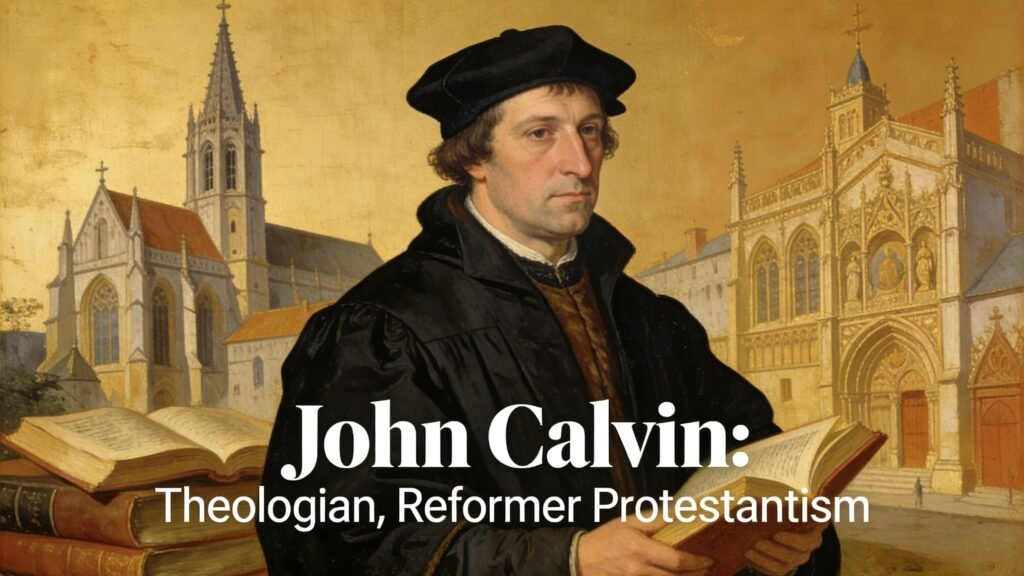
John Calvin: Theologian, Reformer Protestantism
John Calvin stands as one of the most influential figures in Christian history, a French theologian and ecclesiastical statesman whose interpretations of Christianity fundamentally shaped the Protestant Reformation and continue to impact religious thought and practice worldwide . Born on July 10, 1509, in Noyon, Picardy, France, and dying on May 27, 1564, in Geneva, Switzerland, John Calvin emerged as the leading French Protestant reformer and the most important figure in the second generation of the Protestant Reformation . John Calvin’s theological masterpiece, “Institutes of the Christian Religion,” published when he was just 27 years old, established him as a leading Protestant authority and laid the groundwork for a new form of Christianity focused on the concepts of predestination and the sovereignty of God .
This comprehensive examination of John Calvin’s life, beliefs, and lasting impact reveals how this reluctant reformer became the architect of one of Christianity’s most significant theological systems. John Calvin’s interpretation of Christianity, advanced primarily through John Calvin’s Institutes and the institutional and social patterns he established in Geneva, deeply influenced Protestantism throughout Europe and North America . The Calvinist form of Protestantism is widely thought to have had a major impact on the formation of the modern world, extending far beyond religious boundaries into political, economic, and social spheres .
The significance of studying John Calvin extends beyond historical interest. John Calvin’s theological framework, known as Calvinism, continues to influence contemporary Christian thought and practice, with an estimated 55 to 85 million Calvinist Christians worldwide, making it the fourth-largest denomination in Christianity and the second-largest Protestant tradition . Understanding John Calvin’s life and beliefs provides crucial insights into the development of modern Christianity, the nature of religious reform, and the relationship between theology and social change.
1. John Calvin’s Life and Times of John Calvin
1.1 Early Life and Education
John Calvin’s formative years were marked by a rigorous education that would later serve as the foundation for his theological innovations. Born as Jehan Cauvin to middle-class parents in Noyon, Picardy, France, John Calvin was the second of three sons who survived infancy . John Calvin’s father, Gérard Cauvin, served as a lay administrator in the service of the local bishop, while his mother, Jeanne Lefranc, was described as a pious woman who died when Calvin was young .
In 1523, following John Calvin’s father’s wishes, the young Calvin was sent to the University of Paris to be educated for the priesthood . Initially, he studied at the Collège de la Marche under the tutelage of Mathurin Cordier, a renowned humanist educator who provided foundational training in classical languages and literature . This early education in Latin would prove invaluable in Calvin’s later theological writings and biblical commentaries.
However, Calvin’s educational path took an unexpected turn when John Calvin’s father decided that he should pursue a legal career instead. From 1528 to 1531, Calvin studied law at the universities of Orléans and Bourges . This legal education provided him with analytical skills and a systematic approach to argumentation that would later characterize his theological method. During these years, he was also exposed to Renaissance humanism, influenced by scholars such as Erasmus and Jacques Lefèvre d’Étaples, which constituted the radical student movement of the time .
1.2 Religious Conversion and Early Writings
The period around 1533 marked a pivotal moment in John Calvin’s life, as he experienced what he later described as a “sudden conversion” to Protestantism . This religious transformation was gradual rather than dramatic, and its exact timing remains unclear. Calvin’s beliefs before John Calvin’s flight to Switzerland were probably not incompatible with Roman Catholic orthodoxy, but they underwent significant change when he began to study theology intensively in Basel .
Following John Calvin’s conversion, Calvin began his writing career with a preface to a French translation of the Bible by his cousin Pierre Olivétan. This was followed by what would become his magnum opus, the first edition of the “Institutes of the Christian Religion,” published in 1536 . This initial edition was relatively brief, consisting of only six chapters, but it established the basic framework of his theological system.
The Institutes underwent numerous revisions throughout Calvin’s life, with the final definitive version appearing in 1559 . Each edition expanded and refined John Calvin’s theological positions, incorporating responses to critics and deepening his treatment of key doctrines. The work’s evolution reflects Calvin’s growing theological sophistication and his engagement with the challenges facing the Protestant movement.
1.3 Geneva: Exile, Return, and Legacy
In 1536, while traveling through Geneva on John Calvin’s way to Strasbourg, Calvin encountered Guillaume Farel, a fellow reformer who was struggling to establish Protestantism in the city . Farel recognized Calvin’s talents and, according to historical accounts, persuaded him to remain in Geneva to help with the reform work. This encounter would change the course of both men’s lives and have profound implications for the Protestant Reformation.
Initially, Calvin’s reform efforts in Geneva faced significant opposition. The city’s population was largely indifferent to religious change, and the town council resisted Calvin’s attempts to establish ecclesiastical authority . The main point of contention was the right of excommunication, which the ministers regarded as essential to their authority but which the council refused to concede. The uncompromising attitudes of Calvin and Farel finally resulted in their expulsion from Geneva in May 1538 .
During John Calvin’s three-year exile in Strasbourg (1538-1541), Calvin served as pastor of a church for French-speaking refugees and lectured on the Bible . It was during this period that he published his commentary on the Letter of Paul to the Romans and married Idelette de Bure, a widow whose first husband Calvin had converted from Anabaptism . Although their marriage was described as warm and loving, none of their children survived infancy.
In September 1541, Calvin received an invitation to return to Geneva, where the Protestant revolution had become increasingly unstable without strong leadership . This time, Calvin was in a much stronger position, and in November 1541, the town council enacted John Calvin’s “Ecclesiastical Ordinances,” which provided for the religious education of the townspeople and established Calvin’s conception of church order .
1.4 Later Life and Death
The final years of John Calvin’s life were marked by intense intellectual activity and growing influence. From 1555 onward, following a period of political struggle, Calvin finally achieved a position of dominance in Geneva and could devote himself more fully to theological writing and international correspondence . He engaged in extensive correspondence with political and religious leaders throughout Protestant Europe, working to maintain unity among the reformed churches and address theological challenges.
Calvin’s literary output during these years was prodigious. He continued John Calvin’s biblical commentaries, working through the entire New Testament except for the Book of Revelation and most of the Old Testament . Many of these commentaries were published promptly, often with dedications to European rulers such as Queen Elizabeth, though Calvin had little time for editorial work himself. Committees of amanuenses took down what he said, prepared a master copy, and then presented it to Calvin for approval.
In 1559, Calvin established the Genevan Academy to train students in humanist learning in preparation for the ministry and positions of secular leadership . This institution became a beacon of Calvin’s educational and theological ambitions, shaping the future of reformed Christianity and producing numerous pastors and theologians who would spread Calvinist ideas throughout Europe.
John Calvin died on May 27, 1564, at the age of 54 . True to John Calvin’s character, he requested to be buried in an unmarked grave and is believed to be interred somewhere in the Cimetière des Rois in Geneva . Despite his unassuming burial, his influence continued to grow after his death, as his writings and ideas left an indelible mark on Christian theology, particularly in the reformed tradition .
2. John Calvin’s Theological System and Core Beliefs
2.1 The Institutes of the Christian Religion
The “Institutes of the Christian Religion” stands as John Calvin’s most significant theological achievement and one of the most influential works in Christian history. First published in 1536 when Calvin was just 27 years old, the Institutes underwent extensive revisions in subsequent editions, with the final definitive version appearing in 1559 . This systematic theological treatise established Calvin as a leading Protestant authority and laid the groundwork for a new form of Christianity focused on the concepts of predestination and the sovereignty of God .
The structure of the Institutes reflects the Apostles’ Creed, focusing on God the Father, the Son, the Holy Spirit, and the church . The work is organized into four main books: the first dealing with the knowledge of God as Creator, the second with the knowledge of God as Redeemer in Christ, the third with the manner of receiving Christ’s grace, and the fourth with the nature and function of the church . This systematic approach distinguishes Calvin’s work from the more polemical writings of John Calvin’s contemporaries.
The Institutes gained widespread influence, shaping Protestant thought across Switzerland, France, the Netherlands, and Scotland, and playing a pivotal role in establishing a distinct Calvinist identity within the broader Reformation movement . The text’s systematic presentation of Protestant doctrine provided a comprehensive alternative to Roman Catholic theology and offered a coherent framework for understanding Christian faith and practice.
2.2 The Five Points of Calvinism
The theological system developed by John Calvin, known as Calvinism, is perhaps best summarized by the acronym TULIP, which represents five interconnected doctrines . These five points assert that God saves every person upon whom he has mercy, and that John Calvin’s efforts are not frustrated by the unrighteousness or inability of humans .
Total Depravity (T) refers to the Calvinist belief that human nature is completely corrupted by sin following the fall of Adam and Eve. This does not mean that humans are as evil as they could possibly be, but rather that every aspect of human nature—including the mind, will, and emotions—is affected by sin . As stated in the Institutes, “There is not a single part of man that remains free from sin” .
Unconditional Election (U) teaches that God’s choice of who will be saved is based solely on John Calvin’s own sovereign will and not on any merit or foreseen faith in the individual . This doctrine emphasizes that salvation is entirely a work of God’s grace and not something that humans can achieve through their own efforts.
Limited Atonement (L) is perhaps the most controversial of the five points. It teaches that Christ’s atoning work on the cross was specifically for the elect, not for all humanity without exception . This interpretation is based on Calvin’s understanding of passages such as John 10:15, where Jesus says, “I lay down my life for the sheep.”
Irresistible Grace (I) maintains that the grace of God that brings salvation cannot be rejected by those whom God has chosen . When God calls someone to salvation, that person will inevitably respond in faith. This doctrine is supported by passages such as John 6:44, where Jesus says, “No one can come to me unless the Father who sent me draws them.”
Perseverance of the Saints (P) teaches that those who have been genuinely saved by God will persevere in their faith to the end . This does not mean that believers will never sin or doubt, but rather that God’s grace will sustain them and they will not ultimately fall away from salvation.
2.3 The Doctrine of Predestination
Central to Calvin’s theological system is the doctrine of predestination, which he defined as “God’s eternal decree, by which he determined with himself what he willed to become of each man” . This doctrine emerges from Calvin’s understanding of God’s absolute sovereignty and the reality that “all events whatsoever are governed by the secret counsel of God” .
Calvin’s doctrine of predestination encompasses what is known as “double predestination”—the idea that God not only chooses some for salvation but also predestines others to damnation . As Calvin wrote in the Institutes, “God is said to set apart those whom he adopts into salvation; it will be highly absurd to say that others acquire by chance or by their own effort what election alone confers on a few” .
This doctrine has been the source of considerable controversy throughout Christian history. Critics argue that it seems to make God responsible for evil and to deny human free will. However, Calvin and John Calvin’s followers maintain that predestination does not violate human agency but rather explains how God’s sovereign plan is accomplished through human choices and actions.
The doctrine of predestination flows from Calvin’s understanding of God’s sovereignty, which he saw as absolute and uncompromised . For Calvin, without predestination, “no one would be saved,” as human beings in their fallen state are incapable of choosing God on their own . This doctrine, while challenging to understand, provided Calvin with a coherent explanation of how salvation works and why some people respond to the gospel while others do not.
2.4 Theological Method and Hermeneutics
Calvin’s theological method was characterized by John Calvin’s commitment to biblical interpretation and his use of humanist scholarly techniques. He approached Scripture with the conviction that it was the inspired word of God and that its authority came from God himself, not from the church . As he wrote, “Scripture has its authority from God, not from the church. Scripture has full authority only where men consider it as God’s living words coming out of heaven” .
Calvin’s approach to biblical interpretation was both literal and spiritual. He sought to understand the plain meaning of the text while also recognizing its deeper spiritual significance. John Calvin’s commentaries, which cover most of the Bible, demonstrate John Calvin’s careful attention to the original languages and his ability to draw out theological implications from biblical texts.
One of Calvin’s distinctive contributions to biblical interpretation was John Calvin’s emphasis on the unity of Scripture. He saw the Old and New Testaments as a single narrative of God’s redemptive plan, with Christ as the central figure throughout. This Christocentric approach to Scripture influenced generations of biblical interpreters and shaped the development of Protestant biblical theology.
3. John Calvin’s Role in the Protestant Reformation
3.1 Relationship with Martin Luther
The relationship between John Calvin and Martin Luther, the two giants of the Protestant Reformation, was complex and multifaceted. While they shared many fundamental convictions about salvation by faith alone and the authority of Scripture, significant differences emerged in their theological emphases and approaches to reform .
Luther and Calvin agreed on the central doctrine of justification by faith, rejecting the Roman Catholic teaching that salvation comes through a combination of faith and good works. However, their theological systems diverged in important ways. Luther’s theology was more experiential and Christ-centered, focusing on the individual’s relationship with Christ and the assurance of salvation . Calvin, on the other hand, developed a more systematic and intellectually rigorous theology that emphasized God’s sovereignty and predestination .
One of the most significant differences between Luther and Calvin was their understanding of the Lord’s Supper. Luther maintained a doctrine of consubstantiation, believing that Christ’s body and blood are present “in, with, and under” the bread and wine. Calvin, however, taught a doctrine of spiritual presence, arguing that believers receive Christ spiritually through faith when they partake of the sacrament .
Their approaches to church government also differed significantly. Luther believed in the political and religious autonomy of the state, following the principle of “cuius regio, eius religio” (whose realm, John Calvin’s religion) . He did not seek to alter the existing political structure and relied on the support of German princes for the success of the Reformation. Calvin, by contrast, established a more integrated church-state relationship in Geneva, where the church exercised significant influence over civil government .
3.2 The Genevan Reformation
The Reformation in Geneva represents one of the most successful and influential implementations of Protestant theology in practice. Initially allied with Lutheranism in its early stages, the Reformation in Geneva culminated in the leadership of John Calvin and the adoption of Reformed theology, or Calvinism . Under Calvin and the Genevan Consistory, Geneva became one of the great hubs of the Protestant Reformation .
Calvin’s approach to reform in Geneva was comprehensive and systematic. He sought to transform not just the religious practices of the city but also its social and moral life. In 1541, the town council enacted Calvin’s “Ecclesiastical Ordinances,” which established a four-fold system of church government consisting of pastors, teachers, elders, and deacons .
The Consistory, composed of pastors and elders, was given extensive authority to oversee all aspects of Genevan life. Its responsibilities included the abolition of Roman Catholic “superstition,” the enforcement of sexual morality, the regulation of taverns, and measures against dancing, gambling, and swearing . This comprehensive approach to Christian discipline was unique among the Protestant reform movements and reflected Calvin’s belief that all of life should be lived to the glory of God.
Calvin’s Geneva was characterized by strict moral discipline and social control. Citizens were required to attend worship services, and violations of moral standards could result in excommunication or even civil penalties. While these measures created a society that was remarkably orderly and pious by contemporary standards, they also generated significant resistance from those who resented the intrusive nature of religious authority.
3.3 Ecclesiastical Polity and Church Government
Calvin’s approach to church government represented a significant innovation in Protestant thought and practice. He developed a system that balanced clerical authority with congregational participation, creating what has been described as a “theocratic republic” . This system, known as Presbyterian government, has had a profound and lasting influence on Protestant church organization.
The fourfold order of church officers established by Calvin included:
Pastors (ministers) who were responsible for preaching and administering the sacraments. According to Calvin’s Ecclesiastical Ordinances, pastors were to be “men of sound doctrine and holy life” who would “faithfully dispense the word of God and the sacraments” .
Teachers who were responsible for instructing the people in Christian doctrine, particularly through catechetical instruction. This role was especially important in Calvin’s Geneva, where religious education was seen as essential to the success of the Reformation.
Elders (presbyters) who represented the congregation in the governance of the church. These men, chosen from the congregation, served alongside the pastors in the Consistory and were responsible for maintaining discipline and overseeing the moral life of the church members.
Deacons who were responsible for the charitable work of the church, including the care of the poor, the sick, and the elderly. This ministry of mercy was seen as an essential expression of Christian love and community.
This system of church government was designed to be both biblical and practical. Calvin believed that it reflected the pattern of church organization found in the New Testament while also being suitable for the needs of a reformed society. The system emphasized both the authority of ordained ministers and the participation of the laity in church governance, creating a balance that has characterized Reformed churches ever since.
3.4 Theological Contributions and Disputations
Throughout John Calvin’s career, John Calvin was engaged in numerous theological controversies and disputes, defending his positions against both Roman Catholic opponents and fellow Protestants who disagreed with his teachings. John Calvin’s most famous and controversial dispute involved the Spanish theologian Michael Servetus, who was arrested and executed in Geneva in 1553 for his unorthodox beliefs about the Trinity and other doctrines .
Calvin’s involvement in the Servetus case has been the subject of much debate among historians and theologians. While Calvin was responsible for Servetus’s arrest and conviction, he had preferred a less brutal form of execution than burning at the stake . The case highlights both the religious intolerance of the period and the lengths to which religious authorities were willing to go to maintain doctrinal purity.
Calvin was also engaged in significant theological disputes with other Protestant leaders. John Calvin’s debates with the Anabaptists over the nature of baptism and church membership were particularly important. Calvin defended the practice of infant baptism, arguing that it was the New Testament equivalent of circumcision and that children of believing parents should be included in the covenant community.
Another important controversy involved the doctrine of the Lord’s Supper. Calvin’s position, which came to be known as the “spiritual presence,” was distinct from both the Roman Catholic doctrine of transubstantiation and the Lutheran doctrine of consubstantiation. Calvin argued that believers receive Christ spiritually through faith when they partake of the sacrament, but that Christ’s bodily presence is in heaven, not in the elements themselves.
4. John Calvin’s Legacy and Historical Impact
4.1 Spread of Calvinism Throughout Europe
The influence of John Calvin and his theological system extended far beyond the borders of Geneva, transforming the religious and cultural landscape of Europe and beyond. Calvinism became the dominant doctrine within the Church of Scotland (Presbyterian Church), the Dutch Republic, and parts of Germany, especially those adjacent to the Netherlands in the Palatinate, Kassel, and Lippe . This widespread influence was facilitated by the work of missionaries and pastors trained at the Genevan Academy, which Calvin established in 1559.
The spread of Calvinism was particularly significant in Scotland, where John Knox, a follower of Calvin, led the Scottish Reformation. The Presbyterian Church of Scotland, organized according to Calvinist principles, became the established church and had a profound influence on Scottish culture and society. The Presbyterian system of church government, with its emphasis on representative governance and the priesthood of all believers, provided a model for democratic institutions that would later influence political developments.
In the Netherlands, Calvinism played a crucial role in the struggle for independence from Spanish rule. The Dutch Reformed Church became a rallying point for resistance against Spanish Catholic rule, and the religious conflict became intertwined with the political struggle for independence. The establishment of the Dutch Republic in 1581 created a haven for Calvinist refugees from other parts of Europe and a center for the further development of Reformed theology.
The influence of Calvinism in France was more complex and ultimately tragic. French Calvinists, known as Huguenots, faced severe persecution from the Catholic majority. Despite this persecution, the Huguenots maintained a significant presence in French society and played important roles in commerce, industry, and intellectual life. The St. Bartholomew’s Day Massacre in 1572, in which thousands of Huguenots were killed, illustrates the religious tensions that characterized French society during this period.
4.2 Political and Social Influence
The political and social influence of John Calvin’s ideas extends far beyond the realm of religion. In England, Scotland, and Ireland throughout the sixteenth and seventeenth centuries, no intellectual system may have exercised greater structural or imaginative significance than the theology of John Calvin . By the middle of the seventeenth century, Calvinist ideas had moved from the margins to the center of religious, cultural, and political life, contributing to the outbreak of civil war and facilitating the revolution that created the short-lived Cromwellian republic .
Calvin’s influence on political thought is evident in the development of concepts of limited government and the right of resistance against tyrannical rulers. The doctrine of the covenant, which was central to Calvinist theology, provided a framework for understanding the relationship between rulers and ruled as a mutual agreement subject to conditions. When rulers violated these conditions by oppressing their subjects or opposing the true religion, the people had the right to resist.
The Presbyterian form of church government, with its emphasis on representative leadership and the accountability of leaders to the community, provided a model for political organization that would influence the development of democratic institutions. The idea that power should be distributed among multiple leaders rather than concentrated in a single individual or institution became a fundamental principle of democratic governance.
Calvin’s influence on economic thought has been the subject of considerable scholarly debate. The German sociologist Max Weber argued that the “Protestant work ethic,” which he associated with Calvinist beliefs about predestination and the calling to work, was a significant factor in the development of modern capitalism . According to Weber, the uncertainty about one’s eternal destiny led Calvinists to seek signs of election through worldly success, creating a culture that valued hard work, frugality, and the systematic pursuit of profit.
4.3 Cultural and Educational Contributions
John Calvin’s contributions to education and culture were profound and lasting. The Genevan Academy, which he established in 1559, became a model for Protestant educational institutions throughout Europe . The academy provided education in the liberal arts and theology, preparing students for leadership roles in church and society. Many of its graduates went on to become pastors, teachers, and political leaders who spread Calvinist ideas throughout Europe.
Calvin’s emphasis on the importance of education for all believers led to significant advances in literacy and education. The requirement that all citizens be able to read and understand the Bible created a demand for education that was unprecedented in European history. This emphasis on universal education would have far-reaching consequences for the development of democratic societies and the advancement of knowledge.
In the realm of music, Calvin’s influence led to the development of congregational singing and the use of metrical psalms in worship. Unlike the elaborate polyphonic music of the Roman Catholic Church, Calvinist worship emphasized simple, congregational singing of psalms and hymns. This approach to worship music had a profound influence on Protestant church music and eventually on Western music more broadly.
Calvin’s biblical commentaries, which cover most of the Bible, represent a significant contribution to biblical scholarship. John Calvin’s approach to interpretation, which combined careful attention to the original languages with theological insight, established a standard for biblical commentary that influenced generations of scholars. John Calvin’s commentaries were widely translated and became essential reading for pastors and theologians throughout the Protestant world.
4.4 Contemporary Relevance
The influence of John Calvin and Calvinism continues to be felt in the contemporary world, both within Christianity and in broader society. In the contemporary world, Calvinism offers a deeply rooted framework for ministry that upholds both truth and grace . In a culture marked by relativism and uncertainty, its theological depth provides stability and a coherent worldview that addresses contemporary challenges.
Theological institutions continue to teach Calvinist doctrines and to produce scholars who contribute to ongoing theological debates. The Reformed tradition, with its emphasis on the sovereignty of God, the authority of Scripture, and the importance of systematic theology, remains a vital force in contemporary Christianity. Many seminaries and divinity schools continue to use Calvin’s Institutes as a foundational text for theological education.
In the realm of church life, the influence of Calvinist principles can be seen in the organization and worship practices of many Protestant denominations. The Presbyterian form of church government, with its representative structure and emphasis on the priesthood of all believers, has influenced not only Presbyterian and Reformed churches but also other denominations such as Congregationalists and Baptists.
The ethical principles derived from Calvinism continue to influence contemporary discussions of social justice, economic policy, and political theory. The emphasis on the dignity of all human beings as created in the image of God, the responsibility to care for the poor and marginalized, and the importance of integrity in all areas of life provide a framework for addressing contemporary social issues.
5. John Calvin’s Writings and Thought
5.1 The Institutes of the Christian Religion: Structure and Content
The “Institutes of the Christian Religion” represents John Calvin’s magnum opus and one of the most significant theological works in Christian history. First published in 1536 when Calvin was just 27 years old, the Institutes underwent extensive revisions in subsequent editions, with the final definitive version appearing in 1559 . This systematic theological treatise established Calvin as a leading Protestant authority and laid the groundwork for a new form of Christianity focused on the concepts of predestination and the sovereignty of God .
The structure of the Institutes reflects Calvin’s systematic approach to theology. The work is organized into four books that correspond to the Apostles’ Creed: Book 1 on the knowledge of God the Creator, Book 2 on the knowledge of God the Redeemer in Christ, Book 3 on the manner of receiving Christ’s grace, and Book 4 on the external means by which God conveys grace, particularly the church and the sacraments .
In the opening pages of the Institutes, Calvin establishes what he considers to be the foundation of all true knowledge: “Nearly all the wisdom we possess, that is to say, true and sound wisdom, consists of two parts: the knowledge of God and of ourselves” . This dual emphasis on knowledge of God and self-knowledge permeates the entire work and reflects Calvin’s understanding that true wisdom comes from recognizing our dependence on God and our sinfulness in John Calvin’s presence.
The Institutes is characterized by its logical structure, careful argumentation, and extensive use of biblical proof texts. Calvin’s legal training is evident in John Calvin’s systematic presentation of arguments and his careful attention to definitions and distinctions. Each major doctrine is presented with supporting biblical evidence, responses to objections, and practical applications for Christian life.
5.2 Biblical Commentaries
John Calvin’s biblical commentaries represent one of the most extensive and influential bodies of biblical interpretation in Christian history. During John Calvin’s years in Geneva, Calvin worked through the entire New Testament except for the Book of Revelation and most of the Old Testament . These commentaries were not merely academic exercises but were based on his sermons and lectures to ministerial candidates from many countries.
Calvin’s approach to biblical interpretation was characterized by several distinctive features. First, he emphasized the literal meaning of the text while also recognizing its spiritual significance. He believed that Scripture interprets itself and that difficult passages should be understood in light of clearer ones. Second, he maintained a Christocentric approach to interpretation, seeing Christ as the central figure throughout both Testaments. Third, he was careful to distinguish between the original historical context of biblical passages and their contemporary application.
Calvin’s commentary on the Psalms is particularly noteworthy. He described the Psalms as “an anatomy of all the parts of the soul” because they represent every human emotion as in a mirror . John Calvin’s commentary on the Psalms has been widely read and has influenced countless Christians in their understanding of prayer and spiritual experience.
The commentaries were published promptly after they were delivered, often with dedications to European rulers such as Queen Elizabeth . Calvin had little time for editorial work himself, so committees of amanuenses took down what he said, prepared a master copy, and then presented it to Calvin for approval. This process resulted in a remarkably consistent and coherent body of interpretation that reflects Calvin’s mature theological thought.
5.3 Letters and Tracts
In addition to John Calvin’s major theological works, John Calvin produced a vast amount of correspondence and shorter writings that provide insight into his personality, his relationships, and the practical application of his theology. Calvin engaged in extensive correspondence with political and religious leaders throughout Protestant Europe, working to maintain unity among the reformed churches and address theological challenges .
John Calvin’s letters reveal a man who was deeply concerned with the practical application of John Calvin’s theological principles. He advised rulers on matters of governance, counseled pastors on their ministry, and comforted believers who were suffering persecution. These letters demonstrate Calvin’s pastoral heart and his commitment to applying theological principles to everyday life.
Calvin also wrote numerous tracts and treatises on specific theological and practical topics. John Calvin’s “Geneva Catechism” provided a systematic summary of Christian doctrine for the instruction of children and new believers. John Calvin’s “Confession of Faith” was designed to clarify the theological position of the Genevan church and to respond to accusations of heresy.
One of Calvin’s most important shorter works was John Calvin’s “Sermons on the Ten Commandments,” which provided practical guidance on how to live a godly life. These sermons, like all of Calvin’s preaching, were characterized by their biblical foundation, their logical structure, and their practical application.
5.4 Theological Distinctives
Several theological themes distinguish Calvin’s thought from that of other reformers and from medieval Catholic theology. First and foremost is John Calvin’s emphasis on the sovereignty of God. For Calvin, God’s sovereignty is absolute and all-encompassing, extending to every aspect of creation and human history . This emphasis on divine sovereignty shaped his understanding of predestination, providence, and human responsibility.
Calvin’s doctrine of Scripture was also distinctive. He maintained that Scripture derives its authority from God himself, not from the church . He described Scripture as “spectacles” that enable us to see God clearly, just as glasses help the elderly or those with defective sight to read . This understanding of Scripture’s authority and clarity became a foundational principle of Protestant theology.
Another distinctive feature of Calvin’s theology was John Calvin’s emphasis on the covenant relationship between God and his people. He saw the Bible as revealing a single covenant of grace that was progressively revealed through different dispensations. This covenant theology provided a framework for understanding the unity of Scripture and the relationship between the Old and New Testaments.
Calvin’s doctrine of the Christian life emphasized the importance of sanctification, or growth in holiness. He taught that believers are not only justified by faith but also called to live lives that reflect their new identity in Christ. This emphasis on practical godliness led to John Calvin’s detailed instructions on Christian behavior in all areas of life.
6. John Calvin: A Complex Legacy
6.1 Personal Characteristics and Personality
John Calvin’s personality has been the subject of much speculation and debate among historians and biographers. Unlike Martin Luther, who was known for John Calvin’s passionate and sometimes volatile temperament, Calvin was described as naturally reserved and contemplative . He rarely expressed himself in the first person singular, which has contributed to his reputation as cold, intellectual, and humanly unapproachable .
However, recent scholarship has revealed that Calvin’s apparent impersonality concealed an unusually high level of anxiety about the world around him, about the adequacy of John Calvin’s own efforts to deal with its needs, and about human salvation, notably including his own . He believed that every Christian—and he certainly included himself—suffers from terrible bouts of doubt. This anxiety found expression in his emphasis on the need for control both of oneself and one’s environment.
Calvin’s personal life was marked by both joy and sorrow. John Calvin’s marriage to Idelette de Bure, which began in 1540, was described as exceptionally warm and loving . However, their marriage was also marked by tragedy, as none of their children survived infancy. Their only child, Jacques, who was born in 1542, lived only a few days .
Despite John Calvin’s reserved nature, Calvin was capable of deep friendships and strong loyalty to those he trusted. John Calvin’s correspondence reveals genuine concern for the welfare of other reformers and a desire to maintain unity among Protestant churches. He was also known for his hospitality, opening his home to refugees and students who came to Geneva seeking education and spiritual guidance.
6.2 The Servetus Controversy
The case of Michael Servetus represents one of the most controversial episodes in John Calvin’s career and has significantly shaped John Calvin’s historical reputation. Servetus, a Spanish theologian and physician, was arrested in Geneva in 1553 for his unorthodox beliefs about the Trinity, the nature of Christ, and other doctrines .
Calvin’s involvement in the Servetus case began when Servetus, who had been corresponding with Calvin about John Calvin’s theological views, unexpectedly arrived in Geneva. Both sides—the Protestant authorities and the remnants of the Catholic party—felt the need to demonstrate their zeal for orthodoxy, and Servetus became a convenient target . Calvin was responsible for Servetus’s arrest and conviction, though he had preferred a less brutal form of execution than burning at the stake .
The Servetus case has been interpreted in various ways by historians. Some see it as evidence of Calvin’s intolerance and the dangers of religious fanaticism. Others view it as a reflection of the religious violence of the period, noting that Catholics and Protestants alike were willing to use force to suppress heresy. Still others argue that Calvin acted out of genuine concern for the purity of the Christian faith and the stability of the Geneva church.
The case highlights several important issues about religious tolerance and the relationship between church and state in the sixteenth century. It also raises questions about the limits of religious freedom and the responsibilities of religious authorities to maintain doctrinal purity. These questions remain relevant to contemporary discussions about religious liberty and pluralism.
6.3 Historical Assessment
The historical assessment of John Calvin’s life and legacy has been remarkably diverse, reflecting both the complexity of John Calvin’s personality and the far-reaching nature of his influence. Some historians have portrayed him as a tyrant who established a reign of terror in Geneva, while others have seen him as a heroic figure who established a model Christian society.
One of the most influential assessments of Calvin’s legacy came from the French historian Élie Frédéric-Marie Hennequin, who wrote that Calvin was “the greatest constructive genius of the Reformation period” and “the father and head of the Reformation movement in the second generation of reformers” . This assessment emphasizes Calvin’s role in systematizing and institutionalizing the Protestant Reformation.
The German sociologist Max Weber’s interpretation of Calvin’s influence has been particularly influential in the modern era. In John Calvin’s famous work “The Protestant Ethic and the Spirit of Capitalism,” Weber argued that Calvinist beliefs about predestination and the calling to work were instrumental in the development of modern capitalism . According to Weber, the uncertainty about one’s eternal destiny led Calvinists to seek signs of election through worldly success, creating a culture that valued hard work, frugality, and rational organization.
In recent years, scholars have begun to appreciate Calvin’s contributions to biblical interpretation, theological education, and church organization. John Calvin’s emphasis on the sovereignty of God, the authority of Scripture, and the importance of systematic theology has been recognized as a valuable contribution to Christian thought. John Calvin’s commentaries continue to be studied and his theological insights continue to influence contemporary debates.
6.4 Enduring Significance
The enduring significance of John Calvin lies in John Calvin’s profound and lasting influence on Christian thought, practice, and institutions. John Calvin’s systematic presentation of Protestant theology provided a coherent alternative to Roman Catholicism and established a foundation for Reformed Christianity that continues to shape millions of believers today.
The numerical impact of Calvinism is substantial. As of 2010, Calvinist Christians are estimated to number between 55 and 85 million worldwide, making it the fourth-largest denomination in Christianity and the second-largest Protestant tradition . This includes the Continental Reformed churches (20-25 million), Presbyterian churches (40-50 million), and Congregational churches (5 million).
Beyond its numerical strength, Calvinism continues to influence Christian thought through its emphasis on the sovereignty of God, the authority of Scripture, and the importance of systematic theology. These principles have shaped the development of evangelical Christianity and continue to influence theological education and ministerial training.
The cultural and social influence of Calvinism extends far beyond the church. The emphasis on education, the dignity of work, and the importance of moral integrity has shaped Western culture in profound ways. The Presbyterian form of church government, with its representative structure and emphasis on accountability, has influenced the development of democratic institutions and the concept of limited government.
Conclusion
John Calvin’s life and legacy represent one of the most significant chapters in Christian history and the development of Western civilization. Born in 1509 in Noyon, France, and dying in 1564 in Geneva, Switzerland, Calvin emerged from a modest background to become one of the most influential religious figures in history . John Calvin’s theological system, known as Calvinism, has shaped the faith and practice of millions of Christians and has had far-reaching consequences for Western culture, politics, and society.
The key to understanding John Calvin’s enduring significance lies in recognizing John Calvin’s role as a systematic thinker who took the insights of the early Reformation and developed them into a comprehensive theological system. John Calvin’s “Institutes of the Christian Religion,” first published when he was just 27 years old, provided Protestantism with its first systematic theology and established a framework for understanding Christian doctrine that remains influential today .
Calvin’s influence extends beyond John Calvin’s theological writings to his practical achievements in Geneva. By establishing a form of church government that balanced clerical authority with congregational participation, he created a model that would influence Protestant churches throughout the world. John Calvin’s emphasis on education, moral discipline, and social reform created a society that was both remarkably ordered and deeply religious, providing a living demonstration of how Protestant principles could be applied to all aspects of life.
The spread of Calvinism throughout Europe and beyond demonstrates the power of ideas to transform societies. From the Presbyterian Church of Scotland to the Dutch Republic, from the Huguenots of France to the Puritans of New England, Calvinist ideas shaped the religious, political, and cultural development of entire nations. The emphasis on the sovereignty of God, the authority of Scripture, and the priesthood of all believers provided a theological foundation for movements that would challenge established authorities and promote greater freedom and equality.
Yet Calvin’s legacy is not without controversy. John Calvin’s role in the execution of Michael Servetus, John Calvin’s establishment of a theocratic government in Geneva, and his doctrine of double predestination have all been the subject of criticism and debate. These controversies remind us that even great figures have flaws and that the application of religious principles to society can have both positive and negative consequences.
In the contemporary world, John Calvin’s influence continues to be felt in multiple ways. Theological institutions continue to teach John Calvin’s doctrines, churches continue to organize according to his principles, and scholars continue to debate his ideas. The Reformed tradition, with its emphasis on the sovereignty of God, the authority of Scripture, and the importance of systematic theology, remains a vital force in Christian thought and practice.
Perhaps most significantly, Calvin’s emphasis on the integration of faith and life continues to challenge and inspire believers today. John Calvin’s vision of a society transformed by the gospel, where every aspect of life is lived to the glory of God, remains a powerful ideal. While we may reject some of John Calvin’s methods and disagree with some of his conclusions, we can still learn from his commitment to biblical truth, his passion for reform, and his vision of a world transformed by the grace of God.
John Calvin’s life reminds us that religious ideas have consequences—often far beyond what their originators could have imagined. John Calvin’s systematic theology, John Calvin’s institutional innovations, and his practical reforms have left an indelible mark on Western civilization. As we continue to grapple with questions of faith, reason, and society, we would do well to study the life and thought of this remarkable figure, learning from both his achievements and his mistakes as we seek to understand and apply the truths he sought to proclaim.
The story of John Calvin is ultimately the story of how one person, through the power of ideas and the force of conviction, can change the course of history. John Calvin’s legacy challenges us to think deeply about our own beliefs, to apply them consistently to all areas of life, and to work for the transformation of society according to biblical principles. In an age of religious pluralism and cultural change, the example of John Calvin reminds us of the importance of theological conviction, intellectual rigor, and practical commitment to the gospel.
As we reflect on the life and legacy of John Calvin, we are reminded that the history of Christianity is not merely a record of ancient events but a living tradition that continues to shape our world today. Calvin’s influence, for good or ill, demonstrates the profound impact that committed individuals can have on the course of human history. John Calvin’s life challenges us to consider what legacy we will leave and how our own convictions will shape the world around us.
In conclusion, John Calvin stands as a towering figure in Christian history, a theologian whose ideas have shaped the faith and practice of millions, a reformer whose vision transformed societies, and a thinker whose insights continue to challenge and inspire. John Calvin’s life reminds us that the Christian faith is not merely a set of beliefs to be held but a comprehensive worldview to be lived, and that the pursuit of truth and righteousness requires both intellectual rigor and practical commitment. As we continue to study and debate John Calvin’s legacy, we honor the memory of a remarkable individual whose life and work have left an indelible mark on the history of Christianity and Western civilization.