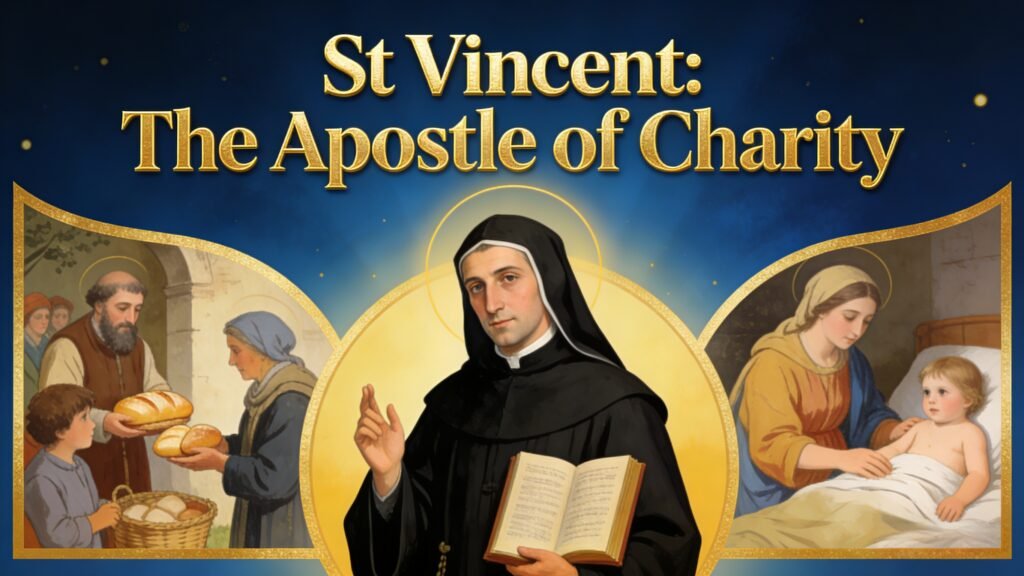
St Vincent: The Apostle of Charity
St Vincent de Paul stands as one of the most influential figures in the history of Christian charity and social service. Born in 1581 in Pouy, Gascony, France, St Vincent would grow to become a Catholic priest, religious reformer, and the founder of two major religious congregations that continue to serve the poor and marginalized worldwide . Known as the “Apostle of Charity,” St Vincent dedicated his life to creating systematic approaches to poverty alleviation, establishing hospitals, orphanages, and charitable organizations that would transform the landscape of Christian service to the poor . His vision and work laid the foundation for modern social welfare systems, and his spiritual legacy continues to inspire millions of people across the globe .
The life and ministry of St Vincent de Paul represent a remarkable journey from personal ambition to profound dedication to serving the poor. Through his establishment of the Congregation of the Mission (Vincentians) in 1625 and the Daughters of Charity in 1633, St Vincent created institutional frameworks for charitable work that have endured for nearly four centuries . His innovative approach to charity, which emphasized both spiritual and material support, community organization, and the involvement of lay people in service to the poor, revolutionized the way Christian charity was conceived and practiced .
Today, St Vincent de Paul is recognized as the patron saint of charitable societies, and his influence extends far beyond the Catholic Church. The Society of St Vincent de Paul, founded in 1833, has grown to become one of the world’s largest charitable organizations, operating in over 150 countries with 800,000 members and 1.5 million volunteers, serving more than 30 million people daily . This article examines the life, work, and enduring legacy of St Vincent de Paul, exploring how his vision and values continue to shape charitable work and social service in the modern world.
1. The Early Life and Formation of St Vincent de Paul
1.1 Humble Origins and Family Background
St Vincent de Paul was born on April 24, 1581, in Pouy, Gascony, France—an area that is now known as Saint-Vincent-de-Paul in his honor . He came from a family of humble farmers, with his father being a modest peasant from the Landes region who encouraged his son to pursue the priesthood as a means of social advancement . St Vincent himself later described his family background with characteristic humility, referring to himself as “a poor peasant, a ragamuffin” .
The young Vincent received his early education from the Franciscans at Dax in France before being ordained as a priest at the remarkably young age of 19 in 1600 at Château-l’Évêque in Dordogne . His early motivation for entering the priesthood was primarily social rather than spiritual, as he initially saw the clerical profession as a pathway to social advancement and economic security . However, his spiritual journey would soon take a profound turn that would redirect the course of his life entirely.
1.2 The Tunisian Captivity: A Life-Changing Experience
One of the most dramatic episodes in St Vincent‘s early life occurred in 1605 when he was captured by Barbary pirates while sailing from Marseille to Castres. He had been traveling to sell property he had inherited from a wealthy patron in Toulouse when he was taken captive and transported to Tunis . This unexpected turn of events would prove to be a pivotal moment in his spiritual development.
During his two-year captivity (1605-1607), St Vincent was sold as a slave and experienced firsthand the harsh realities of human suffering and bondage . His first master was a fisherman, but Vincent’s seasickness made him unsuitable for this work, and he was soon sold to a second master, a spagyric physician, alchemist, and inventor . It was during this period that he learned valuable medicinal skills that would later serve him well in his ministry to the sick and poor.
The most significant aspect of his captivity came when he was purchased by a third master, a former Franciscan priest from Nice named Guillaume Gautier who had converted to Islam to gain his freedom . Through his influence and the intercession of Gautier’s second wife, who was drawn to Vincent’s Christian faith, the former priest experienced a change of heart. Together, St Vincent and Gautier planned their escape, waiting ten months before finally boarding a small boat that carried them across the Mediterranean. They landed at Aigues-Mortes on June 28, 1607, marking the end of Vincent’s captivity .
1.3 Spiritual Conversion and Theological Formation
After his escape from captivity, St Vincent spent a year in Rome continuing his studies before returning to Paris, where he would remain permanently . It was during this period that his spiritual transformation began in earnest. He placed himself under the spiritual guidance of the celebrated Cardinal Pierre de Bérulle, the founder of the Oratory of Jesus and a future cardinal, who would prove to be a decisive influence in his spiritual development .
Cardinal Bérulle’s guidance helped St Vincent move beyond his initial motivation for the priesthood and develop a genuine spiritual vocation. He became increasingly devout and studied the Bible and theology with great fervor . However, it was not through academic study alone that his conversion was completed. Rather, it was through direct contact with the faithful, particularly during his service as a chaplain to the Gondi family, that St Vincent experienced his deepest spiritual transformation.
From 1613 onward, St Vincent served as preceptor to the children of Emmanuel de Gondi, who was the Admiral of the French Mediterranean fleet . Following the Gondi family to their various properties in the Île-de-France region, Vincent had the opportunity to assist parish priests in rural villages, visiting the sick and instructing in catechism. It was during this pastoral service that he first became acutely aware of the profound spiritual and material poverty that existed among the rural poor .
1.4 The Call to Serve the Poor
The defining moment in St Vincent‘s spiritual journey occurred in 1617 in the rural village of Châtillon-sur-Chalaronne. As the parish priest, he delivered a passionate appeal to his congregation to assist a family living in extreme poverty. The response was overwhelming: approximately fifty women immediately volunteered to help . This spontaneous outpouring of charity made St Vincent realize the need to organize charitable efforts in a more systematic way to make them more effective and to involve lay people in the work of charity.
From this experience emerged the first Confraternity of Charity in December 1617. The regulations of this organization already contained the essential principles of St Vincent‘s approach to volunteer work: maintaining constant union with Christ and providing both material and spiritual aid to those in need . This marked the beginning of what would become a lifetime of innovation in the organization and practice of Christian charity.
2. The Founder of Religious Congregations and Charitable Organizations
2.1 The Congregation of the Mission: A New Model for Priestly Ministry
In 1625, driven by his concern for the most abandoned areas of France, St Vincent de Paul founded the Congregation of the Mission as an apostolic society together with several other priests: Anthony Portail, M. Belin, Francis de Coudray, and John de la Salle . This religious congregation, also known as the Lazarists or Vincentians, was established with a specific mission: to preach missions to the peasantry and to educate and train a pastoral clergy .
The founding of the Congregation of the Mission represented a revolutionary approach to religious life and priestly ministry. Unlike traditional monastic orders, the Vincentians were not cloistered but were instead dedicated to active ministry in the world, particularly among the rural poor. Their rule required them to renounce all ecclesiastical offices, benefices, and dignities in order to devote themselves exclusively to the evangelization of the poor .
The Vincentians were organized around several key principles that reflected St Vincent‘s vision for ministry. They were to live in community, practice poverty, and dedicate themselves to preaching missions in rural areas where the Catholic faith was often neglected. They also committed themselves to the education and formation of clergy, recognizing that a well-trained priesthood was essential for the spiritual welfare of the people .
2.2 The Daughters of Charity: Revolutionary Women in Service
Perhaps even more revolutionary than the Congregation of the Mission was St Vincent‘s founding of the Daughters of Charity in collaboration with St. Louise de Marillac in 1633 . This religious community was established with a radical innovation: its members made annual vows rather than perpetual vows, which meant they were always free to leave without requiring ecclesiastical permission .
The Daughters of Charity were officially founded on November 29, 1633, when the first sisters gathered around Louise de Marillac to live their ideal under her guidance in community . The community’s origins can be traced back to the confraternities of charity that St Vincent had established earlier, but the Daughters of Charity represented a more formal and structured approach to women’s religious life and service to the poor.
The work of the Daughters of Charity began with caring for the poor sick in their homes in both cities and countryside—a practice that was revolutionary for its time . Unlike traditional religious communities that remained within convent walls, the Daughters of Charity went out into the world to serve the poor wherever they were found. As their ministry expanded, they gradually moved into caring for patients in hospitals, took responsibility for educating young girls in schools, and extended their care to foundlings, galley slaves, and other marginalized groups .
2.3 The Confraternities of Charity: Lay Participation in Service
Between 1625 and 1660, St Vincent de Paul established numerous Confraternities of Charity throughout Paris and its surrounding areas. These organizations were associations of laywomen, many from noble families, who dedicated themselves to visiting, feeding, and nursing the sick poor . The wealth of these women provided crucial financial support for St Vincent‘s various charitable enterprises, including the establishment of foundling hospitals and other medical institutions .
The confraternities represented St Vincent‘s innovative approach to involving lay people in the work of charity. Rather than restricting charitable work to religious professionals, he recognized the valuable contributions that lay men and women could make to serving the poor. The confraternities operated according to principles that emphasized both spiritual and material support, maintaining the spiritual union with Christ that was central to St Vincent‘s understanding of true charity.
2.4 Other Charitable Institutions and Innovations
Beyond his religious congregations, St Vincent de Paul founded numerous other charitable institutions that addressed specific needs within society. He established orphanages for abandoned children, hospitals for the elderly, and provided assistance for galley slaves, whom he personally visited and advocated for . His work also included the establishment of homes for the aged, institutions for the care of the mentally ill, and various other charitable enterprises that addressed the diverse needs of the poor.
One of St Vincent‘s most significant innovations was his approach to organizing charitable work. He recognized that effective charity required systematic organization, clear governance structures, and the involvement of both clergy and laity working together. His organizations were characterized by simplicity in their rules and structures, allowing them to be easily replicated and adapted to different contexts while maintaining their essential mission of serving the poor.
3. The Ministry and Legacy of St Vincent de Paul
3.1 Apostle of Charity: Systematic Approaches to Poverty Alleviation
St Vincent de Paul’s ministry as the “Apostle of Charity” was characterized by his innovative and systematic approaches to addressing poverty and human suffering. Unlike the more traditional forms of charity that focused primarily on individual acts of mercy, St Vincent developed comprehensive systems for addressing the root causes of poverty while providing immediate relief to those in need .
His approach to charity was grounded in several key principles that distinguished his work from earlier models. First, he emphasized the importance of both material and spiritual aid, recognizing that true charity must address the whole person—body and soul. Second, he believed that charity should be organized and systematic rather than haphazard, ensuring that help reached those who needed it most effectively. Third, he insisted that charitable work should be done with respect and dignity for the poor, treating them not as objects of pity but as brothers and sisters in Christ .
St Vincent‘s influence extended far beyond the institutions he founded. He pioneered modern charity work and inspired the establishment of numerous charitable organizations throughout the world . His approach to social work was so innovative that he is now considered one of the pioneers of modern social action, and his methods continue to inform charitable work and social service provision today .
3.2 The Society of St Vincent de Paul: A Global Movement
The Society of St Vincent de Paul represents one of the most significant and enduring legacies of St Vincent‘s work. Founded in 1833 by French university students led by Frédéric Ozanam, the society was established in response to the social inequality and injustice that the students witnessed in Paris . Under the guidance of Sister Rosalie Rendu, a Daughter of Charity who instructed them in St Vincent‘s teachings, the students formed the first “Conference of Charity” .
In 1834, the conferences took St Vincent as their patron saint and dedicated themselves to the Blessed Virgin Mary . The following year, they produced their first rule, and in 1839 the International Council General was formed . The society’s mission was simple yet profound: to live the Gospel message by serving Christ in the poor with love, respect, justice, and joy .
Today, the Society of St Vincent de Paul has grown to become one of the world’s largest charitable organizations, operating in over 150 countries with 800,000 members and 1.5 million volunteers . Every day, this global network helps more than 30 million people through its various programs and services . The society’s work includes providing food, clothing, shelter, and other basic necessities to those in need, as well as offering friendship, emotional support, and spiritual guidance.
3.3 Canonization and Recognition as Patron Saint
St Vincent de Paul’s reputation for holiness was recognized by his contemporaries, but the formal process of canonization did not begin until 1697, thirty-seven years after his death in 1660 . The Congregation of the Mission officially began the initial application for his cause, which would prove to be a lengthy process involving extensive investigation of his life, virtues, and the miracles attributed to his intercession.
The beatification process was completed on August 13, 1729, when Pope Benedict XIII declared St Vincent blessed at St. Peter’s in Rome . The final step in the canonization process required the verification of two miracles attributed to his intercession. After careful investigation, the Vatican approved two miracles: the cure of a nun suffering from ulcers and the healing of a laywoman afflicted with paralysis .
On June 16, 1737, St Vincent de Paul was officially canonized by Pope Clement XII at a Mass celebrated at St. John Lateran in Rome . The ceremony was attended by an enormous gathering of people, with the procession lasting more than three hours. Twenty-six cardinals, bishops, patriarchs, and other clergy participated in the celebration . In 1885, St Vincent was named the patron of all works of charity of which he is in any way the inspiration .
3.4 Enduring Influence on Modern Charity and Social Work
The legacy of St Vincent de Paul extends far beyond his own lifetime and the institutions he founded. His vision and values continue to shape charitable work and social service provision throughout the world, inspiring countless individuals and organizations to serve those in need. His approach to charity, which emphasized personal contact, respect for human dignity, and the integration of spiritual and material aid, remains highly relevant in contemporary society.
One of the most remarkable aspects of St Vincent‘s legacy is the continued growth and expansion of the organizations he founded. The Daughters of Charity are now present in 91 countries across the globe, continuing their mission of serving the poor in the spirit of their founders . The Congregation of the Mission has spread throughout the world, with Vincentian priests and brothers serving in diverse contexts from inner-city parishes to rural missions.
The Society of St Vincent de Paul, though not founded by St Vincent himself, represents a direct continuation of his work and vision. Its members, known as Vincentians, continue to follow the principles that St Vincent established: serving the poor with love and respect, maintaining personal contact with those in need, and recognizing Christ in every person they serve . The society’s commitment to simplicity, humility, and service reflects the values that characterized St Vincent‘s own life and ministry.
4. Spiritual Teachings and Inspirational Quotes
4.1 The Primacy of Love: “It Is Not Enough to Love God If My Neighbor Does Not Love Him”
St Vincent de Paul’s spiritual teachings were characterized by their profound simplicity and practical wisdom. One of his most famous quotes encapsulates his entire philosophy of life and ministry: “It is not enough for me to love God if my neighbor does not love him” . This statement reflects St Vincent‘s conviction that authentic love of God must necessarily express itself in love for one’s neighbor, particularly the poor and suffering.
For St Vincent, love was not merely an emotion but an active force that compelled believers to serve others. He taught that love “is creative even to infinity,” suggesting that genuine love for God and neighbor would naturally lead to creative and innovative approaches to serving those in need . This understanding of love as creative and dynamic distinguished St Vincent‘s approach to charity from more passive forms of philanthropy.
St Vincent also emphasized that true love must be practical and effective. He famously stated: “Let us love God… let us love God, but let it be with the strength of our arms and with the sweat of our brows” . This quote reflects his belief that love of God requires active engagement with the world and concrete service to others. He warned that many acts of love, including feelings of devotion and benevolence, “are nevertheless to be suspected if they do not reach the practice of effective love” .
4.2 The Practice of Charity: Serving Christ in the Poor
Central to St Vincent‘s spiritual teaching was the belief that service to the poor was equivalent to service to Christ himself. He taught his followers to see Christ in every poor person they encountered, viewing their charitable work as a direct encounter with the divine. This perspective transformed the act of charity from a simple act of kindness into a profound spiritual practice.
St Vincent‘s approach to charity was summarized in his teaching that “the service of the poor should be preferred to everything else” . He instructed his followers that when they encountered a conflict between their prayer schedule and the needs of the poor, they should “leave God for God”—that is, leave their prayer to serve the poor, knowing that in serving the poor they would find God .
His spiritual wisdom extended to practical advice about how to approach charitable work. He taught that “God demands first the heart, then the work,” emphasizing that the motivation behind charitable acts was as important as the acts themselves . He also advised his followers to “be the eye for the blind, the foot for the disabled, the father of the poor, the support of the orphan” , encouraging them to identify with and serve the needs of the poor in a personal and compassionate way.
4.3 Prayer and Spiritual Life: The Foundation of Service
Despite his emphasis on active service to the poor, St Vincent de Paul recognized the crucial importance of prayer and spiritual life as the foundation for effective ministry. He taught that “it is chiefly in prayer that God will give you strength,” and described prayer as “the daily manna which comes down from heaven” .
St Vincent‘s approach to prayer was characterized by its practical nature. He advised his followers that “prayer is a great book for a preacher: from it you will draw the divine truths of the Eternal Word, who is their source, and you in turn will pour them forth on the people” . He believed that without prayer, missionaries would “do little or nothing useful,” but with prayer, they would “certainly… touch hearts” .
One of St Vincent‘s most profound spiritual insights was his teaching about the relationship between prayer and service. He instructed his followers that when they left prayer to serve the poor, they were “losing nothing, because serving the poor is going to God and you should see God in them” . This teaching helped to integrate the contemplative and active aspects of the Christian life, showing how they could be harmoniously united in the service of God and neighbor.
4.4 Wisdom for Daily Life: Patience, Humility, and Trust in God
St Vincent de Paul’s spiritual teachings included many practical insights for daily living that reflected his deep faith and understanding of human nature. He emphasized the importance of patience and trust in God’s timing, teaching that “the affairs of God are accomplished little by little and almost imperceptibly. The spirit of God is neither violent nor hasty” . This wisdom encouraged his followers to trust in God’s providence and to be patient in their efforts to serve others.
St Vincent‘s humility was evident in his own self-understanding. He wrote: “If there is any good in us and in our manner of living, it comes from God, and it is up to God to manifest it, if he thinks it advisable. As for us, however, we are poor, ignorant, sinful men, who should keep ourselves hidden, as being useless for any good and unworthy of consideration” . This attitude of humility characterized his entire approach to ministry and leadership.
His trust in God was reflected in his teaching that “if we are faithful to God, we will lack nothing” . He encouraged his followers to rely completely on God’s providence, teaching them to trust that God would provide for their needs and guide their efforts. This trust in God’s providence gave St Vincent the courage to undertake ambitious projects and to persevere in the face of 困难 and opposition.
5. The Modern Relevance of St Vincent de Paul
5.1 Addressing Contemporary Social Issues
The teachings and example of St Vincent de Paul remain remarkably relevant to contemporary social challenges. In an era marked by increasing inequality, social fragmentation, and the persistence of poverty despite technological advancement, St Vincent‘s holistic approach to charity offers valuable insights for addressing modern social problems.
One of the key aspects of St Vincent‘s legacy that resonates particularly strongly today is his emphasis on personal contact and human dignity. In an age of impersonal social services and bureaucratic approaches to welfare, the Vincentian model of direct, personal service to those in need offers a powerful alternative. The Society of St Vincent de Paul’s commitment to visiting people in their homes, building relationships, and providing assistance with respect and dignity provides a model for more humane and effective social services .
St Vincent‘s understanding of charity as addressing both spiritual and material needs is also highly relevant to contemporary challenges. Modern social service systems often focus exclusively on material needs while neglecting the spiritual and emotional dimensions of human wellbeing. The Vincentian approach, which recognizes that true human flourishing requires attention to all aspects of human life, offers a more comprehensive and effective model for addressing poverty and social exclusion.
5.2 Environmental Stewardship and Social Justice
The modern Vincentian family has expanded its understanding of service to include environmental stewardship and social justice issues. The Society of St Vincent de Paul is now aligned with the 17 Sustainable Development Goals proposed by the United Nations in its Agenda 2030, recognizing that poverty alleviation is interconnected with environmental protection and social justice .
This expansion of the Vincentian mission reflects St Vincent‘s own holistic understanding of human flourishing. Just as he recognized that poverty could not be addressed by material aid alone, modern Vincentians understand that environmental degradation, social inequality, and economic injustice are interconnected challenges that require integrated responses. The society’s commitment to the Global Catholic Climate Movement demonstrates its recognition that caring for the earth is an extension of caring for the poor .
5.3 Digital Age Charitable Work
The legacy of St Vincent de Paul has adapted to the challenges and opportunities of the digital age. While maintaining their commitment to personal contact and direct service, modern Vincentian organizations have developed innovative approaches to charity that utilize technology to reach more people and coordinate services more effectively.
The Society of St Vincent de Paul, for example, now operates food pantries, charitable pharmacies, and housing programs that combine traditional personal service with modern organizational methods . In the United States alone, there are nearly 90,000 Vincentian members in over 4,000 local conferences serving approximately five million neighbors in need every year . These organizations have adapted St Vincent‘s principles to contemporary contexts while maintaining their essential commitment to personal service and human dignity.
5.4 Ecumenical and Interfaith Collaboration
The influence of St Vincent de Paul extends beyond the Catholic Church to inspire ecumenical and interfaith collaboration in charitable work. His emphasis on serving the poor regardless of their religious beliefs or backgrounds has created a foundation for interfaith cooperation in addressing social problems.
The Society of St Vincent de Paul’s principle that “no work of charity is foreign to the Society” and that it “serves persons in need regardless of race, creed, color or religion” reflects St Vincent‘s own inclusive approach to charity . This principle has enabled the society to work effectively with people of all faiths and none, creating opportunities for interfaith dialogue and cooperation in service to the poor.
5.5 Challenges and Opportunities for the Future
As the world faces increasing challenges from climate change, economic inequality, and social fragmentation, the legacy of St Vincent de Paul offers both inspiration and practical guidance for the future of charitable work and social service. His emphasis on innovation, simplicity, and personal relationship provides a framework for addressing complex social problems in ways that respect human dignity and promote authentic human flourishing.
The continued growth and adaptation of Vincentian organizations demonstrates the enduring relevance of St Vincent‘s vision. From the small confraternities he founded in 17th-century France to the global network of organizations operating today, the Vincentian family continues to find new ways to serve the poor and advocate for social justice. This adaptability, combined with a steadfast commitment to core values, ensures that the legacy of St Vincent de Paul will continue to inspire and guide charitable work for generations to come.
Conclusion
St Vincent de Paul’s life and legacy represent one of the most significant contributions to the history of Christian charity and social service. From his humble beginnings as a poor peasant in Gascony to his eventual recognition as the patron saint of all charitable works, St Vincent‘s journey embodies the transformative power of faith and love in action . His innovative approaches to organizing charity, his commitment to serving the poor with dignity and respect, and his integration of spiritual and material aid have created a lasting legacy that continues to inspire millions of people worldwide.
The impact of St Vincent de Paul’s work extends far beyond the specific institutions he founded. Through the Congregation of the Mission, the Daughters of Charity, and the Society of St Vincent de Paul, his vision has created a global network of charitable organizations that serve millions of people every day . These organizations continue to adapt to contemporary challenges while maintaining their founder’s core principles of personal service, respect for human dignity, and commitment to serving Christ in the poor.
Perhaps most significantly, St Vincent de Paul’s spiritual teachings offer profound wisdom for our own time. His emphasis on the primacy of love, his understanding of charity as a creative force that “is creative even to infinity,” and his teaching that “it is not enough to love God if my neighbor does not love him” provide a framework for ethical living and social action that transcends religious boundaries .
As we face the complex challenges of the 21st century—climate change, economic inequality, social fragmentation, and technological disruption—the legacy of St Vincent de Paul offers both inspiration and practical guidance. His example reminds us that effective charity requires not just material resources but also spiritual commitment, personal relationship, and creative innovation. His vision of a world transformed by love in action continues to challenge and inspire us to work for a more just and compassionate society.
The life and work of St Vincent de Paul demonstrate that one person, inspired by faith and motivated by love, can transform the world. His legacy reminds us that the greatest challenges facing humanity can be addressed through simple acts of kindness, systematic organization, and unwavering commitment to serving those in need. As we continue to face new challenges and opportunities, the example of St Vincent de Paul encourages us to remain faithful to the vision of a world where all people are treated with dignity and respect, and where love for God and neighbor finds expression in concrete service to those in need.
In the final analysis, St Vincent de Paul’s greatest legacy is not the institutions he founded or the specific works of charity he initiated, but rather the transformative power of his vision and values. His life demonstrates that authentic Christian charity is not merely about giving to the poor, but about recognizing Christ in the poor and serving them with love, respect, and dignity. This vision continues to inspire people of all faiths and backgrounds to work for a more just and compassionate world, making St Vincent de Paul’s legacy truly timeless and universal in its appeal and application.