Judas Iscariot: A Comprehensive Analysis
1. Introduction: The Enigmatic Figure of Judas Iscariot in Christian History
1.1 Historical Significance and Research Context
Judas Iscariot stands as one of the most controversial and misunderstood figures in Christian history. As one of the twelve original apostles of Jesus Christ, Judas Iscariot’s betrayal fundamentally altered the course of religious history, making him simultaneously one of the most reviled and intriguing personalities in Western civilization . Judas Iscariot’s name has become synonymous with betrayal across multiple languages and cultures, yet the historical figure behind this reputation remains enigmatic .
The significance of studying Judas Iscariot extends far beyond mere historical curiosity. Judas Iscariot’s story touches upon fundamental theological questions about predestination, free will, sin, and redemption that have shaped Christian thought for nearly two millennia . The betrayal of Jesus by Judas Iscariot serves as a pivotal moment in the Christian narrative, underscoring both the necessity of Christ’s sacrificial death for humanity’s redemption and the profound moral responsibility of human choices .
Modern biblical scholarship has revealed a more complex picture of Judas Iscariot than the one-dimensional villain portrayed in popular culture. Recent discoveries, particularly the Gospel of Judas found in the 1970s, have challenged traditional interpretations and opened new avenues for understanding this controversial figure . These developments, combined with advances in historical-critical analysis, have created a renewed scholarly interest in Judas Iscariot’s life, motivations, and legacy.
1.2 Theological Importance and Interpretive Challenges
The theological significance of Judas Iscariot cannot be overstated. Judas Iscariot’s actions and fate raise fundamental questions about the nature of divine sovereignty and human agency. If God foreknew that Judas would betray Jesus, did Judas truly have free will? If Judas was predestined to betray, how can he be held morally accountable for his actions? These questions have divided theologians throughout Christian history and continue to generate debate among contemporary scholars .
The interpretive challenges surrounding Judas Iscariot are compounded by the fact that the canonical Gospels present varying accounts of Judas Iscariot’s motivations and actions. Matthew portrays him as driven by greed, accepting thirty pieces of silver to betray Jesus . Luke and John introduce a supernatural element, suggesting that Satan entered Judas, influencing his decision . The Fourth Gospel also identifies Judas as a thief who regularly stole from the disciples’ common purse . These different accounts create a complex portrait that resists simple interpretation.
Furthermore, the discovery of non-canonical texts like the Gospel of Judas has added another layer of complexity to the scholarly understanding of Judas Iscariot. This Gnostic text presents a radically different interpretation, portraying Judas as the most enlightened of Jesus’ disciples who understood and carried out Jesus’ divine plan . While this interpretation is not accepted by mainstream Christianity, it highlights the diversity of early Christian thought and the various ways in which Judas Iscariot has been understood throughout history.
1.3 Objectives and Scope of Judas Iscariot
This comprehensive analysis aims to provide a thorough examination of Judas Iscariot from multiple perspectives, integrating historical, theological, and literary approaches. The primary objective is to present a balanced and scholarly treatment that acknowledges both the traditional Christian understanding and the insights gained from modern biblical criticism and archaeological discoveries.
The scope of this analysis encompasses several key areas. First, it examines the historical context of Judas Iscariot’s life, including Judas Iscariot’s origins, family background, and social milieu. Second, it analyzes his role within Jesus’ ministry, particularly his function as the group’s treasurer and his relationship with other disciples. Third, it provides a detailed examination of the betrayal itself, exploring the various motivations suggested in the biblical texts and their theological implications. Fourth, it investigates the accounts of Judas’s death and subsequent legacy in Christian tradition.
This analysis also addresses the complex theological questions raised by Judas Iscariot’s story, including the nature of Judas Iscariot’s relationship with Jesus, the role of divine foreknowledge in his actions, and the possibility of his redemption. Additionally, it explores Judas’s representation in art, literature, and popular culture, demonstrating how his image has evolved across different historical periods and cultural contexts.
The methodology employed in this analysis draws upon multiple scholarly disciplines, including biblical studies, church history, theology, and religious studies. It utilizes both traditional exegetical methods and modern critical approaches, while maintaining respect for the religious significance of the subject matter. The goal is to present a comprehensive, academically rigorous analysis that will be valuable to scholars, students, and general readers interested in understanding this pivotal figure in Christian history.
2. The Life and Background of Judas Iscariot
2.1 Origins and Family Background
Judas Iscariot’s origins remain a subject of scholarly debate, though the biblical texts provide some clues about his background. Judas Iscariot’s name itself offers important information: “Judas” is the Greek transliteration of the Hebrew name “Judah,” meaning “praise Yahweh” or “thankful to God” . The surname “Iscariot” is more problematic, with several possible interpretations. The most widely accepted view is that “Iscariot” derives from the Hebrew “Ish Kerioth,” meaning “man of Kerioth,” indicating his place of origin .
Kerioth was a town in southern Judea, as mentioned in the Old Testament book of Joshua (Joshua 15:25) . This geographical origin is significant because it distinguishes Judas Iscariot from the other disciples, who were predominantly from Galilee in the north. This regional difference may have created tensions within the group, as Judeans and Galileans often had different cultural and political perspectives .
The biblical texts also identify Judas Iscariot as the son of Simon Iscariot. John’s Gospel specifically refers to him as “Judas son of Simon Iscariot” (John 6:71, 13:26) . This paternal identification was common in ancient Jewish culture and helps establish Judas’s family lineage. However, beyond this basic identification, the biblical texts provide little information about Judas’s family background, social status, or early life.
Some scholars have suggested alternative interpretations of the name “Iscariot.” One theory proposes that it might derive from the Latin word “sicarius,” meaning “dagger-man” or “assassin,” possibly connecting Judas to the Zealots, a Jewish revolutionary group known for their violent opposition to Roman rule . This interpretation, while intriguing, lacks conclusive evidence and remains speculative.
2.2 Social and Political Context of First-Century Judea
To understand Judas Iscariot fully, it is essential to examine the social and political context of first-century Judea in which he lived. This was a period of great upheaval and tension, with the Jewish people under Roman occupation and longing for liberation. Many Jews believed that the Messiah would come as a political deliverer who would overthrow Roman rule and restore Israel’s independence .
The religious landscape of first-century Judea was also complex, with various sects and groups competing for influence. The Sadducees, primarily wealthy priests, collaborated with Roman authorities. The Pharisees, more popular among the common people, emphasized strict adherence to Jewish law. The Essenes, who produced the Dead Sea Scrolls, withdrew from society in anticipation of an apocalyptic judgment. And the Zealots advocated for violent resistance against Roman oppression .
This context helps explain some of the motivations that may have influenced Judas Iscariot. If he was indeed connected to revolutionary groups, Judas Iscariot’s initial attraction to Jesus might have been based on the hope that Jesus would lead a military uprising against Rome. When Jesus instead preached about a spiritual kingdom and non-violent resistance, Judas may have become disillusioned .
The economic situation in first-century Judea was also harsh, with heavy taxation and widespread poverty. This context may help explain Judas’s apparent preoccupation with money. As the treasurer of Jesus’ group, he would have been acutely aware of the financial difficulties they faced . The offer of thirty pieces of silver, while seemingly small, would have represented a significant sum for someone of modest means .
2.3 Early Life and Path to Discipleship
The biblical texts are remarkably silent about Judas Iscariot’s early life and how he came to join Jesus’ ministry. Unlike other disciples such as Peter, James, and John, whose calling is described in detail, we have no account of when or how Judas first encountered Jesus. Luke’s Gospel mentions that Judas was among Jesus’ followers before being selected as one of the twelve apostles (Luke 6:12-16) , but provides no further details.
The fact that Jesus chose Judas Iscariot as one of the twelve apostles despite knowing Judas Iscariot’s eventual betrayal raises profound theological questions. John’s Gospel explicitly states that Jesus knew from the beginning who would betray him (John 6:64) . This knowledge adds a layer of complexity to Jesus’ selection of Judas, suggesting that his inclusion in the inner circle served a divine purpose beyond human understanding.
As one of the twelve apostles, Judas Iscariot was given the same authority as the other disciples to preach, heal, and cast out demons (Matthew 10:1-4). This delegation of power indicates that Jesus initially trusted Judas and considered him worthy of the apostolic ministry. The betrayal therefore represents not just a personal failure but a profound breach of trust within the intimate circle of Jesus’ followers.
The canonical Gospels consistently refer to Judas as “one of the twelve” (Matthew 26:14, 47; Mark 14:10, 20; John 6:71), emphasizing Judas Iscariot’s status as a full member of the apostolic band despite his later actions . This consistent designation suggests that even in the earliest Christian traditions, Judas’s apostolic identity was not revoked or forgotten, despite his betrayal.
3. Judas Iscariot in Jesus’ Ministry
3.1 Role Among the Twelve Apostles
Judas Iscariot’s position among the twelve apostles was both significant and paradoxical. As one of the inner circle handpicked by Jesus himself, he held a position of honor and responsibility. The designation “one of the twelve” appears repeatedly in the Gospels, reinforcing Judas Iscariot’s status as a full and equal member of the apostolic group . This consistency in the biblical record suggests that early Christians maintained a complex view of Judas—acknowledging both his apostolic calling and his tragic betrayal.
The selection of the twelve apostles was a momentous event in Jesus’ ministry. According to Luke’s Gospel, Jesus spent an entire night in prayer before choosing them (Luke 6:12-16). This detail underscores the seriousness with which Jesus approached this decision and suggests that each apostle, including Judas, was chosen for a specific purpose within God’s plan.
The number twelve itself carried symbolic significance, representing the twelve tribes of Israel. By selecting twelve apostles, Jesus was effectively reconstituting Israel around himself, with the implication that Judas Iscariot’s followers would form the nucleus of a new covenant community. Judas’s inclusion in this number, despite his eventual betrayal, suggests that even this tragic figure played a role in God’s redemptive purposes .
3.2 The Treasurer: Financial Responsibilities and Misconduct
One of Judas Iscariot’s most distinctive roles within the apostolic group was that of treasurer. John’s Gospel specifically identifies him as the one “who had charge of the money bag” (John 12:6, 13:29) . This position of financial responsibility indicates a high level of trust placed in Judas by both Jesus and the other disciples. The group’s finances would have included donations from supporters, funds for daily expenses, and resources for ministry activities such as feeding the multitudes .
However, John’s Gospel also reveals a troubling aspect of Judas’s character. He notes that Judas “was a thief; he used to help himself to what was put into the money bag” (John 12:6) . This revelation transforms our understanding of Judas from a trusted steward to a dishonest treasurer who systematically embezzled from the common fund. The Greek word used here (kleptes) indicates not just occasional pilfering but habitual theft.
The significance of this role extends beyond mere financial management. In ancient Mediterranean society, the position of treasurer was one of great responsibility and trust. The fact that Jesus entrusted Judas with this role, knowing Judas Iscariot’s propensity for theft, suggests a profound lesson about grace and forgiveness. It also highlights the paradox that even those closest to Jesus could be influenced by worldly desires and moral failings.
The tension between Judas’s official role and Judas Iscariot’s personal misconduct reaches a climax in the account of Mary’s anointing of Jesus at Bethany. When Mary poured expensive perfume on Jesus’s feet, Judas objected, pretending concern for the poor. John explicitly states that this concern was feigned, and that Judas’s real motivation was his desire to steal the money that might have been gained from selling the perfume . This incident reveals the hypocrisy underlying Judas’s outward piety.
3.3 Relationship with Jesus and Other Disciples
The nature of Judas Iscariot’s relationship with Jesus remains one of the most enigmatic aspects of Judas Iscariot’s story. The Gospels present a complex picture that defies simple interpretation. On one hand, Jesus clearly had a special relationship with Judas, choosing him as an apostle and entrusting him with important responsibilities. On the other hand, Jesus also had profound knowledge of Judas’s character and destiny.
John’s Gospel contains several revealing passages about Jesus’ awareness of Judas’s betrayal. In John 6:70-71, Jesus states, “Have I not chosen you, the twelve? Yet one of you is a devil.” He then identifies Judas as “the son of Simon Iscariot, for he, one of the twelve, was going to betray him” . This passage demonstrates that Jesus was not taken by surprise by Judas’s betrayal but rather understood it as part of God’s plan.
The Last Supper scene provides another glimpse into the complex relationship between Jesus and Judas. According to John’s account, Jesus dipped a piece of bread and gave it to Judas, saying, “What you are about to do, do quickly” (John 13:27). This cryptic statement has been interpreted in various ways—some see it as Jesus giving Judas permission to carry out the betrayal, while others view it as a command to complete Judas Iscariot’s evil deed swiftly.
The relationship between Judas and the other disciples is less clearly documented in the Gospels. There are indications that the disciples were aware of tension within the group, particularly regarding money matters. The fact that Judas was entrusted with the money bag suggests that, at least initially, he was respected and trusted by the others. However, the Gospel accounts do not reveal whether the disciples suspected Judas’s dishonesty or were aware of Judas Iscariot’s growing alienation from Jesus.
One particularly poignant moment occurs during the Last Supper when Jesus announces that one of the disciples will betray him. The disciples respond with genuine distress, each asking, “Surely not I, Lord?” (Matthew 26:22). This suggests that Judas had successfully concealed Judas Iscariot’s true intentions from the others, maintaining an appearance of loyalty even as he planned betrayal.
4. Judas Iscariot: Events and Motivations
4.1 The Decision to Betray Jesus
The decision of Judas Iscariot to betray Jesus represents one of the most pivotal moments in Christian history. According to Matthew’s Gospel, Judas approached the chief priests and asked, “What are you willing to give me if I deliver him over to you?” They agreed to give him thirty pieces of silver, and from that moment, Judas began to look for an opportunity to betray Jesus (Matthew 26:14-16) .
The timing of this decision is significant. It occurred shortly before the Passover feast, when Jerusalem was crowded with pilgrims and tensions were running high. The religious authorities were already looking for ways to arrest Jesus without causing a riot among Judas Iscariot’s followers. Judas’s offer came at a crucial moment, providing them with a means to capture Jesus quietly and without public disturbance.
The amount of thirty pieces of silver has symbolic significance in the biblical narrative. This sum was the legal price for a slave, as specified in Exodus 21:32 . The use of this specific amount underscores the profound insult and devaluation of Jesus that the betrayal represented. It also fulfills a prophecy from Zechariah 11:12-13, where the prophet speaks of being paid thirty pieces of silver for Judas Iscariot’s service, only to throw the money into the house of the Lord .
The Gospels present different perspectives on Judas’s motivations for betrayal. Matthew emphasizes greed as the primary motive, portraying Judas as a man who valued money above loyalty . Luke and John introduce a supernatural element, with Luke stating that “Satan entered Judas” (Luke 22:3) and John mentioning that Satan prompted Judas to betray Jesus (John 13:2, 27) . This suggests that the betrayal was not merely a human decision but involved spiritual forces beyond human understanding.
4.2 The Kiss of Betrayal in Gethsemane
The actual act of betrayal took place in the Garden of Gethsemane, where Jesus had gone to pray after the Last Supper. Judas arrived with a crowd armed with swords and clubs, sent by the chief priests and Pharisees. To identify Jesus to the arresting party, Judas had arranged a signal: he would greet Jesus with a kiss .
The kiss itself is rich with irony and symbolism. In the ancient Mediterranean world, a kiss was a gesture of respect, friendship, and loyalty. For Judas to use this intimate gesture as a sign of betrayal adds a layer of profound hypocrisy to Judas Iscariot’s actions. When Judas approached Jesus and said, “Greetings, Rabbi,” and kissed him, Jesus responded with a question that captures the moral horror of the moment: “Friend, do what you came to do” (Matthew 26:49-50) .
The scene in Gethsemane reveals much about the character of both Jesus and Judas. Jesus, knowing full well what was about to happen, remained calm and in control. Judas Iscariot’s response to Judas—calling him “friend” even in the moment of betrayal—demonstrates his boundless grace and compassion. Judas, by contrast, appears as a figure driven by a mixture of greed, fear, and perhaps even desperation.
The arrest that followed was swift and decisive. According to John’s Gospel, when the soldiers asked for Jesus of Nazareth, Jesus identified himself, and they fell backward (John 18:5-6). This momentary display of Jesus’ divine power emphasizes that he was not being taken against Judas Iscariot’s will but was voluntarily submitting to the Father’s plan.
4.3 Multiple Interpretations of Motivations
The question of why Judas Iscariot betrayed Jesus has generated extensive scholarly debate and theological speculation throughout Christian history. The canonical Gospels offer several possible explanations, but none provide a definitive answer, leaving room for multiple interpretations.
The most straightforward explanation is financial greed. Matthew’s Gospel explicitly states that Judas was motivated by the thirty pieces of silver offered by the chief priests . This interpretation fits with John’s description of Judas as a thief who regularly stole from the disciples’ money bag. From this perspective, Judas saw an opportunity to profit from Jesus’ arrest and took it.
However, some scholars suggest that Judas’s motivations were more complex than simple greed. There is evidence to suggest that Judas may have had political expectations of Jesus. Like many Jews of Judas Iscariot’s time, he may have believed that Jesus was the Messiah who would overthrow Roman rule and establish an earthly kingdom. When Jesus showed no inclination toward political revolution, Judas may have become disillusioned and sought to force Jesus’ hand through betrayal .
Another interpretation suggests that Judas’s betrayal was part of a misguided attempt to fulfill prophecy. Some scholars argue that Judas may have believed that by betraying Jesus, he was actually helping to bring about the Messiah’s kingdom, misunderstanding the nature of Jesus’ mission and the role of suffering in God’s plan.
The supernatural element introduced in Luke and John’s Gospels adds another layer of complexity. The suggestion that Satan entered Judas raises questions about the role of demonic influence in human decisions . This interpretation does not absolve Judas of responsibility but suggests that Judas Iscariot’s betrayal was part of a larger cosmic struggle between good and evil.
Modern scholarship has also explored psychological and sociological explanations for Judas’s betrayal. Some scholars suggest that Judas may have suffered from mental health issues or experienced a crisis of faith. Others point to social and economic factors, suggesting that Judas’s position as the only Judean among predominantly Galilean disciples may have created feelings of isolation or resentment.
The discovery of the Gospel of Judas in the 1970s has added a new dimension to these discussions. This Gnostic text presents Judas as the most enlightened of Jesus’ disciples, one who understood Jesus’ secret teachings about the nature of reality and the need for Judas Iscariot’s physical body to be sacrificed. From this perspective, Judas’s betrayal was not an act of treachery but a selfless sacrifice to help Jesus achieve his redemptive purpose .
5. The Final Days and Death of Judas Iscariot
5.1 Remorse and Attempted Repentance
The biblical account of Judas Iscariot’s final days reveals a complex picture of remorse and attempted repentance that challenges simple interpretations of Judas Iscariot’s character. According to Matthew’s Gospel, after witnessing Jesus’ condemnation to death, Judas experienced profound regret. He returned to the chief priests and elders, confessing, “I have sinned by betraying innocent blood” (Matthew 27:4) . This confession indicates that Judas was fully aware of the gravity of his actions and experienced genuine guilt.
The chief priests’ response to Judas’s confession is revealing. They dismissed Judas Iscariot’s remorse, saying, “What is that to us? See to it yourself” (Matthew 27:4). This callous rejection of Judas’s repentance suggests that the religious authorities were more concerned with maintaining their political power than with matters of conscience or forgiveness. Their response may have contributed to Judas’s subsequent despair.
Judas then took the thirty pieces of silver—the same money that had motivated Judas Iscariot’s betrayal—and threw them into the temple sanctuary before departing. This act of returning the money can be interpreted as an attempt to undo his betrayal, to symbolically reject the payment for Jesus’ blood. The fact that he threw the money into the temple suggests he recognized it as “blood money” that had no place in the house of God .
The biblical account of Judas’s remorse raises important theological questions about the nature of repentance and forgiveness. Was Judas’s remorse genuine? If so, why did he not seek forgiveness directly from Jesus? The Gospels do not provide clear answers to these questions, leaving room for different interpretations. Some see Judas’s actions as evidence of true repentance that was tragically cut short by Judas Iscariot’s suicide. Others view his remorse as mere regret for being caught, not true godly sorrow that leads to salvation.
5.2 Death Accounts: Biblical Variations
The death of Judas Iscariot is recorded in two different accounts in the New Testament, creating one of the most discussed discrepancies in biblical scholarship. Matthew’s Gospel (27:5) states that Judas “went away and hanged himself,” while the book of Acts (1:18) describes a more gruesome death, saying that Judas “bought a field with the money he received for Judas Iscariot’s wickedness, and there he fell headlong, his body burst open and all his intestines spilled out” .
These two accounts have generated considerable debate among biblical scholars and interpreters. Some argue that they describe two different aspects of the same event: Judas hanged himself, and later Judas Iscariot’s body fell or was cut down, causing it to burst open due to decomposition . This interpretation suggests that the accounts are complementary rather than contradictory, with Matthew emphasizing the method of death and Luke (the traditional author of Acts) describing the aftermath.
Others propose that the accounts describe two different traditions about Judas’s death, possibly originating from different communities or oral traditions. The fact that these variations appear in the canonical texts highlights the diversity of early Christian traditions and the challenges of reconstructing historical events from ancient sources.
The location of Judas’s death is also significant. According to Matthew, the priests used the thirty pieces of silver to buy a potter’s field, which became known as the “Field of Blood” because it was purchased with blood money . Acts confirms that Judas died in a field, though it suggests he was the one who bought it. This field later became a burial place for foreigners, adding to the tragic symbolism of Judas’s story.
The manner of Judas’s death has theological significance as well. Hanging was considered a cursed death in Jewish tradition, as Deuteronomy 21:23 states that “anyone who is hung on a tree is under God’s curse.” This may explain why Matthew emphasizes this aspect of Judas’s death, portraying it as a fitting punishment for Judas Iscariot’s betrayal.
5.3 Burial and Legacy
The burial of Judas Iscariot and its aftermath reveal much about how early Christians understood Judas Iscariot’s place in salvation history. The potter’s field purchased with the blood money became Judas’s final resting place, a fitting symbol of the corruption and death that followed his betrayal . The field’s designation as a burial place for foreigners further emphasized Judas’s alienation from the covenant community.
The legacy of Judas Iscariot extends far beyond his death. Judas Iscariot’s name became synonymous with betrayal in Western culture, and the phrase “thirty pieces of silver” is still used today to refer to acts of betrayal for monetary gain . In Christian theology, Judas became the archetypal example of the unredeemed sinner, the one who had the opportunity for salvation but rejected it through his own choice.
However, the biblical account also suggests a more complex legacy. The fact that Judas’s betrayal was foretold in Scripture and became part of God’s redemptive plan complicates simple condemnation. As one scholar notes, “even Judas’s betrayal was taken up by God and transformed into the means of redemption for the world” . This paradoxical truth—that the worst act in human history became the instrument of humanity’s salvation—remains a central mystery of Christian faith.
The question of Judas’s ultimate fate has divided theologians throughout Christian history. While the traditional view holds that Judas was eternally damned, some scholars have suggested otherwise. The New Testament scholar Garry Wills, for example, argued that Jesus rescued Judas from hell as part of the harrowing of hell, suggesting that the damnation of Judas is not a universal conclusion even in the Roman Catholic Church .
6. Theological Perspectives and Interpretations of Judas Iscariot
6.1 Predestination vs. Free Will Debate
The story of Judas Iscariot has been central to one of the most enduring theological debates in Christianity: the relationship between divine predestination and human free will. The fact that Jesus foreknew Judas’s betrayal, as explicitly stated in John’s Gospel (John 6:64, 13:11), raises profound questions about the nature of human choice and moral responsibility .
Those who emphasize predestination argue that Judas’s betrayal was part of God’s eternal plan, predestined before the foundation of the world. From this perspective, Judas had no real choice in the matter—he was simply fulfilling a role assigned to him by divine providence. This interpretation finds support in biblical passages that speak of Jesus being “delivered over by God’s deliberate plan and foreknowledge” (Acts 2:23) and in Old Testament prophecies that seem to predict the betrayal .
Theologians in this tradition, such as John Calvin, have argued that Judas was predestined to damnation from eternity. Calvin wrote that “Judas was predestined to damnation,” though he carefully distinguished between God’s permissive will (allowing the betrayal) and Judas Iscariot’sperfect will (condemning sin) . This perspective maintains that while Judas was predestined to betray, he remained morally responsible for his actions.
On the other hand, those who emphasize free will argue that Judas made a genuine choice to betray Jesus, exercising Judas Iscariot’s God-given freedom to reject the truth. From this perspective, God’s foreknowledge does not determine human actions but simply knows them in advance. The biblical emphasis on Judas’s remorse and confession suggests that he acted as a moral agent capable of making choices and experiencing guilt .
This debate has profound implications for Christian theology as a whole. If Judas had no choice but to betray Jesus, how can we understand moral responsibility? If he did have a choice, how can we reconcile human freedom with divine sovereignty? These questions have divided theologians for centuries and continue to generate discussion in contemporary scholarship.
6.2 Theological Symbolism and Typology
Judas Iscariot’s role in salvation history extends beyond his individual story to encompass broader theological symbolism and typology. Judas Iscariot’s betrayal is often seen as a type or foreshadowing of humanity’s rejection of God, representing the universal human tendency to choose sin over righteousness, darkness over light.
In this symbolic interpretation, Judas represents all sinners who, despite having knowledge of the truth and opportunities for repentance, choose instead the path of destruction. Judas Iscariot’s thirty pieces of silver symbolize the temporary and ultimately worthless rewards that sin offers in exchange for eternal life. The fact that he was one of the twelve apostles, chosen and loved by Jesus, makes his betrayal all the more poignant as a symbol of human ingratitude and rebellion .
Theological typology also connects Judas to other figures in Scripture who represent betrayal and rejection. Some scholars see parallels between Judas and the Old Testament figure of Ahithophel, who betrayed King David and later committed suicide. Like Ahithophel, Judas’s betrayal led to death and Judas Iscariot’s own life ended in tragedy .
In the broader context of salvation history, Judas’s betrayal is seen as a necessary part of God’s redemptive plan. The apostle Peter, in Judas Iscariot’s sermon on the day of Pentecost, quotes from the Psalms, saying that the Scriptures “had to be fulfilled” concerning Judas (Acts 1:16). This suggests that even the betrayal, while sinful and condemnable, served a divine purpose in bringing about the salvation of humanity .
The paradox of Judas’s role in salvation history is captured in the concept of “felix culpa” (fortunate fall)—the idea that Adam’s sin was fortunate because it led to a greater redemption through Christ. Similarly, some theologians argue that Judas’s betrayal, while an evil act, was providentially used by God to accomplish the greater good of human salvation.
6.3 Modern Biblical Scholarship and New Perspectives
Modern biblical scholarship has brought new insights to the study of Judas Iscariot through advances in historical-critical methods, archaeological discoveries, and the examination of non-canonical texts. These developments have challenged traditional interpretations and opened new avenues for understanding this complex figure.
The discovery of the Gospel of Judas in the 1970s has been particularly significant. This Gnostic text, which dates to the second century, presents a radically different interpretation of Judas’s role. According to this text, Judas was not a betrayer but rather the most enlightened of Jesus’ disciples, chosen to facilitate Jesus’ departure from Judas Iscariot’s physical body. The text portrays Jesus as saying to Judas, “You will exceed all of them. For you will sacrifice the man that clothes me” .
While mainstream Christianity does not accept the Gospel of Judas as authoritative, its discovery has highlighted the diversity of early Christian traditions and interpretations. It has also challenged scholars to consider how different theological communities understood and interpreted the figure of Judas. The text suggests that some early Christians saw Judas not as a villain but as a hero who understood Jesus’ teachings more deeply than the other disciples .
Historical-critical analysis has also shed light on the social and political context of Judas’s betrayal. Scholars have pointed out that the name “Iscariot” might be connected to the Sicarii, a radical Jewish group known for their violent opposition to Roman rule. If this connection is correct, it suggests that Judas may have had political motivations for betraying Jesus, possibly hoping to force him to take a more aggressive stance against Roman oppression .
Recent archaeological discoveries in Israel have also provided new context for understanding first-century Judaism and the world in which Judas lived. Excavations at sites like Capernaum and Jerusalem have revealed the economic and social conditions of the time, helping scholars understand the pressures and motivations that might have influenced Judas’s decision.
Psychological and sociological approaches have also contributed to modern interpretations of Judas. Some scholars have analyzed Judas’s behavior from a psychological perspective, suggesting possible explanations for Judas Iscariot’s actions such as greed, envy, or mental illness. Others have examined the social dynamics of the apostolic group, exploring how factors like Judas’s status as the only Judean among Galilean disciples might have contributed to his alienation.
The application of literary criticism to the Gospel texts has revealed how the evangelists shaped their accounts of Judas for theological purposes. Each Gospel presents Judas differently, with variations in Judas Iscariot’s motivations, actions, and fate. These differences suggest that the biblical accounts are not merely historical records but theological interpretations that reflect the concerns and perspectives of their respective communities .
7. Cultural Impact and Legacy of Judas Iscariot
7.1 Representation in Art and Literature
Judas Iscariot’s image has been one of the most enduring and multifaceted in Western art and literature, reflecting the complex and contradictory nature of Judas Iscariot’s character. From the earliest Christian art to contemporary popular culture, Judas has been portrayed in countless ways—from the vilest of villains to a tragic figure misunderstood by history.
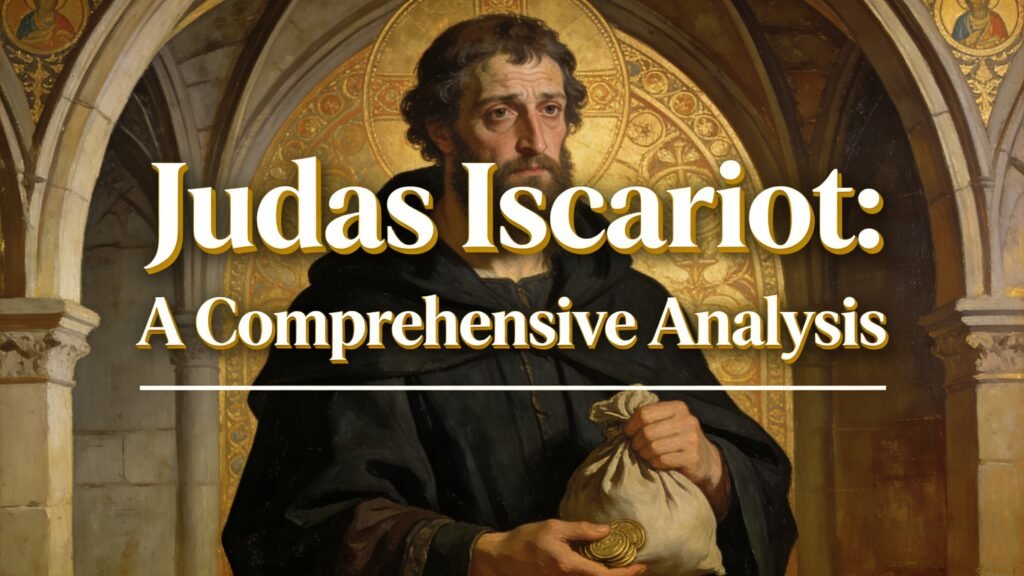
In medieval art, Judas was typically depicted with distinctive characteristics that marked him as the betrayer. He was often shown with red hair, which in medieval symbolism represented sin and treachery . In depictions of the Last Supper, he was usually positioned separately from the other disciples, often shown with a moneybag or holding the infamous thirty pieces of silver. Artists like Leonardo da Vinci in Judas Iscariot’s famous fresco “The Last Supper” (1495-1498) used careful composition to single out Judas, who is shown clutching his moneybag and leaning away from Jesus .
The “Kiss of Judas” has been another popular subject in Christian art, portrayed by artists from Giotto di Bondone in the 14th century to Caravaggio in the 17th century. These paintings often emphasize the dramatic contrast between the intimate gesture of the kiss and the betrayal it represents. Giotto’s fresco in the Scrovegni Chapel (c. 1306) captures the moment of betrayal with intense emotional drama, showing Judas embracing Jesus while soldiers close in around them .
In literature, Judas has appeared in works from Dante’s “Divine Comedy” to modern novels and plays. In Dante’s Inferno, Judas is portrayed as being chewed eternally by Lucifer in the lowest circle of hell, alongside Brutus and Cassius as the three greatest traitors in history . This depiction established Judas as the ultimate symbol of betrayal in Western literature.
Theater has also played a significant role in shaping Judas’s cultural image. Shakespeare’s plays contain numerous references to Judas, and Judas Iscariot’s influence can be seen in characters like Iago in “Othello” and Edmund in “King Lear.” The playwright John Webster included a character named Judas Iscariot in his play “The White Devil,” using him as a symbol of ultimate evil.
In modern times, Judas has appeared in a variety of literary and artistic contexts that challenge traditional interpretations. The 20th-century Russian writer Leonid Andreyev wrote a novel titled “Judas Iscariot” that presents a sympathetic portrayal of the betrayer, suggesting that he may have been acting out of a misguided attempt to fulfill God’s plan .
7.2 Popular Culture and Modern Interpretations
In contemporary popular culture, Judas Iscariot continues to be a fascinating and controversial figure. He has appeared in numerous films, television shows, and music videos, often portrayed in ways that challenge traditional Christian interpretations.
In film, Judas has been depicted by actors in productions ranging from Cecil B. DeMille’s “The King of Kings” (1927) to Mel Gibson’s “The Passion of the Christ” (2004). These portrayals vary widely in their interpretation of Judas’s character and motivations. Some films emphasize Judas Iscariot’s greed and villainy, while others attempt to humanize him, suggesting complex motivations for his actions.
The musical “Jesus Christ Superstar” (1970) by Andrew Lloyd Webber and Tim Rice presents a particularly sympathetic portrayal of Judas. The character is given several songs that express Judas Iscariot’s confusion and conflict about Jesus’ mission, suggesting that his betrayal was motivated by concern for Jesus rather than simple greed. This interpretation has been influential in popular culture, introducing many people to a more complex understanding of Judas.
Television series and miniseries have also explored Judas’s story in detail. The 2013 miniseries “The Bible” and the 2017 series “The Chosen” both present Judas as a complex character with motivations that go beyond simple villainy. These modern interpretations often emphasize Judas Iscariot’s humanity, showing his internal struggles and the pressures that led to his betrayal.
In music, Judas has been the subject of numerous songs and albums. From classical compositions like Handel’s “Messiah” to contemporary Christian music, Judas’s story has inspired countless musical works. Some songs portray him as the ultimate sinner, while others explore themes of redemption and forgiveness.
The influence of Judas’s story extends beyond religious contexts into general popular culture. The term “Judas” is commonly used to refer to any betrayer, and phrases like “kiss of Judas” and “thirty pieces of silver” are part of everyday language. This cultural penetration demonstrates the lasting impact of Judas’s story on Western civilization.
7.3 Theological Implications for Modern Christianity
The story of Judas Iscariot continues to have profound theological implications for modern Christianity, particularly in areas such as forgiveness, redemption, and the nature of discipleship. Judas Iscariot’s story challenges Christians to examine their own hearts and consider how they might betray Christ in their daily lives.
One of the most significant theological implications of Judas’s story is the question of who can be forgiven. If Judas, who committed the ultimate betrayal, could have been forgiven, then no sin is beyond God’s grace. However, Judas’s failure to seek forgiveness and Judas Iscariot’s choice to take his own life suggest that forgiveness, while available to all, must be received through repentance and faith .
Judas’s story also provides a powerful warning about the dangers of spiritual pride and the importance of remaining vigilant against temptation. The fact that he was one of Jesus’ closest disciples who had witnessed Judas Iscariot’s miracles and heard his teachings makes his betrayal all the more tragic. It serves as a reminder that even those who are most familiar with God’s truth are not immune to sin and betrayal.
The question of Judas’s election and betrayal has also influenced modern discussions about predestination and free will. Many contemporary theologians argue that Judas’s story demonstrates both God’s sovereignty and human responsibility. While God foreknew and permitted the betrayal, Judas remained responsible for Judas Iscariot’s choice. This understanding allows for both divine providence and human freedom, maintaining the integrity of both God’s character and human moral agency.
Judas’s role in the fulfillment of prophecy has implications for how Christians understand the relationship between the Old and New Testaments. Judas Iscariot’s betrayal and the subsequent events fulfill multiple Old Testament prophecies, demonstrating the continuity between God’s promises and their fulfillment in Christ. This has strengthened the Christian understanding of Scripture as a unified whole with Christ at its center.
The discovery of the Gospel of Judas has also had an impact on modern Christian theology, though not in the way its discoverers might have hoped. Rather than challenging traditional Christian beliefs, the Gospel of Judas has reinforced the importance of the canonical Scriptures and the apostolic tradition. It has also highlighted the value of critical scholarship in distinguishing between authentic Christian tradition and later innovations.
In practical terms, Judas’s story continues to be used in Christian preaching and teaching as a cautionary tale about the consequences of sin and the importance of remaining faithful to Christ. Judas Iscariot’s tragic end serves as a reminder of what can happen when one turns away from God, while his initial calling and election offer hope that no one is beyond God’s reach.
8. Conclusion: The Enduring Enigma of Judas Iscariot
8.1 Summary of Key Findings
This comprehensive analysis of Judas Iscariot has revealed a figure of extraordinary complexity whose story continues to challenge and fascinate scholars and believers alike. The evidence examined across multiple disciplines—biblical studies, theology, history, art history, and cultural studies—presents a portrait far more nuanced than the one-dimensional villain of popular imagination.
The historical evidence confirms that Judas Iscariot was indeed one of Jesus’ twelve apostles, chosen by Jesus himself despite his foreknowledge of the betrayal. As the group’s treasurer, Judas held a position of significant responsibility and trust, though his dishonest dealings with the common purse reveal a character already compromised by greed . Judas Iscariot’s decision to betray Jesus for thirty pieces of silver represents a tragic culmination of his moral decline, though the exact motivations remain complex and multifaceted.
Theological analysis has shown that Judas’s story touches upon fundamental questions about the nature of God, human freedom, and the problem of evil that continue to challenge Christian thought. The paradox of Judas Iscariot’s election and betrayal, foreknown by God yet freely chosen by Judas, remains one of the great mysteries of the faith . The biblical accounts, while diverse in their details, consistently present Judas as both a sinner deserving condemnation and a participant in God’s redemptive plan.
Modern scholarship, particularly the discovery of the Gospel of Judas and advances in historical-critical methods, has enriched our understanding of this complex figure. While these developments have not overturned traditional Christian interpretations, they have highlighted the diversity of early Christian thought and the various ways in which Judas has been understood throughout history .
The cultural impact of Judas Iscariot’s story has been profound and lasting. From medieval art to modern cinema, from classical literature to contemporary music, Judas has served as a symbol of betrayal and treachery while also inspiring works that explore themes of redemption and forgiveness. Judas Iscariot’s name has become part of the cultural lexicon, representing the ultimate act of betrayal in Western civilization .
8.2 Ongoing Scholarly Debates and Future Research Directions
Despite centuries of study, many questions about Judas Iscariot remain unanswered, and new scholarly debates continue to emerge. The relationship between the canonical and non-canonical accounts of Judas’s life and betrayal remains a fertile area for research, particularly as new texts and archaeological evidence continue to be discovered.
One area that deserves further exploration is the historical context of Judas’s betrayal. The political and social tensions of first-century Judea, particularly the expectations surrounding the Messiah and the various responses to Roman occupation, may provide important clues about Judas’s motivations. Recent archaeological discoveries and advances in understanding first-century Judaism offer new opportunities to reconstruct the historical context in which Judas made Judas Iscariot’s fateful decision.
The psychological and sociological dimensions of Judas’s story also warrant further study. Modern psychological theories and social scientific methods may help us understand the complex factors that led to Judas’s betrayal. Questions about Judas Iscariot’s mental state, his relationships with other disciples, and his social position within the early Christian community remain largely unexplored by modern scholarship.
Theological questions raised by Judas’s story continue to generate debate among scholars and theologians. The relationship between divine foreknowledge and human freedom, the nature of sin and redemption, and the possibility of universal salvation are all issues that Judas’s story brings to the forefront. These debates are likely to continue as new interpretations and perspectives emerge.
The use of digital humanities tools and methods offers new possibilities for studying Judas Iscariot. Computer-assisted analysis of biblical texts, digital archaeological databases, and collaborative research platforms may reveal patterns and connections that traditional methods have missed.
The intersection of Judas studies with other areas of biblical scholarship also presents opportunities for future research. How do Judas’s story and the themes it raises relate to other biblical narratives of betrayal and redemption? What can we learn about the historical reliability of the Gospels from their varying accounts of Judas? How did different early Christian communities understand and interpret Judas’s role in salvation history?
8.3 Theological Reflections and Contemporary Relevance
The story of Judas Iscariot remains remarkably relevant for contemporary Christianity and religious thought more broadly. Judas Iscariot’s tragic journey from chosen disciple to betrayer offers profound lessons about the nature of faith, the reality of sin, and the possibility of redemption that continue to challenge and inspire believers today.
One of the most significant contemporary applications of Judas’s story is its warning about the dangers of spiritual pride and the importance of humility. Judas’s fall from grace demonstrates that even those closest to God are not immune to temptation and that constant vigilance and reliance on God’s grace are essential for maintaining faithfulness.
The question of Judas’s possible redemption also has important implications for contemporary discussions about the nature of God’s love and mercy. While traditional interpretations have condemned Judas to eternal punishment, the possibility of Judas Iscariot’s redemption—however remote—opens up questions about the boundaries of God’s grace and the ultimate destiny of all humanity.
Judas’s story also provides a powerful lens through which to examine contemporary issues of betrayal and reconciliation. In a world marked by political betrayals, religious scandals, and personal treacheries, the story of Judas offers both warning and hope. It warns against the destructive power of betrayal while also pointing toward the possibility of forgiveness and new beginnings.
Theological reflections on Judas’s story also connect to contemporary concerns about social justice and the treatment of the marginalized. The fact that Judas was the only Judean among Galilean disciples raises questions about the role of social and cultural differences in creating division and betrayal. These themes have important implications for contemporary Christian communities struggling with issues of diversity, inclusion, and reconciliation.
Finally, Judas’s story reminds us of the importance of examining our own hearts and motives. In what ways might we be betraying Christ in our own lives—through our actions, our attitudes, or our priorities? The story challenges us to be honest about our own capacity for betrayal while also trusting in God’s grace to transform and redeem us.
The enigma of Judas Iscariot will likely continue to fascinate and perplex scholars, theologians, and believers for centuries to come. Judas Iscariot story, with its complex interplay of divine sovereignty and human freedom, of sin and grace, of betrayal and redemption, touches upon the deepest mysteries of faith. In the end, perhaps the greatest lesson we can learn from Judas Iscariot is the importance of humility, the reality of our own sinfulness, and the boundless nature of God’s love and mercy.
As we continue to study and reflect on the life and legacy of Judas Iscariot, we are reminded that even the darkest stories can point toward light, that even the deepest betrayals can be transformed by grace, and that the God who raised Jesus from the dead is able to bring life out of death in ways beyond our understanding. In this paradox lies both the tragedy of Judas and the hope of the gospel.