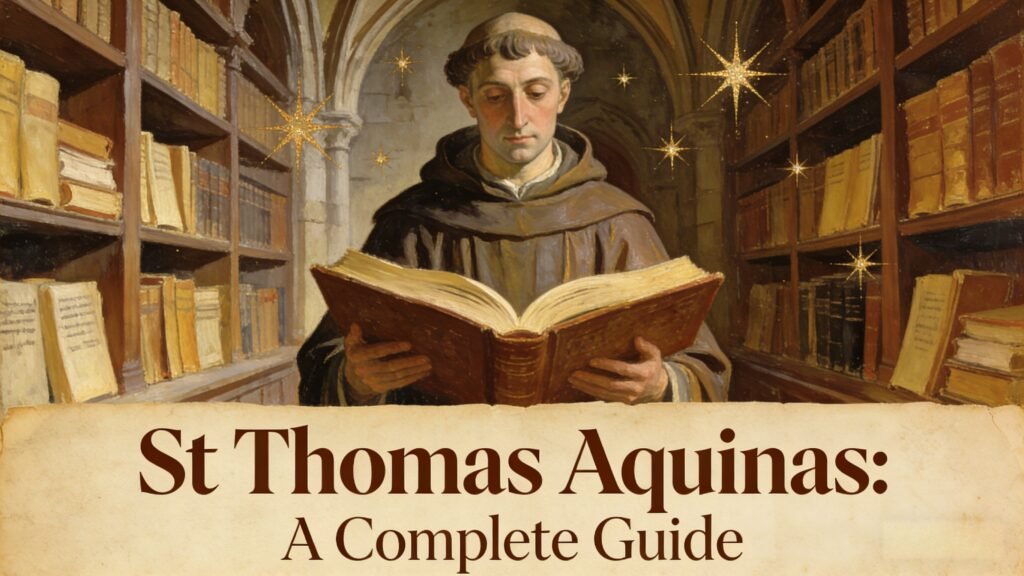
St Thomas Aquinas: A Complete Guide
St Thomas Aquinas is one of the most influential figures in Western intellectual and religious history, a medieval Dominican friar whose work continues to shape Catholic doctrine, philosophical discourse, and ethical thought nearly eight centuries after his death. Known as the “Angelic Doctor,” he dedicated his life to synthesizing Christian theology with Aristotelian philosophy, creating a systematic framework that remains foundational to Catholic education and scholarly inquiry worldwide. Born in 1225 in Roccasecca, Italy, his contributions to theology, philosophy, and ethics have made him a central figure in both Catholic tradition and Western intellectual history. From his early education to his final mystical experiences, he pursued truth with unwavering rigor, and his works—especially the Summa Theologica—have ensured his enduring relevance for scholars, believers, and seekers alike. The Catholic Church has long celebrated him as a Doctor of the Church, recognizing his profound impact on Christian thought and his ability to reconcile faith and reason in a way that still resonates today.
This comprehensive guide explores the life, teachings, and enduring legacy of St Thomas Aquinas, delving into his early years, academic journey, major works, and the profound influence he has had on Catholicism, philosophy, and Western civilization. More than just a historical figure, he is a thinker whose ideas continue to address contemporary questions of morality, faith, and reason. Whether examining his five proofs for God’s existence, his natural law theory, or his prayers and devotions, this article will provide a thorough, accessible overview of his life and work, ensuring that the core keyword is woven naturally throughout, without disrupting the flow of ideas or compromising academic integrity. By the end of this guide, readers will have a deep understanding of who he was, what he is known for, and why he remains relevant in the 21st century.
1. St Thomas Aquinas: Early Life and Formative Years
1.1 Noble Origins and Family Background
St Thomas Aquinas was born around 1225 in Roccasecca, a hilltop castle in the Kingdom of Sicily (modern-day Lazio, Italy). He came from a distinguished noble family with strong political connections: his father, Count Landulf of Aquino, served as a knight for Emperor Frederick II, and his mother, Theodora, was the Countess of Teano, a member of the Neapolitan nobility. The youngest of at least nine children, his noble birth initially set him on a path toward a prestigious career in the Church—one that his family hoped would bring honor and influence to the Aquino name. St Thomas Aquinas’s family’s alignment with the imperial faction in the ongoing tensions between the papacy and the Holy Roman Empire would later influence his thinking on the relationship between temporal and spiritual authority, a theme that would appear repeatedly in his writings. Even in his early years, he showed signs of intellectual curiosity, often asking profound questions about God and the nature of reality—questions that would define his life’s work.
1.2 Education at Monte Cassino
At the age of five, following the custom of noble families in the 13th century, he was sent to the Benedictine monastery at Monte Cassino. St Thomas Aquinas’s parents intended for him to eventually become the abbot of this prestigious monastery, which was one of the most important centers of learning in medieval Europe. Monte Cassino’s vast library and scholarly community provided him with a comprehensive education in the liberal arts, including the trivium (grammar, rhetoric, logic) and the quadrivium (arithmetic, geometry, music, astronomy). He thrived in this environment, and his instructors were often astonished by his intellectual depth—especially when he asked, “What is God?” during a lesson, a question that revealed the philosophical curiosity that would drive him throughout his life. He spent nine years at Monte Cassino, building the foundation for the rigorous intellectual work he would pursue later. However, in 1239, political conflict disrupted his education: Emperor Frederick II, in dispute with Pope Gregory IX, expelled the Benedictine monks from Monte Cassino, forcing him to return to his family’s castle in Roccasecca.
1.3 The Dominican Calling at the University of Naples
After leaving Monte Cassino, he enrolled in the University of Naples, a new institution founded by Emperor Frederick II in 1224. Unlike traditional monastic schools, the University of Naples embraced the “new” Aristotelian texts being translated from Arabic and Greek into Latin—a development that would profoundly shape his philosophical outlook. At Naples, he encountered a vibrant intellectual community that encouraged critical thinking and the integration of philosophy and theology. It was here that he experienced a life-changing calling: he decided to join the Dominican Order, a new mendicant order dedicated to preaching, teaching, and poverty. St Thomas Aquinas’s decision shocked his family, who had envisioned a prestigious ecclesiastical career for him, not a life of simplicity as a Dominican friar. St Thomas Aquinas’s brothers responded by kidnapping him as he traveled to Rome to join the Dominicans, imprisoning him in the family castle for over a year. During his captivity, he remained steadfast in his vocation: he rejected worldly temptations, including an attempt to compromise his chastity, and continued to study and pray. St Thomas Aquinas’s unwavering commitment eventually persuaded his family to release him, and in 1244, he officially joined the Dominican Order, dedicating his life to scholarly pursuit and service to the Catholic Church.
2. St Thomas Aquinas: Academic Career and Scholarly Development
2.1 Studies with Albert the Great in Cologne
After joining the Dominicans, he was sent to Paris to study, but his superiors soon redirected him to Cologne to learn under Albert the Great (Albertus Magnus), one of the most renowned scholars of the time. Albert the Great was a pioneer in integrating Aristotelian philosophy with Christian theology—an approach that perfectly aligned with his intellectual interests. Under Albert’s guidance, he deepened his understanding of Aristotelian thought, studying works on metaphysics, ethics, and natural philosophy. St Thomas Aquinas’s quiet demeanor and large physical build earned him the nickname “the Dumb Ox” among his fellow students, who underestimated his intellectual abilities. But Albert the Great recognized his genius, declaring, “We call him the Dumb Ox, but his bellowing will resound throughout the world.” He studied with Albert from 1248 to 1252, developing the methodological approach that would define his work: rigorous logical analysis combined with deep theological insight. During this time, he also began to formulate his ideas on faith and reason, arguing that the two are complementary, not contradictory—a central tenet of his thought that would revolutionize Catholic theology.
2.2 Return to Paris and Theological Mastery
In 1252, he returned to Paris to pursue a doctorate in theology at the University of Paris, one of the most prestigious academic institutions in medieval Europe. Despite being two years younger than the minimum age requirement, he was admitted on Albert the Great’s recommendation, a testament to his exceptional abilities. He spent four years as a bachelor of theology, lecturing on the Bible and Peter Lombard’s Sentences, a foundational text in medieval theology. During this period, he engaged in rigorous academic disputations, defending his ideas against critics and refining his theological framework. In 1256, he received his doctorate and was appointed a master of theology at the University of Paris—a remarkable achievement for someone so young, especially during a time of tension between mendicant orders and the secular clergy. He served as a professor in Paris until 1259, during which time he began work on his first major theological text, the Commentary on the Sentences, which established him as a leading systematic theologian. St Thomas Aquinas’s time in Paris also allowed him to engage with other scholars, further shaping his ideas on metaphysics, ethics, and the relationship between God and humanity.
2.3 Work in Italy and the Papal Court
In 1259, the Dominican Order transferred him back to Italy, which rotated scholars through different positions to spread knowledge and strengthen the order’s intellectual influence. He first served in Orvieto, where he taught at a Dominican studium and advised Pope Urban IV. It was in Orvieto that he began work on his most ambitious project: the Summa Theologica, a comprehensive systematic theology that would become his greatest legacy. He intended the Summa Theologica to be a guide for theology students, synthesizing Christian doctrine with philosophical reasoning in a clear, accessible way. From Orvieto, he moved to Rome, where he taught at the Dominican monastery of Santa Sabina from 1265 to 1267. In Rome, he continued work on the Summa Theologica and also began writing commentaries on Aristotle’s works, including the Nicomachean Ethics and the Metaphysics. These commentaries were crucial for making Aristotelian philosophy accessible to Christian scholars, and they solidified his reputation as a master of both philosophy and theology. St Thomas Aquinas’s work in Rome also brought him closer to the papal court, where he advised popes on theological and philosophical matters, further elevating his influence within the Catholic Church.
2.4 Second Term in Paris and the Averroist Controversy
In 1268, he was recalled to Paris for a second term as a professor of theology, tasked with addressing a growing theological controversy known as Latin Averroism. The Averroists, following the Islamic philosopher Averroës, argued for a “double truth” doctrine: that philosophical truth and religious truth could be contradictory, with reason leading to one conclusion and faith to another. This idea threatened to split faith and reason, a split that he vehemently opposed. He dedicated his second term in Paris to refuting Averroism, arguing that faith and reason are complementary paths to the same truth—truth that ultimately comes from God. He used his deep knowledge of Aristotelian philosophy and Christian theology to demonstrate that reason, when properly employed, supports faith, and that faith does not contradict reason. During this time, he also continued work on the Summa Theologica, expanding his treatment of natural law, ethics, and Christology. St Thomas Aquinas’s refutation of Averroism was a pivotal moment in medieval intellectual history, as it preserved the integration of faith and reason that would define Western Christian thought. St Thomas Aquinas’s work during this period also further established him as the leading theologian of his time, with scholars from across Europe traveling to Paris to study with him.
3. St Thomas Aquinas: Final Years, Mystical Experience, and Death
3.1 Return to Naples and the End of St Thomas Aquinas’s Writing
In 1272, he returned to Italy once more, this time to Naples, where he was appointed professor at the Dominican studium generale. He was eager to complete the Summa Theologica, which he had been working on for nearly a decade, and he dedicated himself to finishing this monumental work. However, on December 6, 1273, during a Mass at the Dominican monastery in Naples, he experienced a profound mystical vision that changed everything. After this vision, he ceased all writing, telling his secretary, “All that I have written seems to me like straw compared with what has now been revealed to me.” This mystical experience marked a dramatic shift in his life: he turned away from intellectual work and focused entirely on spiritual contemplation, recognizing that divine mystery transcends human reason. St Thomas Aquinas’s decision to stop writing shocked his colleagues, who begged him to continue the Summa Theologica, but he remained firm, believing that his intellectual work was insignificant compared to the divine truth he had glimpsed. For the remaining months of his life, he dedicated himself to prayer and meditation, living out the spiritual ideals he had written about throughout his career.
3.2 Journey to the Second Council of Lyons and St Thomas Aquinas’s Death
In early 1274, Pope Gregory X summoned him to attend the Second Council of Lyons, hoping to benefit from his wisdom in resolving theological disputes and uniting the Church. Despite his declining health, he agreed to travel to Lyons, recognizing his duty to serve the Catholic Church. However, during his journey, he fell seriously ill, likely from a combination of exhaustion and illness. He was forced to stop at the Cistercian monastery of Fossanova, located approximately twenty miles from his birthplace of Roccasecca. At Fossanova, the Cistercian monks cared for him, and he spent his final days in prayer and contemplation. On March 7, 1274, at the age of 49, he died peacefully, surrounded by the monks. St Thomas Aquinas’s last words were reported to be, “I receive Thee, ransom of my soul. For love of Thee have I studied and kept vigil, toiled, preached, and taught.” St Thomas Aquinas’s death was mourned throughout the Church and the scholarly community, as many recognized that the world had lost one of its greatest intellectual and spiritual giants. Even in his final moments, he exemplified the virtues he had taught: humility, piety, and a deep love for God. St Thomas Aquinas’s death marked the end of a life dedicated to truth, but it was only the beginning of his enduring legacy.
3.3 Canonization and Recognition as a Doctor of the Church
Shortly after his death, reports of miracles attributed to his intercession began to circulate. Believers from across Europe prayed to him, and many claimed to have been healed or blessed through his prayers. In 1319, the Catholic Church initiated a formal canonization process for him, examining his life, works, and the miracles attributed to him. On July 18, 1323, Pope John XXII officially declared him a saint, recognizing his holiness, intellectual brilliance, and dedication to the Church. This canonization was a testament to the profound impact he had on the Catholic faith, even in the decades following his death. In 1567, Pope Pius V elevated him to the rank of Doctor of the Church, a title reserved for the Church’s greatest theologians, alongside Ambrose, Augustine, Jerome, and Gregory the Great. This recognition solidified his position as one of the most authoritative voices in Catholic theology. The pinnacle of his official recognition came in 1879, when Pope Leo XIII, in his encyclical Aeterni Patris, declared Thomism—his philosophical and theological system—the official philosophy of the Catholic Church. This encyclical called for a revival of his teachings in seminaries and universities worldwide, ensuring that his ideas would continue to shape Catholic education and thought for generations to come.
4. St Thomas Aquinas: Philosophical Contributions
4.1 Metaphysics: Being and Essence
At the core of his philosophical system is his groundbreaking distinction between being (esse) and essence (essentia)—a distinction that revolutionized Western metaphysics. He argued that in all created beings, there is a real difference between what a thing is (its essence) and that it is (its existence). For example, he noted that we can understand the essence of a unicorn (a horse with a horn) without knowing whether unicorns actually exist. This ability to separate essence from existence demonstrates that the two are distinct in finite beings. He further argued that only God is a being whose essence is identical to its existence—God is “being itself” (ipsum esse subsistens). All other beings participate in existence; they have being but are not identical to being. This metaphysical framework is central to his understanding of God and creation, as it explains how finite beings depend on God, the source of all being. He also developed the concepts of substance and accident to further explain the nature of reality: substances are independent beings (like a human or a tree), while accidents are properties that exist only in substances (like color or size). This distinction allowed him to explain how things can change while remaining the same—for example, a person can grow taller (an accidental change) but still be the same person (substantially). St Thomas Aquinas’s metaphysics remains one of his most influential contributions to philosophy, shaping the work of countless thinkers in the centuries since.
4.2 Integration of Aristotelian Philosophy
St Thomas Aquinas is famous for his masterful integration of Aristotelian philosophy with Christian theology—a synthesis that became known as Thomism. Unlike some of his contemporaries who rejected Aristotelian thought as incompatible with Christianity, he recognized the value of Aristotle’s ideas and sought to adapt them to a Christian framework. He adopted Aristotle’s key concepts, including form and matter, act and potency, and the four causes (material, formal, efficient, final), but he transformed them to reflect Christian beliefs. For example, he used Aristotle’s concept of the unmoved mover to support his argument for God’s existence, but he identified this unmoved mover as the Christian God, who is both the creator and sustainer of the universe. He also rejected Aristotle’s belief in the eternity of the world, arguing instead that the world was created by God ex nihilo (out of nothing)—a central Christian doctrine. One of the most important aspects of his Aristotelian synthesis is his understanding of the human person as a unity of body and soul. Following Aristotle, he viewed the soul as the form of the body, rejecting Platonic dualism (which sees body and soul as separate entities). This hylomorphic (body-soul unity) view allowed him to affirm the goodness of the material world while also defending the immortality of the soul—a key Christian belief. St Thomas Aquinas’s integration of Aristotelian philosophy made ancient wisdom accessible to Christian scholars and laid the foundation for Western intellectual thought.
4.3 Natural Theology: The Five Ways
St Thomas Aquinas’s natural theology—his attempt to demonstrate God’s existence through reason alone—is one of his most famous contributions to philosophy and theology. In the Summa Theologica, he presented five arguments (known as the Five Ways) to prove God’s existence, each starting from observable facts about the natural world and leading to the conclusion that God exists. The first way is the argument from motion: he observed that things in the world are in motion, and whatever is moved must be moved by another. Since an infinite regress of movers is impossible, there must be a first unmoved mover—God. The second way is the argument from efficient causation: nothing can cause itself, so every effect has a cause, and this chain of causes must end with a first uncaused cause—God. The third way is the argument from contingency and necessity: some things are contingent (they can exist or not exist), but if everything were contingent, there would have been a time when nothing existed. Since nothing comes from nothing, there must be a necessary being that exists of its own nature—God. The fourth way is the argument from gradations of perfection: we observe degrees of goodness, truth, and nobility in the world, and these gradations imply a maximum standard—God, the perfect being. The fifth way is the argument from design: natural objects act toward ends even without intelligence (e.g., acorns grow into oak trees), which suggests an intelligent designer—God. These Five Ways remain some of the most influential arguments for God’s existence, and they continue to be studied and debated by philosophers and theologians today. St Thomas Aquinas’s natural theology demonstrates his belief that reason can lead us to knowledge of God, even without divine revelation.
4.4 On Faith and Reason
One of his most important teachings is the relationship between faith and reason. He firmly believed that faith and reason are not contradictory but complementary paths to truth. For him, there are two sources of knowledge: natural reason (which can discover truths about the natural world and some truths about God) and divine revelation (which reveals supernatural truths that reason alone cannot grasp). He argued that reason can demonstrate certain truths about God, such as God’s existence (through the Five Ways), but other truths—like the Trinity, the Incarnation, and the Resurrection—can only be known through faith in divine revelation. However, he emphasized that these revealed truths do not contradict reason; instead, they complete and perfect what reason can discover. He summed up this idea with the phrase, “Grace does not destroy nature but perfects it.” This means that supernatural grace builds on human nature, enhancing our ability to know and love God. St Thomas Aquinas’s teaching on faith and reason was revolutionary because it defended the value of human reason within a Christian framework, countering those who rejected reason in favor of blind faith. He argued that studying philosophy and science is not a threat to faith but a way to deepen our understanding of God’s creation. This teaching allowed him to integrate ancient philosophy with Christian theology and laid the groundwork for the development of Western science and intellectual thought.
4.5 Ethics and Natural Law Theory
St Thomas Aquinas’s ethical philosophy is grounded in his understanding of human nature and natural law. For him, natural law is “the rational creature’s participation in the eternal law”—God’s perfect plan for the universe. He defined the first principle of natural law as “do good and avoid evil,” a principle that he believed is self-evident to human reason. From this first principle, he derived other moral principles, such as the duty to preserve life, to seek knowledge, to form families, and to live in community. He identified four types of law: eternal law (God’s plan for creation), natural law (human participation in eternal law through reason), human law (laws made by humans to implement natural law), and divine law (revealed by God in Scripture to guide human behavior). He argued that human laws are just only if they are consistent with natural law; if a human law contradicts natural law, it is not a true law and should be disobeyed. He also developed a virtue ethics based on Aristotle’s teachings, identifying two types of virtues: natural virtues (prudence, justice, fortitude, temperance) and theological virtues (faith, hope, charity). The natural virtues perfect human nature and can be developed through practice, while the theological virtues are gifts from God that direct us toward our ultimate end in God. St Thomas Aquinas’s natural law theory has had a profound influence on Western ethics and law, shaping concepts of human rights, justice, and moral obligation. St Thomas Aquinas’s ethics remains relevant today, as it provides a framework for addressing complex moral issues with reason and compassion.
4.6 Political Philosophy
St Thomas Aquinas’s political philosophy, developed primarily in his work De Regno (On Kingship), addresses the nature of political authority, the purpose of government, and the relationship between temporal and spiritual power. For him, the state exists to promote the common good—the well-being of all its citizens—and to help people develop virtue. He argued that government is a natural institution, arising from human social nature; humans are not meant to live alone but in communities. Political authority, according to him, derives from God through natural law, but it is also dependent on the consent of the governed. He recognized that different forms of government (monarchy, aristocracy, democracy) can be legitimate, but the best form of government is a just monarchy—one where the ruler acts for the common good, not for personal gain. He also developed a theory of just war, outlining criteria for when war is morally permissible: just cause (defending against injustice), legitimate authority (declared by a proper ruler), right intention (seeking peace, not revenge or conquest), and proportionality (the harm caused by war must not exceed the good achieved). This just war theory has influenced international law and ethical discussions about war and peace for centuries. He also addressed the relationship between Church and state, arguing that spiritual authority (the Church) and temporal authority (the state) have different roles but are both subject to God’s law. He believed that the Church should guide the state in moral matters, but the state should not interfere in spiritual affairs. This separation of powers, while different from modern concepts, laid the groundwork for understanding the relationship between religion and government.
5. St Thomas Aquinas: Theological Contributions
5.1 Christology: The Incarnation
St Thomas Aquinas’s Christology—the study of Jesus Christ—is a central part of his theological system. He focused on the hypostatic union: the union of divine and human natures in the one person of Jesus Christ. He rejected two heresies: Nestorianism (which claimed there are two separate persons in Christ) and Monophysitism (which denied Christ’s true humanity). Instead, he taught that Christ is one person with two distinct natures—fully divine and fully human. For him, the Incarnation is God’s way of reconciling humanity to himself: by becoming human, God shared in our nature, suffered for our sins, and opened the way to salvation. He argued that Christ’s divine nature is the same as the Father’s (as taught in the Trinity), while his human nature is like ours, except without sin. He also wrote about Christ’s knowledge: he taught that Christ possessed both divine knowledge (knowing all things) and human knowledge (learning and growing like other humans), with his human intellect perfected by the beatific vision (direct contemplation of God) from the moment of his conception. His Christology also addresses Christ’s mission: to save humanity from sin and restore us to communion with God. He emphasized that Christ’s death and resurrection are the central events of salvation history, and that through faith in Christ, we receive grace and eternal life. St Thomas Aquinas’s treatment of the Incarnation is notable for its clarity and precision, using philosophical concepts to explain a profound theological mystery without reducing its depth. St Thomas Aquinas’s Christology remains a foundational text for Catholic teaching on Jesus Christ.
5.2 Sacramentology: Instruments of Grace
St Thomas Aquinas’s sacramentology—the study of the sacraments—is a systematic treatment of how God communicates grace to humanity through visible signs. He affirmed the Catholic teaching of seven sacraments: baptism, confirmation, the Eucharist, penance, anointing of the sick, holy orders, and matrimony. For him, a sacrament is “an outward sign instituted by Christ to give grace.” Each sacrament has a specific matter (the physical element, like water for baptism) and form (the words spoken, like the baptismal formula), and both are essential for the sacrament to be valid. He taught that sacraments are not just symbols; they are effective instruments of grace, through which God actually gives the grace they signify. For example, baptism removes original sin and incorporates us into the Church, while the Eucharist nourishes our spiritual life and unites us with Christ and one another. The Eucharist holds a special place in his sacramentology: he defended the doctrine of transubstantiation, which teaches that the bread and wine become the body and blood of Christ, while retaining the appearance of bread and wine. He used his metaphysical distinction between substance and accident to explain transubstantiation: the substance of the bread and wine is replaced by the substance of Christ’s body and blood, but the accidents (color, taste, texture) remain. He also wrote about the other sacraments: confirmation strengthens the grace of baptism, penance restores grace after sin, anointing of the sick brings comfort and healing, holy orders ordains men to serve the Church, and matrimony is a covenant between a man and a woman, blessed by God. St Thomas Aquinas’s sacramentology remains central to Catholic teaching, explaining how God works through material signs to sanctify us.
5.3 Mariology: The Blessed Virgin Mary
St Thomas Aquinas’s mariology—the study of the Blessed Virgin Mary—reflects his commitment to integrating Scripture, tradition, and reason. He emphasized Mary’s role as the Mother of God (Theotokos), arguing that she is truly the mother of the person of Christ, who is both God and man. This title is central to his mariology, as it affirms Mary’s unique place in salvation history. He also wrote about Mary’s sinlessness: while he did not explicitly teach the doctrine of the Immaculate Conception (which was later defined in 1854), he believed that Mary was sanctified in the womb and lived a sinless life, filled with grace. He argued that Mary’s sinlessness was necessary because she was the mother of God; she could not be stained by sin if she was to bear the Son of God. He also defended Mary’s perpetual virginity, teaching that she remained a virgin before, during, and after Christ’s birth. He explained that Christ’s birth was a miracle, allowing Mary to retain her physical virginity while giving birth to the Son of God. He also wrote about Mary’s role as a model of faith and virtue: he saw Mary as the perfect disciple, who obeyed God’s will and trusted in his plan. St Thomas Aquinas’s mariology also includes prayers to Mary, and he believed that Mary intercedes for us before God. While his mariology is not as extensive as some later theologians, it laid the groundwork for Catholic teaching on Mary, emphasizing her dignity and her role in salvation.
5.4 Eschatology: The Four Last Things
St Thomas Aquinas’s eschatology—the study of the last things (death, judgment, heaven, hell)—is a comprehensive treatment of what happens after death. He taught that death is the separation of body and soul, but it is not the end of human existence. After death, each person undergoes a particular judgment, where God judges their actions and determines their eternal fate. He distinguished between the particular judgment (immediately after death) and the general judgment (at the end of time), when Christ will return, the dead will be resurrected, and all human actions will be publicly revealed. He described heaven as the state of perfect happiness, where the blessed enjoy the beatific vision—the direct contemplation of God. This vision, according to him, is the ultimate end of human life, the fulfillment of all our desires. He taught that hell is the state of eternal separation from God, where the damned experience both the pain of loss (being separated from God) and the pain of sense (physical and spiritual suffering). He also wrote about purgatory, a state of purification for those who die in God’s grace but still have venial sins or temporal punishment due for mortal sins. In purgatory, he taught, souls are cleansed so that they can enter heaven, pure and holy. He also affirmed the resurrection of the body, teaching that at the general judgment, the souls of the dead will be reunited with their bodies, which will be transformed and perfected. This teaching reflects his hylomorphic view of human nature, which sees body and soul as a unity. St Thomas Aquinas’s eschatology provides hope for believers, reminding us that our earthly life is a preparation for eternal life with God.
5.5 Trinitarian Theology
St Thomas Aquinas’s Trinitarian theology—the study of the Trinity (Father, Son, Holy Spirit)—is a sophisticated synthesis of biblical revelation and philosophical reasoning. He taught that God is one in essence and three in persons, a mystery that can be known through divine revelation but cannot be fully understood by human reason. He used the concept of subsistent relations to explain the Trinity: the Father, Son, and Holy Spirit are distinct persons, defined by their relations to one another. The Son is begotten of the Father (generation), and the Holy Spirit proceeds from the Father and the Son (spiration). He emphasized that these relations are not accidents but are part of God’s very essence. To help explain the Trinity, he used a psychological analogy: the generation of the Son from the Father is like the formation of a concept in the intellect (the Father is like the mind, the Son is like the idea), and the procession of the Holy Spirit is like the movement of love from the will (the Holy Spirit is like the love between the Father and the Son). This analogy is not perfect, but it helps to illustrate the unity and distinction within the Trinity. He also connected Trinitarian theology to Christology and soteriology: the Son’s mission (Incarnation) and the Holy Spirit’s mission (sanctification) reveal the eternal relations within the Trinity and accomplish the work of salvation. St Thomas Aquinas’s Trinitarian theology is notable for its clarity and precision, avoiding heresies while affirming the mystery of the Trinity. St Thomas Aquinas’s teaching on the Trinity remains central to Catholic doctrine, helping believers to understand the nature of God.
6. St Thomas Aquinas: Prayers, Quotes, and Devotions
6.1 Prayers
St Thomas Aquinas was not only a scholar but also a deeply spiritual man, and he wrote many prayers that continue to be used by Catholics today. One of his most famous prayers is the Prayer Before Study, which asks God for wisdom and understanding. This prayer reads: “Come, Holy Spirit, Divine Creator, true source of light and fountain of wisdom! Pour forth your brilliance upon my dense intellect, dissipate the darkness which covers me, that of sin and ignorance. Grant me a penetrating mind to understand, a retentive memory, method and ease in learning, the lucidity to comprehend, and abundant grace in expressing myself. Guide the beginning of my work, direct its progress, and bring it to successful completion. This I ask through Jesus Christ, Your Son, our Lord, Who lives and reigns with You and the Holy Spirit, God, for ever and ever. Amen.” This prayer reflects his belief that true wisdom comes from God, and that study should be a form of prayer and devotion. Another well-known prayer of his is the Prayer After Communion, which thanks God for the Eucharist and asks for grace. This prayer is: “I thank You, O Lord, for the grace You have bestowed upon me in this Holy Communion. Help me to live in union with You, and to show forth Your love in my daily life. May this sacrament strengthen me in virtue and protect me from sin. Amen.” He also wrote a Prayer Before Mass, which prepares the heart for worship, and a Prayer to himself, which asks for his intercession. This intercessory prayer reads: “St Thomas Aquinas, Angelic Doctor, pray for me that I may grow in wisdom and love of God. Help me to understand the truths of the faith and to live according to Your teachings. Intercede for me before God, that I may receive the grace to become a holy person. Amen.” St Thomas Aquinas’s prayers reflect his deep piety and his commitment to integrating faith and intellectual pursuit. He believed that prayer and study go hand in hand, and his prayers continue to inspire believers to seek God through both. Other prayers attributed to him include those for wisdom, virtue, and the Church, each marked by humility, devotion, and a deep love for God.
6.2 Quotes
St Thomas Aquinas’s writings are filled with profound quotes that continue to inspire and challenge people today. These quotes reflect his wisdom, his faith, and his understanding of human nature. One of his most famous quotes is: “The things that we love tell us what we are.” This quote reminds us that our loves shape our character and reveal our true selves. Another well-known quote of his is: “To one who has faith, no explanation is necessary. To one without faith, no explanation is possible.” This quote captures his understanding of the relationship between faith and reason, and the limits of human understanding. He also said: “Love is the most perfect form of knowledge.” This quote reflects his belief that love is not just an emotion but a way of knowing God and others. Another powerful quote from him is: “We must love them both, those whose opinions we share and those whose opinions we reject. For both have labored in the search for truth, and both have helped us in finding it.” This quote demonstrates his humility and his respect for other thinkers, even those he disagreed with. He also wrote: “Happiness is secured through virtue; it is a good attained by man’s own will.” This quote reflects his ethical teaching that true happiness comes from living a virtuous life. Other notable quotes from him include: “Reason in man is rather like God in the world.” “The highest good is God, and the greatest evil is separation from God.” “Faith is the virtue by which we believe what we do not see, and the reward of this faith is to see what we believe.” These quotes are widely cited and continue to be used in sermons, speeches, and writings. St Thomas Aquinas’s sayings are not just intellectual observations; they are spiritual truths that guide believers in their daily lives, reminding us of the importance of faith, reason, virtue, and love.
6.3 Devotions and Symbols
St Thomas Aquinas is honored through various devotions and symbols in the Catholic Church. One of the most common devotions to him is the novena, a nine-day prayer asking for his intercession. This novena is often prayed by students, scholars, and those seeking wisdom, as he is the patron saint of students and scholars. He is also the patron saint of universities, colleges, and schools, and many educational institutions are named after him, including St Thomas Aquinas Catholic Faith Community. St Thomas Aquinas’s feast day is January 28 (formerly March 7, the day of his death), and Catholics around the world celebrate this day with Mass, prayers, and devotions. This feast day is a time to honor his life and work, and to ask for his intercession. He is also represented by various symbols, including a star (symbolizing his wisdom), a book (symbolizing his writings), and an ox (symbolizing his nickname “the Dumb Ox”). Statues and medals of him are common in Catholic churches and homes, serving as reminders of his holiness and wisdom. St Thomas Aquinas’s statues often depict him holding a book (the Summa Theologica) and a star, while his medals feature his image and a prayer for his intercession. Some icons of him also exist, particularly in Eastern Catholic churches, depicting him as a holy doctor of the Church. He is also associated with the Holy Family, and there are devotions that connect him to the Holy Family, reflecting his love for Jesus, Mary, and Joseph. Many Catholics pray to him for help with studies, intellectual pursuits, and spiritual growth, and his devotions continue to be a source of inspiration and grace.
7. St Thomas Aquinas: Legacy and Contemporary Relevance
7.1 Influence on Scholasticism and Medieval Education
St Thomas Aquinas’s most immediate influence was on scholasticism, the dominant intellectual method of the Middle Ages. Scholasticism emphasized systematic analysis, logical disputation, and the reconciliation of authorities, and he perfected this method through his works. St Thomas Aquinas’s ability to synthesize Aristotelian philosophy with Christian theology made scholasticism the preeminent intellectual framework for medieval education, and his works became required reading in universities across Europe. The Dominican Order, his religious order, played a key role in spreading his ideas: Dominican friars taught his works in monasteries and universities, ensuring that his thought reached a wide audience. St Thomas Aquinas’s emphasis on intellectual discipline and the pursuit of wisdom shaped the curriculum of medieval universities, which focused on logic, natural philosophy, ethics, and theology—all areas he had mastered. St Thomas Aquinas’s influence on medieval education was so profound that his works remained the foundation of university education for centuries. Even after the Middle Ages, his ideas continued to shape education, as his emphasis on critical thinking and the integration of knowledge remains relevant today. St Thomas Aquinas’s legacy in education is evident in the many universities and colleges named after him, which continue to uphold his commitment to academic excellence and spiritual growth.
7.2 Influence on Catholic Theology and Church Teaching
St Thomas Aquinas’ influence on Catholic theology is immeasurable. St Thomas Aquinas’s Summa Theologica is one of the most important theological texts in Catholic history, and it continues to be used as a textbook in seminaries and theology schools worldwide. St Thomas Aquinas’s systematic approach to theology, which organizes Christian doctrine into clear, logical sections, has become the model for Catholic theological writing. In 1879, Pope Leo XIII declared Thomism the official philosophy of the Catholic Church, recognizing that his teachings provide the most coherent and faithful expression of Catholic doctrine. This declaration led to a revival of Thomism in the late 19th and 20th centuries, known as Neo-Thomism, which adapted his ideas to address modern challenges. St Thomas Aquinas’s influence on specific Catholic doctrines is evident in many areas: his natural law theory shapes Catholic social teaching, his sacramentology defines Catholic understanding of the sacraments, his Christology and Trinitarian theology are central to Catholic doctrine, and his natural theology provides the foundation for Catholic apologetics. His teachings on faith and reason have also shaped the Catholic Church’s approach to science and philosophy, encouraging dialogue between faith and reason rather than conflict. The Catholic Church continues to honor him as a Doctor of the Church, and his feast day is celebrated as a major feast in the liturgical calendar. St Thomas Aquinas’s legacy in the Catholic Church is one of faithfulness, wisdom, and intellectual rigor, and his teachings continue to guide the Church today.
7.4 Influence on Modern Philosophy and Ethics
St Thomas Aquinas’s influence extends far beyond the Catholic Church into the broader realm of Western philosophy. In the 20th century, philosophers such as Elizabeth Anscombe, Alasdair MacIntyre, and John Finnis revived interest in his ethical thought, particularly his natural law theory and virtue ethics. These philosophers argued that his ethics provides a better framework for addressing modern moral issues than consequentialist or deontological approaches. St Thomas Aquinas’s virtue ethics, which emphasizes character formation and the pursuit of human flourishing, has become a major alternative to modern ethical theories. St Thomas Aquinas’s natural law theory has also influenced modern legal and political philosophy, shaping concepts of human rights, justice, and the relationship between law and morality. Many modern philosophers and legal scholars look to him for guidance on issues such as abortion, euthanasia, genetic engineering, and environmental ethics, as his natural law theory provides a consistent and compassionate approach to these complex issues. St Thomas Aquinas’s metaphysics, particularly his distinction between being and essence, has also influenced modern philosophy, shaping the work of philosophers such as Martin Heidegger and Jacques Maritain. St Thomas Aquinas’s teaching on faith and reason has also been influential in modern philosophy of religion, providing a model for how religious belief can be intellectually respectable. St Thomas Aquinas’s influence on modern philosophy is a testament to the enduring relevance of his ideas, which continue to address the fundamental questions of human existence.
7.5 Influence on Science and Political Thought
St Thomas Aquinas’s influence on modern science is indirect but significant. St Thomas Aquinas’s affirmation of the goodness of the material world and his belief that reason can discover truths about creation helped to create an intellectual climate conducive to scientific inquiry. Unlike some medieval thinkers who viewed the material world as sinful or unimportant, he argued that the material world is a reflection of God’s goodness, and that studying it is a way to glorify God. This view encouraged medieval scholars to study nature, laying the groundwork for the development of modern science. St Thomas Aquinas’s emphasis on reason and observation also influenced the scientific method, which values empirical evidence and logical reasoning. In the realm of political thought, his ideas about natural law, the common good, and the limits of political authority have influenced the development of democratic theory and human rights discourse. St Thomas Aquinas’s natural law theory, which holds that there are universal moral principles accessible to human reason, provided the philosophical foundation for the concept of natural rights—rights that belong to all humans by nature. This idea was influential in the American Revolution and the drafting of the Declaration of Independence, which refers to “natural and unalienable rights.” St Thomas Aquinas’s theory of just war has also influenced international law, shaping the criteria for when war is morally permissible. St Thomas Aquinas’s political thought continues to be relevant today, as his emphasis on the common good and the dignity of the human person provides a counterbalance to individualism and utilitarianism in modern politics.
7.6 St Thomas Aquinas in the 21st Century
He remains relevant in the 21st century, as his ideas continue to address the challenges of modern life. In a world marked by intellectual fragmentation, his vision of integrated knowledge—uniting faith and reason, philosophy and theology, science and ethics—provides a compelling alternative. St Thomas Aquinas’s teachings on natural law offer a consistent framework for addressing complex moral issues such as bioethics, environmental ethics, and social justice. In bioethics, his principles of preserving life, respecting human dignity, and avoiding harm guide discussions about abortion, euthanasia, and genetic engineering. In environmental ethics, his belief that the natural world is a gift from God encourages stewardship of the environment and respect for creation. In social justice, his emphasis on the common good and the dignity of the human person challenges modern systems of inequality and injustice. St Thomas Aquinas’s teachings on faith and reason also address the modern conflict between science and religion, showing that the two can coexist and complement each other. St Thomas Aquinas’s emphasis on virtue and character formation is also relevant in a world that often focuses on success and pleasure, reminding us that true happiness comes from living a virtuous life. The Neo-Thomist movement continues to adapt his ideas to modern challenges, ensuring that his thought remains alive and relevant. St Thomas Aquinas’s legacy in the 21st century is one of wisdom, compassion, and intellectual rigor, and his teachings continue to inspire people of all faiths and backgrounds to seek truth, goodness, and beauty.
8. St Thomas Aquinas: Facts and Frequently Asked Questions
8.1 Facts
There are many interesting facts about St Thomas Aquinas that help to paint a picture of his life and work. Here are some key facts: He was born in 1225 in Roccasecca, Italy, and died in 1274 at the age of 49. He was the youngest of nine children in a noble family. St Thomas Aquinas’s fellow students nicknamed him “the Dumb Ox” because of his quiet demeanor and large build, but he was actually a brilliant scholar. He studied under Albert the Great, one of the most renowned scholars of the Middle Ages. He wrote over 60 works, including the Summa Theologica, which is over 2,000 pages long. The Catholic Church canonized him as a saint in 1323 by Pope John XXII. He was declared a Doctor of the Church in 1567 by Pope Pius V. Pope Leo XIII declared his philosophy (Thomism) the official philosophy of the Catholic Church in 1879. He is the patron saint of students, scholars, universities, and colleges. In 1273, he experienced a mystical vision that led him to stop writing, declaring his work “straw” compared to the divine truth he had glimpsed. He never completed the Summa Theologica, as he died before finishing it. He wrote commentaries on all of Aristotle’s major works, helping to make Aristotelian philosophy accessible to Christian scholars. He was a Dominican friar, dedicated to poverty, chastity, and obedience. St Thomas Aquinas’s feast day is January 28. These facts highlight his remarkable life and achievements, and they help to explain why he remains such an important figure in Western history.
8.2 Frequently Asked Questions
Who is St Thomas Aquinas? He was a 13th-century Dominican friar, philosopher, and theologian, known as the Angelic Doctor. He is one of the most influential figures in Western intellectual and religious history, famous for his synthesis of Aristotelian philosophy and Christian theology. What is he known for? He is known for his major works, including the Summa Theologica and the Summa Contra Gentiles, his Five Ways to prove God’s existence, his natural law theory, and his integration of faith and reason. What is he the patron saint of? He is the patron saint of students, scholars, universities, colleges, and schools. Why is he important to the Catholic Church? He is important because his systematic synthesis of theology and philosophy became the foundation of Catholic teaching, and he is recognized as one of the Church’s greatest Doctors. What is Thomism? Thomism is the philosophical and theological system based on his teachings, which was declared the official philosophy of the Catholic Church in 1879. Did he complete the Summa Theologica? No, he stopped writing after a mystical vision in 1273 and died the following year, leaving the work unfinished. What was his view on faith and reason? He believed that faith and reason are complementary, not contradictory—reason can discover natural truths, while faith reveals supernatural truths that reason alone cannot grasp. How did he influence Western thought? He influenced Western philosophy, ethics, law, and science by integrating Aristotelian thought with Christian theology, developing natural law theory, and defending the compatibility of faith and reason. What was his nickname, and why was he called that? St Thomas Aquinas’s nickname was “the Dumb Ox” because of his quiet, reserved demeanor and large physical build, but his brilliance was recognized by his mentor, Albert the Great. When is his feast day? St Thomas Aquinas’s feast day is January 28, celebrated annually by Catholics around the world.