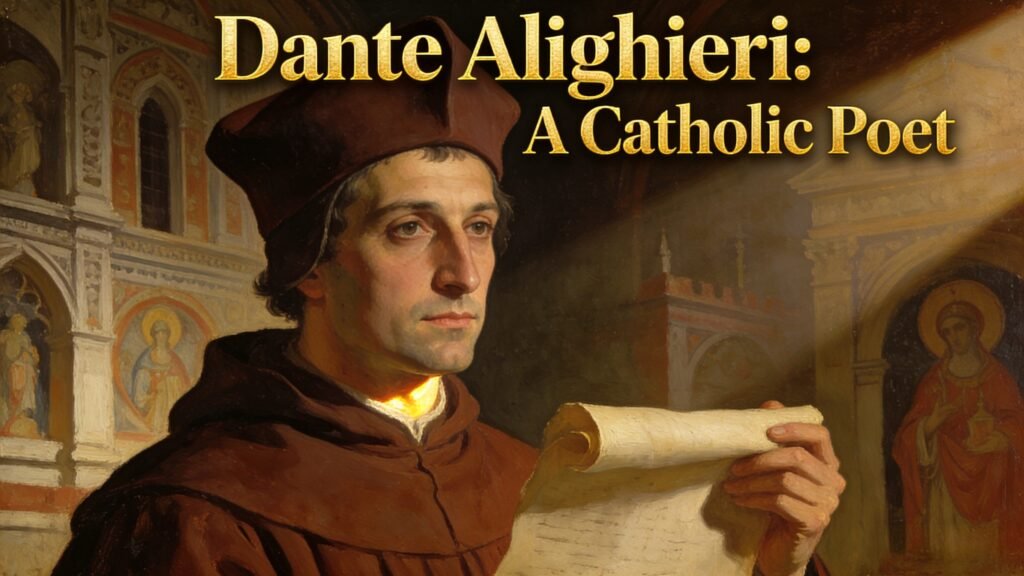
Dante Alighieri: A Catholic Poet
Dante Alighieri stands as one of the most significant figures in world literature, a Catholic poet whose masterpiece The Divine Comedy has shaped Western culture for over seven centuries. Born in Florence in 1265, he emerged from a family of modest nobility during a tumultuous period in Italian history. His life was marked by political exile, profound religious faith, and a poetic vision that would forever transform European literature. This article explores the life, works, and lasting legacy of Dante Alighieri, examining how his Catholic faith and philosophical insights culminated in the creation of one of humanity’s greatest literary achievements.
The significance of this iconic poet extends far beyond his role as a wordsmith. He is considered the father of the modern Italian language and a pivotal figure in the development of vernacular literature. His work represents a synthesis of medieval Catholic theology, classical philosophy, and poetic innovation, creating a comprehensive vision of the human condition and the journey toward divine salvation. For scholars and readers alike, his writings offer a window into the intellectual and spiritual landscape of the late Middle Ages, making him a timeless subject of study and admiration.
1. Dante Alighieri’s Life and Times
1.1 Early Life and Family Background
Dante Alighieri was born in Florence in 1265, likely in late May, to a family of ancient lineage but modest means. His full name was Durante Alighieri, though he is universally known by his shorter, more familiar moniker. His father, Alighiero di Bellincione, worked as a businessman and moneylender, while his mother, Bella degli Abbati, came from a well-respected noble Florentine family. His family claimed descent from the ancient Romans, with his great-great-grandfather Cacciaguida having been knighted by Emperor Conrad III and died as a crusader in the Holy Land.
The poet’s early education was foundational to his later intellectual achievements. He studied under Brunetto Latini, whom he always regarded with deep affection. Through Latini’s guidance, he received instruction in rhetoric, philosophy, and classical literature. His formal education included study at the Franciscan school in the monastery of Santa Croce, where he received the typical education of a Florentine youth of his circumstances. He also dedicated “some thirty months” to frequenting “the schools of the religious orders and the disputations of the philosophers,” likely including the Dominican school at Santa Maria Novella.
During his youth, Dante Alighieri developed a deep love for literature and philosophy, which would later inform every aspect of his writing. He immersed himself in the works of Virgil, Homer, and other classical authors, while also studying the theological teachings of the Catholic Church. This blend of classical and religious education would become a defining feature of his greatest work, shaping its themes, structure, and symbolism.
1.2 Political Career and Exile
Between 1285 and 1302, Dante Alighieri was actively engaged in the cultural and civic life of Florence. He served as a soldier, participating in the Battle of Campaldino on June 11, 1289, on the Guelph side against the Ghibellines. Following his military service, he entered politics, holding several important positions including councilman, elector, and prior of Florence. His political career reflected his commitment to Florentine independence and his belief in a just society governed by reason and faith.
The political landscape of Florence during his time was dominated by the conflict between the Guelphs and Ghibellines. After the Guelphs achieved victory, they themselves split into two factions: the White Guelphs and the Black Guelphs. Dante Alighieri aligned with the White Guelphs, who opposed the excessive influence of Pope Boniface VIII and advocated for Florentine independence from papal control. This alignment would ultimately change the course of his life, leading to his exile and shaping the themes of his later writing.
In 1301, when conflict arose between the Black Guelphs (strongly committed to papal interests) and the White Guelphs, Pope Boniface VIII intervened, supporting the Blacks. Dante Alighieri was part of an embassy to Rome to discuss matters with the pope, but he was outmaneuvered. While he was in Rome, Charles of Valois entered Florence, and the Blacks seized power. He was subsequently condemned in absentia and sentenced to pay a large fine and be exiled for two years. When he refused to return and pay the fine—knowing he would be imprisoned or executed—his sentence was increased to perpetual exile and threatened execution if he ever returned to Florence.
1.3 Exile and Later Life
The exile of Dante Alighieri from Florence marked a profound turning point in his life. He spent the remaining twenty years of his life traveling throughout Italy, seeking patronage and protection from various noble families. During this period, he spent significant time at the courts of Can Grande della Scala in Verona and later Guido Novello da Polenta in Ravenna. Exile was a source of great pain for him, as he longed for his homeland, but it also provided the solitude and reflection necessary to create his greatest work.
His exile deeply influenced his literary work. The pain and longing for his homeland, combined with his philosophical and theological reflections, provided the impetus for his greatest creation,The Divine Comedy. In 1319, he moved from Verona to Ravenna, where he completed the Paradiso section of his masterpiece. Dante Alighieri died in Ravenna on September 14, 1321, at the age of 56, shortly after returning from a diplomatic mission to Venice. Though he never returned to Florence in life, his legacy would eventually make him one of the city’s most beloved sons.
During his exile, Dante Alighieri also wrote several other important works, including Convivio (The Banquet) and De Monarchia (On Monarchy). These works further explored his philosophical and political beliefs, complementing the themes of The Divine Comedy and showcasing his wide-ranging intellectual interests. Together, these writings establish him as not just a poet, but a profound thinker whose ideas continue to resonate today.
2. The Divine Comedy by Dante Alighieri: Structure and Symbolism
2.1 Composition and Structure
The Divine Comedy by Dante Alighieri represents one of the most ambitious literary projects in human history. The poem was composed between approximately 1308 and 1321, spanning most of his exile. It consists of 14,233 lines divided into three canticles: Inferno (Hell),Purgatorio (Purgatory), and Paradiso (Paradise). Each canticle contains 33 cantos, with the Inferno having an additional introductory canto, bringing the total to 100 cantos—a number rich in symbolic meaning.
The structure of The Divine Comedy is fundamentally based on the number three, symbolizing the Holy Trinity. This divine number appears throughout the work, from the three main sections to the terza rima rhyme scheme (ABA, BCB, CDC, etc.). The poem follows the journey of the pilgrim Dante, who is guided through Hell and Purgatory by the Roman poet Virgil and through Paradise by Beatrice. This structure reflects Dante Alighieri’s Catholic faith, as it mirrors the spiritual journey of every Christian toward salvation.
Dante Alighieri’s choice of terza rima was innovative for its time, as it allowed for a fluid, rhythmic narrative that could convey both complex ideas and emotional depth. The rhyme scheme also serves a symbolic purpose, as the linking of lines (each new rhyme building on the previous one) represents the interconnectedness of all things in God’s creation. This structural innovation is just one example of how he merged form and content to create a masterpiece of religious and literary significance.
2.2 Theological and Philosophical Themes
The Divine Comedy by Dante Alighieri encompasses a vast array of theological and philosophical themes. Central to the work is the concept of sin and redemption. Throughout the poem, he emphasizes the importance of acknowledging one’s sins, seeking forgiveness, and working toward redemption, ultimately leading to the salvation of the soul. This theme reflects his deep Catholic faith and his belief in the teachings of the Church regarding sin, repentance, and eternal life.
The poem’s structure itself reflects these themes. Inferno illustrates the consequences of sin, Purgatorio presents hope through repentance, and Paradiso represents divine love and enlightenment. This progression reinforces the idea that redemption is achievable through acknowledgment of one’s sins and striving for moral improvement. Dante Alighieri believed that every human being has the free will to choose between good and evil, and that these choices determine one’s eternal fate.
His treatment of the relationship between human reason and divine revelation is particularly significant. In the poem, Virgil symbolizes human reason and classical wisdom, while Beatrice represents divine revelation, grace, and faith. This dual guidance system reflects Dante Alighieri’s view of the complementary roles of reason and faith in the journey toward God. He believed that reason could lead one to an understanding of moral truth, but that faith was necessary to reach divine enlightenment.
2.3 Literary Devices and Symbolism
The Divine Comedy employs rich symbolism and allegory to convey complex theological concepts. The poem is filled with symbolic numbers, colors, and other elements that carry deep meaning. The number nine appears repeatedly, representing the nine circles of Hell, the nine levels of Purgatory, and the nine celestial spheres of Paradise. This number is symbolic of the Virgin Mary, who is often associated with the number nine in Catholic tradition.
Dante Alighieri uses allegory extensively to represent abstract ideas and spiritual truths. The journey through the afterlife serves as an allegory for the soul’s journey toward God. Each realm represents a different stage of spiritual growth, and the characters he encounters often represent specific virtues, vices, or historical figures. For example, in Inferno, Judas Iscariot is punished in the deepest circle of Hell for his betrayal of Jesus, while in Paradiso, saints and martyrs reside in the highest spheres, closest to God.
The poem’s famous opening lines, “Nel mezzo del cammin di nostra vita / mi ritrovai per una selva oscura” (“Midway upon the journey of our life / I found myself within a dark wood”), establish the central metaphor of life as a journey and the human condition as one of spiritual wandering. This metaphor resonates throughout the poem, as the pilgrim Dante navigates the darkness of sin and ignorance toward the light of divine truth. Dante Alighieri’s use of symbolism and allegory makes The Divine Comedy a rich, multi-layered work that rewards repeated reading and study.
3. Dante Alighieri’s Theological Vision and Catholic Identity
3.1 Dante Alighieri’s Catholic Faith
Dante Alighieri was a devout Catholic whose faith profoundly shaped his literary and philosophical vision. His work reflects deep engagement with medieval Catholic theology and philosophy, especially Thomistic philosophy derived from the Summa Theologica of Thomas Aquinas. He believed in the Trinity of three co-equal and co-eternal persons, understanding God as both one in essence and three persons—the Father, the Son, and the Holy Spirit.
The relationship between Dante Alighieri and the Catholic Church is complex and multifaceted. On one hand, he was deeply committed to the Church’s teachings and viewed it as essential to human salvation. On the other hand, he was highly critical of the corruption and political ambitions he witnessed among many Church leaders. His condemnation of Pope Boniface VIII in the Inferno exemplifies this tension—he respected the Church as an institution but condemned the actions of those who abused their power in its name.
His Catholic faith is evident in every aspect of The Divine Comedy, from its structure to its themes to its characters. The poem reflects the Church’s teachings on sin, repentance, heaven, and hell, while also exploring more complex theological concepts such as predestination, free will, and the nature of divine love. Dante Alighieri saw his work as a tool for moral and spiritual instruction, helping readers to understand the path to salvation and the consequences of straying from it.
3.2 Theological Innovation in The Divine Comedy
Dante Alighieri’s theological vision in The Divine Comedy represents a synthesis of classical philosophy and Christian doctrine. He draws extensively on the works of Thomas Aquinas, Albert the Great, and other scholastic theologians. However, he also brings his own innovative interpretations to traditional theological concepts, making the poem a unique contribution to Catholic theology.
One of the most striking aspects of his theology is his treatment of the afterlife. His vision of Hell, Purgatory, and Paradise is highly structured and hierarchically organized. Each level of these realms corresponds to specific sins or virtues, creating a comprehensive moral universe where every human action has its corresponding consequence. This structure reflects his belief in divine justice and the idea that God’s judgment is both fair and merciful.
Dante Alighieri’s understanding of the relationship between free will and predestination is particularly sophisticated. While the souls in Hell are portrayed as having made choices that led to their eternal damnation, those in Purgatory and Paradise have chosen paths of repentance and virtue. This emphasis on human choice reflects his belief in the importance of moral responsibility and the possibility of redemption. He believed that God grants humans free will to choose between good and evil, and that these choices shape one’s eternal destiny.
3.3 Beatrice as Theological Symbol
The character of Beatrice in The Divine Comedy serves as a central theological symbol. She represents divine love, grace, and the path to salvation. In the poem, Beatrice is described as the expression of the Trinity par excellence, and she repeats the word “ben” thrice to indicate that she is the miracle of the Trinity. For Dante Alighieri, Beatrice was more than just a fictional character—she was a symbol of the divine love that draws all humans toward God.
His idealization of Beatrice reflects his broader theological vision. Through her character, he explores the transformative power of love and the possibility of human union with the divine. The progression from Virgil’s guidance (representing human reason) to Beatrice’s guidance (representing divine revelation) symbolizes the necessary movement from human understanding to divine grace in the journey toward God. Dante Alighieri believed that love—both human and divine—is the driving force behind all creation and the key to salvation.
Beatrice’s role in The Divine Comedy also reflects Dante Alighieri’s personal experiences. In real life, he knew a woman named Beatrice Portinari, whom he first met when he was nine years old. He was deeply infatuated with her, and her death in 1290 had a profound impact on him. He transformed his personal grief into a spiritual journey, using Beatrice as a symbol of divine love and grace. This blending of personal experience and theological symbolism is one of the reasons The Divine Comedy is such a powerful and enduring work.
4. Dante Alighieri’s Impact on Literature and Language
4.1 The Italian Language Revolution
Dante Alighieri is universally recognized as the father of the modern Italian language. His decision to write The Divine Comedy in the Tuscan vernacular rather than Latin was revolutionary for its time. Before his work, Latin was the predominant language of literature, education, and administration in Italy. Most literary works were written in Latin, which was accessible only to the educated elite. Dante Alighieri’s choice to use the vernacular made his work accessible to a much broader audience, including ordinary people who spoke Tuscan.
His use of the Florentine dialect established a literary standard that would eventually become the basis for modern Italian. His work demonstrated the potential of vernacular language to express complex philosophical and theological ideas with the same sophistication as Latin. Through his writings, Dante Alighieri not only gave voice to the emerging lay culture of his own country but also made Italian the literary language in Western Europe for several centuries. His influence on the Italian language is so profound that modern Italian is still based largely on the Florentine dialect he used.
Dante Alighieri’s commitment to the vernacular was rooted in his belief that literature should be accessible to all people, not just the educated few. He believed that the message of his work—about sin, redemption, and divine love—was too important to be confined to a small, elite audience. By writing in the Tuscan vernacular, he ensured that his ideas would reach people from all walks of life, shaping their understanding of faith, morality, and the human condition.
4.2 Literary Legacy and Influence
The literary influence of Dante Alighieri extends far beyond his contributions to the Italian language. The Divine Comedy is widely considered the greatest literary work composed in the Italian language and a masterpiece of world literature. It is also regarded as the greatest literary statement produced in medieval Europe. His work set a precedent that important Italian writers such as Petrarch and Boccaccio would later follow, inspiring them to write in the vernacular and explore similar themes.
His influence on subsequent generations of writers has been profound. The Divine Comedy has inspired countless adaptations, translations, and imitations across multiple languages and artistic forms. The poem’s structure, themes, and literary techniques have become part of the Western literary canon. Its influence can be seen in the works of Chaucer, Milton, and countless other poets who have followed in his footsteps. The concept of the spiritual journey as a narrative framework, the use of allegory to convey philosophical ideas, and the synthesis of poetry and theology all reflect Dante Alighieri’s lasting impact on world literature.
Dante Alighieri’s work also influenced the development of literary genres. His use of allegory and symbolism helped to shape the genre of epic poetry, while his exploration of the afterlife inspired countless works of fiction, poetry, and drama. Even today, writers continue to draw inspiration from The Divine Comedy, adapting its themes and structure to address contemporary issues and concerns. His legacy as a poet is unparalleled, and his work remains a touchstone for literary excellence.
4.3 Cultural and Intellectual Influence
Dante Alighieri’s impact extends beyond literature into philosophy, theology, and culture. His work represents a comprehensive synthesis of medieval knowledge, encompassing not only literature but also philosophy, theology, astronomy, and politics. The Divine Comedy serves as an encyclopedia of medieval thought, providing insight into the intellectual and cultural life of the 13th and 14th centuries. For historians and scholars, his work is an invaluable resource for understanding the medieval world.
The poet’s philosophical legacy remains significant, though more difficult to assess than his literary contributions. His writings provide powerful tools for studying the landscape of late medieval and Renaissance philosophy. Dante Alighieri’s synthesis of Aristotelian philosophy with Christian theology, his exploration of the relationship between reason and faith, and his vision of the cosmos all contributed to the development of Western thought. His ideas influenced later philosophers such as Descartes, Kant, and Hegel, who engaged with his work and built upon his insights.
Dante Alighieri’s cultural influence is also evident in art, music, and architecture. Throughout history, artists have depicted scenes fromThe Divine Comedy in paintings, sculptures, and other works of art. Composers have written operas, symphonies, and other musical works inspired by his poem. Even today, his work continues to shape popular culture, with references to The Divine Comedy appearing in films, television shows, and video games. His influence is a testament to the enduring power of his ideas and the universal appeal of his work.
5. Dante Alighieri’s Enduring Relevance
5.1 Modern Interpretations and Adaptations
Dante Alighieri’s The Divine Comedy continues to be studied, interpreted, and adapted in contemporary times. Modern scholars and artists find in his work themes that remain relevant to 21st-century concerns. The poem’s exploration of moral choices, the consequences of evil, and the possibility of redemption resonate with contemporary audiences facing complex ethical challenges. In a world marked by conflict, inequality, and moral ambiguity, his work offers a vision of hope and a framework for understanding right and wrong.
Recent adaptations of his work include films, video games, and multimedia presentations that bring his vision to new audiences. These adaptations demonstrate the timeless quality of his narrative and the universal appeal of his themes. For example, the video game Dante’s Inferno adapts the Inferno section of his poem into an interactive experience, allowing players to navigate the circles of Hell and confront the consequences of sin. Other adaptations, such as films and stage plays, explore the emotional and spiritual depth of his work, making it accessible to new generations of readers and viewers.
Modern scholars also continue to explore new interpretations of The Divine Comedy, examining its themes from feminist, postcolonial, and environmental perspectives. These new interpretations shed light on previously overlooked aspects of the poem and demonstrate its ongoing relevance to contemporary issues. Dante Alighieri’s work is not just a historical artifact—it is a living text that continues to evolve and speak to new audiences.
5.2 Dante Alighieri’s Quotes and Wisdom
Dante Alighieri’s writings are filled with memorable quotes that continue to inspire and challenge readers. One of his most famous statements is “The darkest places in hell are reserved for those who maintain their neutrality in times of moral crisis.” This quote reflects his belief in the importance of moral courage and the danger of remaining silent in the face of injustice. It resonates with contemporary audiences who are called to stand up for what is right in a world marked by moral ambiguity.
Another well-known quote from him is “All hope abandon, ye who enter here,” which appears at the entrance to Hell in the Inferno. This phrase captures the finality of damnation and the irreversible nature of certain choices. It serves as a warning about the consequences of giving in to sin and abandoning moral virtue. Despite its dark tone, the quote also emphasizes the importance of hope and the possibility of redemption for those who choose the path of righteousness.
Perhaps the most profound of Dante Alighieri’s quotes is the climactic line from the Paradiso: “The love that moves the sun and all the other stars.” This statement represents the culmination of his journey and his understanding of the ultimate nature of reality. It suggests that love, rather than mere physical forces, is the fundamental principle that governs the universe. This quote reflects his Catholic faith and his belief in the transformative power of divine love, which continues to inspire readers of all faiths.
5.3 Contemporary Significance
The figure of Dante Alighieri and his work continue to be sources of inspiration for contemporary readers and scholars. His vision of the human journey toward God, his emphasis on moral responsibility, and his synthesis of reason and faith offer valuable insights for our own time. In an age marked by secularism and skepticism, his work reminds us of the importance of spiritual reflection and the search for meaning beyond material possessions.
Dante Alighieri’s commitment to using vernacular language to express profound ideas has parallels in contemporary efforts to make complex knowledge accessible to broader audiences. His belief in the power of literature to transform individuals and societies remains relevant in an age of rapid technological change and social upheaval. In a world where information is abundant but wisdom is scarce, his work offers a model for how literature can educate, inspire, and transform.
Furthermore, his critical engagement with power structures, particularly his condemnation of corruption in both Church and state, offers important lessons for contemporary society. His vision of a just and ordered society, guided by both human reason and divine wisdom, continues to inspire those working for social justice and moral renewal. Dante Alighieri’s work reminds us that we all have a responsibility to work toward a better world, one rooted in justice, compassion, and love.
Conclusion
Dante Alighieri stands as a towering figure in the history of Western civilization, a Catholic poet whose vision has shaped literature, language, and thought for over seven centuries. His masterpiece, The Divine Comedy, represents the culmination of medieval thought and the beginning of a new era in literary expression. Through his work, he synthesized classical philosophy with Christian theology, created a new standard for vernacular literature, and provided humanity with a profound vision of the spiritual journey.
The life of Dante Alighieri, marked by political exile and personal suffering, ultimately produced one of the world’s greatest literary achievements. His decision to write in the Tuscan vernacular revolutionized Italian literature and established the foundation for the modern Italian language. His theological insights, expressed through the medium of poetry, continue to offer wisdom and inspiration to readers of all faiths. He was not just a poet, but a thinker, a visionary, and a moral teacher whose ideas continue to resonate today.
His legacy extends beyond his literary achievements. He remains a symbol of the power of human creativity to transform suffering into art, of the importance of moral courage in the face of injustice, and of the eternal human quest for meaning and salvation. His vision of a universe ordered by love, his belief in the possibility of redemption, and his commitment to using literature for moral instruction continue to resonate with contemporary audiences.
As we continue to face the challenges of our own age, the wisdom of Dante Alighieri offers valuable guidance. His emphasis on the importance of moral choices, his vision of the human journey as one of spiritual growth, and his belief in the ultimate triumph of love over darkness provide hope and inspiration for all who seek to live meaningful and ethical lives. In this sense, he remains not just a historical figure but a living voice speaking to the deepest concerns of the human heart.
The enduring relevance of Dante Alighieri’s work reminds us that the fundamental questions he addressed—about the nature of good and evil, the possibility of redemption, and the ultimate meaning of human existence—are as pressing today as they were in the 14th century. His synthesis of reason and faith, his commitment to using literature for moral instruction, and his vision of a world transformed by love continue to offer valuable insights for our own journey through life’s challenges.
In conclusion, Dante Alighieri represents the best of human achievement—the capacity to transform personal suffering into universal wisdom, to use artistic expression to explore profound philosophical questions, and to create works that speak to the deepest yearnings of the human spirit. His legacy as a poet, philosopher, and moral teacher ensures that his voice will continue to be heard for generations to come, offering guidance and inspiration to all who seek to understand the meaning of life and the path to eternal salvation.
For anyone interested in literature, theology, philosophy, or the human condition, Dante Alighieri’s work is essential reading. His The Divine Comedy is more than just a poem—it is a journey of the soul, a guide to moral living, and a testament to the enduring power of faith, love, and reason. In a world that often feels chaotic and uncertain, his vision offers a beacon of hope, reminding us that even in the darkest of times, there is a path to light and redemption.