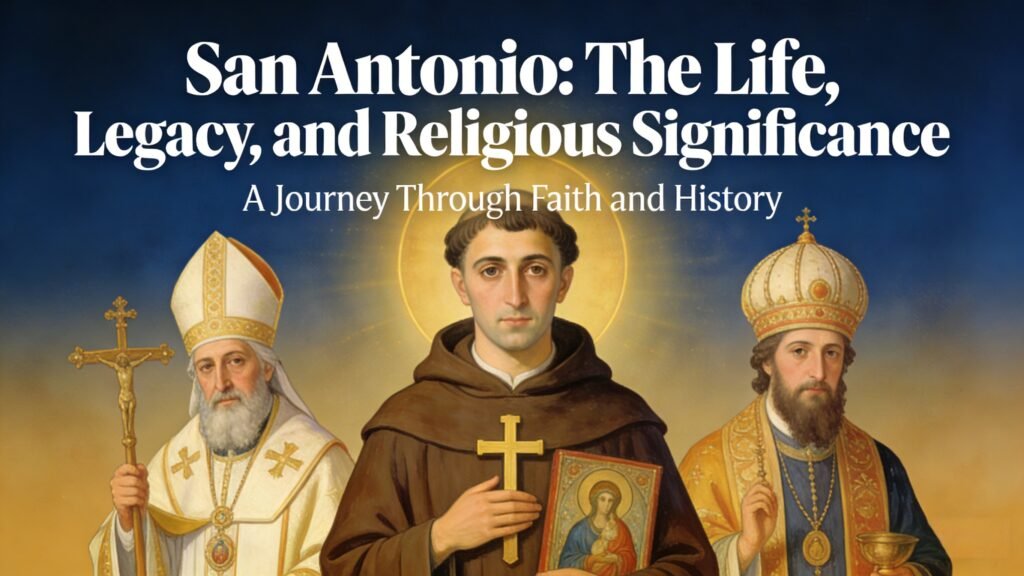
San Antonio: The Life, Legacy, and Religious Significance
1. The Enigmatic Figure of San Antonio
1.1 Historical Context and Identity
San Antonio stands as one of the most revered religious figures in Christian history, yet the name itself encompasses multiple saints who have shaped the spiritual landscape of both Western and Eastern Christianity. The primary figure associated with the name is San Antonio de Padua (Saint Anthony of Padua), a 13th-century Franciscan friar whose influence extends far beyond his lifetime . Born Fernando Martins de Bulhões in 1195 in Lisbon, Portugal, he would later be known as the “Doctor of the Church” and the patron saint of lost items .
However, the name “San Antonio” also refers to San Antonio Abad (Saint Anthony the Great), the 4th-century Egyptian monk who is considered the father of Christian monasticism . This dual identity creates a rich tapestry of religious tradition, with both figures being venerated in various Christian denominations including Catholic, Orthodox, and Anglican churches . The distinction between these two saints is crucial for understanding the full scope of San Antonio’s religious significance.
1.2 Religious Traditions and Denominational Context
The veneration of San Antonio spans multiple Christian traditions, each contributing unique perspectives to his legacy. In the Catholic Church, Saint Anthony of Padua holds a special place as one of the most popular saints, canonized in 1232 just one year after his death . The Archdiocese of San Antonio in Texas, established in 1874, was specifically named in his honor, with its episcopal see designated as San Antonio .
In the Orthodox Church, both Anthony figures are revered, though with different roles and significance. Saint Anthony the Great is celebrated as the founder of monasticism, with his feast day on January 17 . The Orthodox Church recognizes his pivotal role in defending Christian doctrine during the Arian controversy . Meanwhile, Saint Anthony of Padua is also venerated in Eastern Catholic churches and some Orthodox communities, particularly in the Near East where his intercession for fertility is widely sought .
The religious landscape of San Antonio, Texas, reflects this rich diversity. The city is home to numerous Catholic parishes, Orthodox churches, and other Christian denominations, all contributing to the complex tapestry of religious expression . This geographical concentration of religious institutions dedicated to various manifestations of San Antonio makes the city a unique center of religious pilgrimage and devotion.
2. Early Life and Formation of San Antonio
2.1 Birth and Family Background
The early life of San Antonio de Padua (Saint Anthony of Padua) began in Lisbon, Portugal, where he was born as Fernando Martins de Bulhões in 1195 . He came from a wealthy and noble family, with his father being a knight in service to the Portuguese king . His parents, Martin Bulhões and Teresa Taveira, were members of the Portuguese nobility, providing young Fernando with a privileged upbringing and access to education .
The circumstances of his birth and early childhood are documented in several hagiographical sources, though details vary. Some accounts suggest he was born on August 15, 1195, while others place his birth between 1191 and 1195 . Regardless of the exact date, his early years were marked by intelligence and religious devotion. From a young age, he demonstrated exceptional piety and a keen intellect that would later serve him well in his religious vocation .
In contrast, San Antonio Abad (Saint Anthony the Great) was born around 251 AD in Egypt, to a wealthy family in Upper Egypt . His birth name is not recorded in historical sources, but he would later be known as Anthony after taking the monastic habit. His family’s wealth provided him with a comfortable upbringing, but it was his encounter with Christian teaching that would fundamentally alter the course of his life .
2.2 Religious Vocation and Initial Formation
The religious journey of San Antonio de Padua began at the early age of 15 when he entered the Canons Regular of St. Augustine at the Monastery of St. Vincent outside Lisbon . This decision was made against the wishes of his family, who had hoped for a more conventional path for their son. At the monastery, he took the name Anthony in honor of the Franciscan hermitage where he resided .
His time at the Augustinian monastery was marked by intense study and spiritual formation. He dedicated himself to the study of the Bible and the Church Fathers, acquiring the theological knowledge that would later distinguish him as a preacher and teacher . His intellectual gifts were evident from the beginning, and he quickly mastered the theological curriculum of his time.
The decisive moment in his religious journey came in 1220 when he witnessed the return of the relics of five Franciscan missionaries who had been martyred in Morocco. Their story inspired young Fernando to seek a more radical form of Christian discipleship. He requested permission to leave the Augustinian order and join the Franciscan Friars Minor, a request that was granted after some deliberation .
For San Antonio Abad, his religious vocation began with a profound spiritual experience. After hearing a sermon on the Gospel passage where Jesus says, “If you want to be perfect, go, sell what you have and give to the poor, and you will have treasures in heaven; and come, follow Me,” he was deeply moved . At the age of 20, he sold his family inheritance, distributed the proceeds to the poor, and began his life of asceticism and prayer in the Egyptian desert .
2.3 Transition to Franciscan Life (for San Antonio de Padua)
The transition from Augustinian to Franciscan life marked a significant turning point in the life of San Antonio de Padua. Taking the name Anthony, he set out for Morocco with the intention of preaching the Gospel to the Muslims and following in the footsteps of the martyred friars who had inspired him . However, divine providence had different plans.
During his journey to Morocco, Anthony fell seriously ill and was forced to return to Europe. In 1221, he participated in the famous “Chapter of the Mats” at Assisi, where he met Saint Francis of Assisi for the first time . This meeting would prove to be formative, as Francis recognized Anthony’s exceptional gifts and assigned him to a life of preaching and teaching.
Initially, Anthony sought a life of quiet contemplation and was assigned to a small hermitage at Forlì in northern Italy. However, his life took an unexpected turn when he was asked to preach at a priestly ordination ceremony. His sermon revealed such profound knowledge and eloquence that his superiors immediately recognized his calling as a preacher . This marked the beginning of his remarkable career as one of the most influential preachers in Church history.
2.4 Monastic Formation (for San Antonio Abad)
The monastic formation of San Antonio Abad was characterized by progressive withdrawal from society and deepening asceticism. After selling his possessions, he initially remained near his village, living a life of prayer and fasting. After several years, he moved to a more remote location, eventually settling in a cave in the desert near the Nile River .
His monastic life was marked by extreme asceticism and spiritual discipline. He practiced prolonged fasting, spent hours in prayer, and engaged in intense spiritual warfare against what he perceived as demonic temptations. His biographer, Saint Athanasius, describes his daily routine as consisting of “晨祷、禁食、默想” (morning prayer, fasting, and meditation) .
As his reputation for holiness spread, other men began to seek him out, desiring to follow his example. In response to this growing movement, Anthony began to organize these followers into a more structured community. Around 305 AD, he established the first Christian monastery at Pispir (later known as Der el-Medina), where monks lived in individual cells but came together for communal prayer and worship .
This early form of monastic organization would become the foundation for all subsequent Christian monasticism. Anthony’s influence extended beyond his immediate community, as his example inspired the development of monasticism throughout Egypt, Syria, and eventually the entire Christian world . His “monastic rules” provided the basis for countless monasteries that would follow .
3. Religious Ministry and Contributions of San Antonio
3.1 Preaching and Teaching Ministry
The preaching ministry of San Antonio de Padua represents one of the most remarkable chapters in Christian history. His sermons were characterized by exceptional biblical knowledge, profound theological insight, and persuasive eloquence that drew crowds wherever he went . Pope Gregory IX, who had the opportunity to hear him preach, described him as the “Ark of the Testament” (Arca Testamenti), a title that reflected his encyclopedic knowledge of Scripture .
Anthony’s preaching ministry was marked by several distinctive characteristics. First, his sermons were deeply rooted in Scripture, with one source noting that his sermons contained over six thousand biblical citations . This extensive use of Scripture earned him the specific title “Doctor Evangelicus” (Evangelical Doctor) when he was proclaimed a Doctor of the Church in 1946 .
His preaching had a profound impact on both clergy and laity. He was particularly effective in reconciling those who had strayed from the Church, earning him the nickname “异教者的铁锤” (Hammer of Heretics) for his ability to refute false teachings . His sermons were not merely intellectual exercises but were filled with spiritual power that moved hearts and transformed lives.
In terms of teaching ministry, Anthony became one of the first, if not the first, theology teachers of the Franciscan Order. He began his teaching in Bologna with the blessing of Saint Francis, who sent him a letter that simply stated: “I would like you to teach the brethren theology” . His theological contributions laid the foundation for Franciscan theology, which would later reach its peak with Saint Bonaventure and Blessed Duns Scotus .
3.2 Theological Writings and Doctrinal Contributions
The theological writings of San Antonio de Padua consist primarily of two major works: “Sunday Sermons” (Sermones Dominicales) and “Sermons on the Saints” (Sermones in Festivitates). These works were intended for the Franciscan Order’s preachers and teachers of theological studies . In these writings, Anthony employed the medieval method of biblical interpretation using the four senses: literal or historical, allegorical or Christological, tropological or moral, and anagogical, which orientates a person to eternal life .
His theological approach was characterized by its Christocentric focus. Anthony always placed Christ at the center of his teaching, preaching, and writing. This Christocentrism is evident in his famous meditation on the Cross, where he wrote: “Christ who is your life is hanging before you, so that you may look at the Cross as in a mirror. There you will be able to know how mortal were your wounds, that no medicine other than the Blood of the Son of God could heal” .
In his writings on prayer, Anthony developed a fourfold structure that has become influential in Christian spirituality. He defined prayer as consisting of four indispensable attitudes: obsecratio (confidently opening one’s heart to God), oratio (speaking with Him affectionately), postulatio (presenting our needs to Him), and gratiarum actio (praising and thanking Him) . This approach to prayer emphasizes the relational aspect of the spiritual life.
3.3 Monastic Leadership and Spiritual Guidance (for San Antonio Abad)
The monastic leadership of San Antonio Abad (Saint Anthony the Great) was characterized by wisdom, compassion, and a deep understanding of human psychology. As the founder of organized Christian monasticism, he established a pattern of community life that would influence religious communities for centuries . His approach to monastic leadership was both practical and spiritual, addressing the physical, emotional, and spiritual needs of his followers.
Anthony’s spiritual guidance was sought by people from all walks of life, including emperors and bishops. In 337 AD, Emperor Constantine and his sons wrote to Anthony, asking for his prayers . This demonstrates the wide-ranging influence of his spiritual authority, extending far beyond the monastic community.
His leadership style emphasized communal living with individual responsibility. While he initially practiced extreme solitude, he later recognized the value of community support in the spiritual journey. His monasteries were organized with individual cells for prayer and contemplation, but with regular communal worship and shared work . This balance between solitude and community became a hallmark of Eastern monasticism.
3.4 Missionary Activities and Church Leadership
The missionary activities of both San Antonio figures took different forms but were equally impactful. For San Antonio de Padua, his missionary work was primarily through preaching and teaching. He traveled extensively throughout Italy and France, combating heresies and bringing people back to the Church . His missionary approach was characterized by intellectual rigor and spiritual passion, making him particularly effective against the Cathar heresy that was prevalent in southern France.
San Antonio Abad’s missionary influence was more indirect but equally profound. His life of extreme asceticism and spiritual warfare inspired countless others to embrace the monastic life. His biographer, Saint Athanasius, wrote that “安东尼的故事迅速传遍基督教世界,激励了无数修士走向荒漠,追寻心灵的纯净” (Anthony’s story quickly spread throughout the Christian world, inspiring countless monks to go into the desert in pursuit of spiritual purity) .
In terms of formal church leadership, neither figure held ecclesiastical offices in the traditional sense. San Antonio de Padua served as Provincial Superior of the Franciscan friars in northern Italy, combining administrative responsibilities with his preaching ministry . San Antonio Abad remained an abbot of his monastery but never sought ordination to the priesthood, instead focusing on his role as a spiritual father and guide.
3.5 Social and Charitable Works
Both San Antonio figures demonstrated a profound commitment to the poor and marginalized, though their approaches differed. San Antonio de Padua was known for his “undying love and devotion to the poor and the sick” . His preaching often included strong social criticism, challenging the wealthy to use their resources for the benefit of the poor. In one famous sermon, he urged the wealthy to “befriend the poor, welcome them into your homes: it will subsequently be they who receive you in the eternal tabernacles” .
San Antonio Abad’s charitable work was more focused on providing spiritual and physical support to those who came to him seeking help. His monastery became a center of hospitality, providing food, shelter, and spiritual guidance to travelers, the sick, and the poor. His approach to charity was holistic, addressing both material needs and spiritual hunger.
The social impact of their charitable works extended beyond immediate relief to broader social transformation. San Antonio de Padua’s preaching challenged the social order of his time, advocating for a more equitable distribution of resources. His influence helped to shape the development of Christian social teaching, particularly regarding the obligations of the wealthy to the poor.
4. Miracles and Spiritual Legacy of San Antonio
4.1 Documented Miracles and Supernatural Events
The miracle accounts associated with San Antonio de Padua are numerous and varied, contributing to his reputation as one of the most powerful intercessors in the Church. One of the most famous miracles attributed to him involves the recovery of a lost book of psalms. According to tradition, a novice who had decided to leave the order took Anthony’s psalter with him. After Anthony prayed for its return, the novice experienced a vision that compelled him to return the book . This incident gave rise to the widespread practice of praying to Saint Anthony for the recovery of lost items.
Another well-documented miracle involves Anthony’s preaching to fish. When his preaching was rejected by the people of Rimini, he went to the seashore and began preaching to the fish. According to the account, the fish “turned their heads toward him, and the water was calmed” as they listened to his sermon . This miracle is often depicted in art and has become one of the most recognizable images associated with Saint Anthony.
Perhaps the most significant miracle associated with Anthony occurred after his death. When his tomb was opened thirty years later, his entire body had decomposed except for his tongue, which remained perfectly preserved . This phenomenon was interpreted as a sign of his exceptional gift as a preacher and teacher, with the preserved tongue symbolizing the enduring power of his words.
San Antonio Abad (Saint Anthony the Great) is also credited with numerous miracles, primarily involving healings and exorcisms. His biographer, Saint Athanasius, records that Anthony was instrumental in healing people from various illnesses, particularly ergotism, which became known as “圣安东尼之火” (St. Anthony’s Fire) . He was also known for his ability to cast out demons and to protect people from spiritual attacks.
4.2 Patronage and Intercessory Role
The patronage of San Antonio de Padua extends to multiple areas of human need. He is perhaps best known as the patron saint of lost items, a devotion that has spread throughout the world. However, his patronage encompasses much more: he is also the patron saint of the poor, travelers, barren women, and those seeking employment . In some traditions, he is also considered the patron saint of finding lost love and the protection of children.
The intercessory role of San Antonio is particularly evident in popular devotions. The prayer to “San Antonio, perfect imitator of Jesus, who received from God the special power of restoring lost things” reflects the belief in his ability to intercede effectively for specific needs . This prayer has been translated into numerous languages and is recited by millions of people worldwide.
In the Orthodox tradition, San Antonio Abad is venerated as the patron saint of monks and hermits. His role as the “Father of All Monks” makes him a special intercessor for those living the monastic life . He is also invoked for protection against temptation and for strength in spiritual warfare.
4.3 Canonization and Church Recognition
The canonization of San Antonio de Padua was remarkably swift by medieval standards. He died on June 13, 1231, and was canonized by Pope Gregory IX on May 30, 1232, less than one year later . This rapid canonization was due to the numerous miracles attributed to his intercession and the widespread recognition of his holiness. The canonization ceremony took place in Spoleto, Italy, and was attended by thousands of faithful .
In 1946, San Antonio de Padua was proclaimed a Doctor of the Church by Pope Pius XII, with the specific title “Doctor Evangelicus” (Evangelical Doctor) . This recognition was given in acknowledgment of his profound theological insights and the lasting influence of his writings on the development of Christian thought. He is one of only 37 Doctors of the Church, a title that recognizes exceptional contributions to theological understanding.
San Antonio Abad was not formally canonized in the modern sense, as the formal canonization process was not yet established in the 4th century. However, he was universally recognized as a saint from the time of his death in 356 AD . His feast day is celebrated on January 17 in both the Eastern Orthodox and Catholic Churches .
4.4 Influence on Christian Spirituality
The influence of both San Antonio figures on Christian spirituality has been profound and lasting. San Antonio de Padua‘s approach to prayer and spiritual life has shaped the development of Franciscan spirituality and has influenced countless spiritual writers and teachers. His emphasis on the relational nature of prayer, expressed in his fourfold structure of obsecratio, oratio, postulatio, and gratiarum actio, provides a practical framework for Christian prayer .
His Christocentric spirituality has been particularly influential. His meditation on the Cross, where he invites believers to “look at the Cross as in a mirror” to understand both their sinfulness and their worth, has become a classic of Christian spiritual writing . This approach to the Cross as both a mirror of human condition and a source of divine love has inspired generations of spiritual seekers.
San Antonio Abad‘s influence on Christian spirituality is primarily through his founding of monasticism and his development of ascetical theology. His approach to spiritual warfare, his methods of prayer and fasting, and his understanding of the spiritual life as a struggle against demonic forces have profoundly shaped Eastern Christian spirituality. His legacy continues in the monastic communities that follow his Rule and in the spiritual practices of Orthodox and Catholic Christians worldwide.
The spiritual legacy of both figures extends beyond formal religious practice to popular piety. The widespread devotion to “San Antonio” in various forms—whether as the finder of lost items, the patron of the poor, or the father of monks—demonstrates the continuing relevance of their spiritual insights and intercessory power in contemporary Christian life.
5. Cultural Impact and Modern Devotions of San Antonio
5.1 Popular Devotions and Religious Practices
The popular devotions associated with San Antonio have evolved over centuries to encompass a wide range of spiritual practices and cultural expressions. In many Catholic communities, the “Novena to St. Anthony” has become a standard practice, consisting of nine days of prayer recited as follows: “O Holy St. Anthony, gentlest of saints, your love for God and charity for his creatures made you worthy, when on earth, to possess miraculous powers. Encouraged by this thought, I implore you to obtain for me [mention your request here]” .
The practice of praying to San Antonio for the recovery of lost items has become so widespread that it has entered popular culture. In many Spanish-speaking countries, the phrase “¡San Antonio, perdido perdido!” (Saint Anthony, lost, lost!) is commonly used when something is misplaced . This devotion has spread beyond Catholic communities to influence popular culture in many parts of the world.
In the Orthodox tradition, San Antonio Abad is honored through various devotional practices. The Feast of St. Anthony the Great on January 17 is celebrated with special liturgies and processions. In some Orthodox communities, it is traditional to bless animals on this day, reflecting Anthony’s role as the patron saint of animals .
The “Vueltas de San Antón” in Madrid, Spain, represents a unique fusion of religious devotion and cultural celebration. This festival, held on January 17, has evolved from medieval origins to become a celebration that includes the blessing of pets, traditional foods called “panecillos de San Antón,” and various cultural activities . The celebration has spread to other cities in Spain and Latin America, demonstrating the cultural adaptability of San Antonio devotion.
5.2 Artistic and Cultural Representations
The artistic representation of San Antonio has produced some of the most recognizable images in Christian art. San Antonio de Padua is typically depicted holding the Child Jesus, a reference to the mystical vision he is said to have experienced. This image has been reproduced countless times in paintings, sculptures, and religious icons. The symbolism of the Child Jesus in Anthony’s arms represents both his role as a teacher of divine wisdom and his special relationship with the incarnate Word .
In Spanish and Latin American art, San Antonio is often portrayed with a lily, symbolizing purity, or with a book, representing his role as a Doctor of the Church . The famous painting by Tiziano (Titian) in the Scuola del Santo in Padua depicts scenes from the life of San Antonio, including “The Miracle of the Jealous Husband” and “The Child Testifies to His Mother’s Innocence” .
The representation of San Antonio Abad in art typically emphasizes his role as a desert father. He is often depicted as an elderly man with a long beard, dressed in simple robes, and accompanied by a donkey or other desert animals. His portrayal often includes elements of asceticism, such as emaciated features and simple surroundings, reflecting his life of extreme self-denial .
In modern popular culture, San Antonio has been referenced in literature, music, and film. The character of San Antonio appears in various forms of media, often representing wisdom, intercession, or spiritual guidance. His image is frequently used in religious art and iconography, and his name has been adopted by numerous institutions, including churches, schools, and hospitals.
5.3 Institutional Presence in San Antonio, Texas
The city of San Antonio, Texas, serves as a unique center of San Antonio devotion, with numerous institutions bearing his name. The Archdiocese of San Antonio, established on August 28, 1874, was specifically named in honor of St. Anthony of Padua . The archdiocese encompasses 134 parishes and serves a diverse Catholic population in South Texas .
The Basilica of the National Shrine of the Little Flower in San Antonio represents one of the most significant religious structures in the city. Founded by Spanish friars in 1926, the basilica has been called “the most beautiful church in San Antonio” . This designation reflects not only its architectural beauty but also its importance as a center of Catholic devotion in the region.
Holy Cross of San Antonio is a Catholic, coeducational college preparatory secondary school founded in 1957 . The school continues the charism of the Congregation of Holy Cross, dedicated to providing quality Catholic education to the youth of San Antonio. The school’s mission statement emphasizes its commitment to “impart Catholic values through theology classes, various campus ministry programs and the overall academic and disciplinary programs” .
The city is also home to numerous parishes dedicated to San Antonio, including St. Anthony Catholic Church, St. Anthony of Padua Parish, and others. These institutions serve as centers of worship, education, and community service, continuing the legacy of San Antonio’s ministry to the poor and marginalized.
5.4 Annual Celebrations and Festivals
The annual celebrations associated with San Antonio in the city of San Antonio, Texas, reflect both religious devotion and cultural heritage. The most significant celebration is Fiesta San Antonio, an annual festival held in April that began in 1891 . While initially started to honor the heroes of the Alamo and San Jacinto battles, the festival has evolved into a citywide celebration that includes parades, music, food, and various cultural events.
The Feast of Corpus Christi is celebrated annually with a Mass at San Fernando Cathedral followed by a Eucharistic procession through the streets of downtown San Antonio . This celebration, which has deep roots in Catholic tradition, demonstrates the continued importance of religious observance in the city’s cultural life.
The “Nochebuena” and “Las Posadas” celebrations in December reflect the Hispanic heritage of San Antonio. These traditional celebrations, which include candlelit processions and the reenactment of Mary and Joseph’s search for shelter, are held at various churches and missions throughout the city .
In addition to these city-wide celebrations, individual parishes and institutions hold their own annual celebrations in honor of San Antonio. These include special Masses, processions, parish festivals, and charitable events that reflect the ongoing spiritual and social impact of San Antonio’s legacy.
6. Architectural and Geographic Significance of San Antonio
6.1 Basilica of St. Anthony in Padua, Italy
The Basilica of St. Anthony in Padua, Italy, stands as one of the most important pilgrimage sites in the Catholic world. Built shortly after Anthony’s death in 1231, the basilica was constructed over the small church where he was originally buried . The construction of this magnificent structure began around 1232 and was completed by 1307, though additions and modifications continued over the centuries.
The basilica’s architecture reflects multiple styles, including Romanesque, Gothic, and Renaissance elements. The exterior features a distinctive bell tower and multiple domes, creating a striking profile against the Paduan skyline. The interior is equally impressive, with numerous chapels, elaborate frescoes, and ornate decorations. The high altar contains Anthony’s tomb, which has become a major center of pilgrimage .
The basilica houses several important relics of St. Anthony, including his tongue, which remained incorrupt when his tomb was opened thirty years after his death . This preserved tongue is displayed in a special reliquary and is considered a powerful source of grace and intercession. The basilica also contains numerous works of art depicting scenes from Anthony’s life, including the famous frescoes by Titian in the Scuola del Santo .
The significance of this basilica extends beyond its architectural and artistic value. It serves as a major center of Catholic pilgrimage, attracting millions of visitors each year who come to pray at Anthony’s tomb and seek his intercession. The basilica complex includes a museum, a friary, and various educational and spiritual facilities, making it a comprehensive center of Franciscan spirituality.
6.2 Missions in San Antonio, Texas
The San Antonio Missions in Texas represent a unique collection of Spanish colonial religious settlements that have been designated as a UNESCO World Heritage Site . These missions, including Mission San José, Mission San Juan, Mission Espada, and Mission Concepción, were established in the 18th century and represent one of the most complete examples of Spanish colonial frontier missions in North America.
While not all of these missions are specifically dedicated to San Antonio, they collectively represent the religious and cultural legacy associated with the name. The missions were founded by Spanish Franciscan friars who brought the devotion to St. Anthony to the New World. The architecture of these missions reflects a fusion of Spanish and indigenous design elements, creating a unique architectural style that is distinctively Texan.
Mission San José, the largest of the San Antonio missions, is particularly significant. Known as the “Queen of the Missions,” it features a magnificent rose window and extensive decorative elements. The mission complex includes a church, living quarters for the friars, workshops, and defensive structures. The church is still in active use for worship, maintaining the religious function for which it was originally built .
Mission Espada, the southernmost of the missions, contains one of the oldest irrigation systems in the United States, dating back to the 1740s . This system continues to function today, providing water to surrounding farms and demonstrating the practical agricultural innovations of the early missionaries.
The missions serve as important cultural and historical sites, attracting visitors from around the world. They provide insight into the Spanish colonial period and the introduction of Christianity to Texas. The missions also continue to function as active places of worship, maintaining their original religious purpose while serving as museums and cultural centers.
6.3 Churches and Shrines Worldwide
The devotion to San Antonio has inspired the construction of countless churches, shrines, and religious institutions throughout the world. In Lisbon, Portugal, the birthplace of St. Anthony of Padua, the Church of St. Anthony stands on the site of his birthplace. Though the original house was destroyed in the 1755 earthquake, the church preserves the memory of his birth and early life .
In the Near East, particularly in Armenia and Syria, devotion to St. Anthony of Padua is widespread among both Eastern Catholic and Orthodox communities. Many churches and shrines in this region are dedicated to him, reflecting the historical influence of his intercession for fertility and the special devotion of women seeking to conceive .
In Mexico and Latin America, the devotion to San Antonio is particularly strong, with numerous churches and shrines dedicated to him. The name “San Antonio” appears frequently in place names, reflecting the Spanish colonial heritage and the widespread devotion to the saint. Many of these churches serve as centers of community life, combining religious functions with social and cultural activities.
The geographic distribution of San Antonio churches reflects the global spread of Christianity and the universal appeal of his intercession. From small rural chapels to large urban cathedrals, these institutions serve as visible reminders of San Antonio’s enduring influence on Christian faith and practice.
6.4 Geographic Nomenclature and Toponymy
The influence of San Antonio on geographic nomenclature is extensive and varied. The name “San Antonio” appears in numerous place names throughout the world, particularly in regions with Spanish or Portuguese colonial heritage. The city of San Antonio, Texas, is perhaps the most famous example, but there are many others.
In Spain and Portugal, the name appears in various forms including San Antonio, Santo António, and Sant Antoni. These place names often mark locations where churches or shrines to San Antonio were established. In some cases, the name reflects historical events or legends associated with the saint.
In Latin America, the name is particularly common, appearing in countries such as Mexico, Argentina, Chile, and Colombia. Cities, towns, rivers, mountains, and other geographic features have been named after San Antonio, reflecting the deep influence of Catholicism on the region’s culture and history.
The naming of the city of San Antonio, Texas, has a particularly interesting history. The city was named by Spanish explorers who encountered the San Antonio River in 1691. The river was named in honor of St. Anthony of Padua, and the name was later extended to the settlement that developed around the missions . This naming reflects the central role of religious devotion in the colonization of the New World.
7. Comparative Analysis of San Antonio: Catholic and Orthodox Perspectives
7.1 Different Roles and Functions
The veneration of San Antonio in Catholic and Orthodox traditions reveals significant differences in emphasis and understanding. In the Catholic Church, San Antonio de Padua is primarily venerated as a preacher, teacher, and wonderworker. His role as a Doctor of the Church emphasizes his contribution to theological understanding, while his patronage of lost items reflects his intercessory power in everyday matters . The Catholic Church’s devotion to him centers on his preaching ministry, his Eucharistic spirituality, and his role as a powerful intercessor.
In contrast, the Orthodox Church has a more complex relationship with the two Anthony figures. San Antonio Abad (Saint Anthony the Great) is revered as the “Father of All Monks” and the founder of Christian monasticism . His role in Orthodox spirituality is primarily as a model of asceticism and spiritual warfare. The Orthodox Church celebrates his feast day on January 17 and honors him as one of the Desert Fathers who shaped early Christian spirituality .
The Orthodox Church also recognizes San Antonio de Padua, though his veneration is less widespread than in Catholicism. In some Eastern Catholic churches and Orthodox communities, particularly in the Near East, he is venerated for his intercession in matters of fertility and family . However, his role as a Doctor of the Church is not formally recognized in Orthodox tradition.
The functional differences extend to liturgical practices. In Catholicism, the Mass in honor of St. Anthony includes specific prayers and readings that highlight his preaching and teaching ministry. In Orthodoxy, the services for St. Anthony the Great emphasize his role as a monastic founder and his struggle against demonic forces.
7.2 Theological Interpretations
Theological interpretations of San Antonio’s significance vary between Catholic and Orthodox traditions. Catholic theology emphasizes San Antonio de Padua‘s role as a mediator of divine grace, particularly through his intercession. The Catholic understanding of his preserved tongue as a sign of God’s favor reflects a theology of relics and bodily incorruption that emphasizes the goodness of the material world and the hope of bodily resurrection .
Catholic spirituality associated with San Antonio often emphasizes his Christocentric approach to theology and prayer. His famous meditation on the Cross, where he invites believers to see themselves reflected in the suffering of Christ, exemplifies a Catholic approach to spirituality that emphasizes both sin and redemption . This theology of the Cross as both judgment and mercy is central to Catholic spiritual practice.
Orthodox theology, particularly regarding San Antonio Abad, emphasizes his role in the development of Christian asceticism and his defense of Orthodox Christology during the Arian controversy. The Orthodox Church recognizes his theological contributions primarily through his role in combating heresy and defending the divinity of Christ .
The Orthodox understanding of San Antonio Abad’s asceticism reflects a different theological framework than Catholicism. Orthodox spirituality emphasizes theosis (divinization) through ascetic practice, and Anthony’s life of extreme self-denial is seen as a path to union with God. This theological emphasis on spiritual transformation through asceticism differs from the Catholic emphasis on grace and intercession.
7.3 Liturgical Celebrations
The liturgical celebrations of San Antonio in Catholic and Orthodox churches reflect their different theological perspectives and spiritual emphases. In the Catholic Church, the feast of St. Anthony of Padua on June 13 is celebrated with a solemn Mass that includes special prayers and readings. The liturgy emphasizes his role as a preacher, teacher, and wonderworker, and often includes the blessing of articles brought by the faithful, reflecting his patronage of lost items .
The Catholic celebration often includes devotional practices such as the recitation of the “Miracle Prayer” and the singing of hymns in honor of St. Anthony. The Eucharistic celebration may include special intentions for the sick, the poor, and those seeking intercession. In many parishes, the celebration extends beyond the liturgy to include processions, relic veneration, and charitable activities.
In the Orthodox Church, the feast of St. Anthony the Great on January 17 is celebrated with a Divine Liturgy that emphasizes his role as a monastic founder and spiritual father. The service includes special hymns (troparia and kontakion) that praise his ascetic life and his struggle against demonic forces . The liturgy often includes readings from his life and teachings, particularly from the writings of St. Athanasius.
Orthodox celebrations may include the blessing of oil or water for use in healing services, reflecting Anthony’s role as a healer. In some Orthodox communities, the feast day includes the blessing of animals, particularly farm animals, reflecting Anthony’s traditional role as patron of animals .
7.4 Devotional Practices
The devotional practices associated with San Antonio in Catholic and Orthodox traditions reveal important differences in spiritual approach. Catholic devotion to San Antonio de Padua is characterized by personal prayer for specific needs, particularly the recovery of lost items. The widespread use of the prayer beginning “San Antonio, perfect imitator of Jesus” reflects a Catholic emphasis on personal intercession and the belief in the saint’s ability to obtain specific graces from God .
Catholic devotional practices also include the wearing of medals or scapulars bearing St. Anthony’s image, the lighting of candles in his honor, and the practice of the novena. These practices reflect a Catholic understanding of the communion of saints as a living network of intercession and support.
Orthodox devotion to San Antonio Abad is more communal and liturgical in nature. Orthodox Christians may keep icons of St. Anthony in their homes and venerate them during family prayer. The Orthodox practice of prostrations and the sign of the cross when venerating icons reflects a more formal and ritualized approach to saint veneration.
In Orthodox tradition, the commemoration of saints often includes the use of holy water and blessed oil, which are believed to convey grace. The practice of “sprinkling” (using holy water in blessings) is common in Orthodox devotions to St. Anthony, particularly in healing services.
The differences in devotional practices reflect deeper theological differences between Catholic and Orthodox approaches to the spiritual life. Catholic practices tend to emphasize personal relationship and individual needs, while Orthodox practices emphasize communal worship and spiritual transformation.
8. Legacy and Contemporary Relevance of San Antonio
8.1 Impact on Modern Christianity
The legacy of San Antonio continues to shape modern Christianity in profound ways. In Catholicism, San Antonio de Padua remains one of the most popular saints, with millions of devotees worldwide. His role as a patron of lost items has evolved in the modern era to include the recovery of lost keys, documents, and other personal items, but also extends to the recovery of lost relationships, health, and hope .
The modern Church continues to promote devotion to San Antonio through various initiatives. The Year of St. Anthony proclaimed by some dioceses has encouraged renewed study of his life and teachings. His spiritual writings, particularly his sermons, continue to be published and studied in seminaries and theological schools. The Church recognizes his relevance for contemporary issues, particularly his emphasis on care for the poor and his teaching on the value of human life.
In Orthodox Christianity, the legacy of San Antonio Abad remains central to monastic life and spiritual formation. His teachings on prayer, fasting, and spiritual warfare continue to guide Orthodox monks and nuns. The influence of his monastic Rule can be seen in contemporary Orthodox monasteries, where his emphasis on communal worship combined with individual prayer continues to shape monastic practice.
The ecumenical significance of San Antonio’s legacy is increasingly recognized. Both Catholic and Orthodox Churches honor the two Anthony figures, though with different emphases. This shared devotion provides a point of contact for ecumenical dialogue and mutual understanding between the two traditions.
8.2 Social Justice and Charity Work
The social justice legacy of San Antonio continues to inspire charitable work and advocacy for the poor. San Antonio de Padua‘s emphasis on care for the poor and his criticism of wealth inequality resonate in contemporary discussions of social justice. His famous sermon urging the wealthy to “befriend the poor” continues to challenge Christians to examine their use of material resources .
Numerous charitable organizations bear San Antonio’s name, including hospitals, orphanages, and shelters for the homeless. These institutions continue his ministry to the sick, the orphaned, and the marginalized. The Society of St. Vincent de Paul, while not directly named after San Antonio, embodies the same spirit of service to the poor that characterized his ministry.
In the city of San Antonio, Texas, various organizations continue to serve the poor and marginalized, following the example of their patron saint. These include food banks, homeless shelters, and programs for at-risk youth. The annual Fiesta de los Reyes (Feast of the Kings) celebration includes charitable activities that provide food and gifts to needy families, demonstrating the continued relevance of San Antonio’s social teaching.
The social justice dimension of San Antonio’s legacy extends beyond direct service to advocacy for systemic change. His teachings on the dignity of the human person and the obligation to care for the poor inspire Christians to work for justice in areas such as immigration reform, healthcare access, and economic equality.
8.3 Educational and Academic Institutions
The educational legacy of San Antonio is perpetuated through numerous institutions of learning. Holy Cross of San Antonio in Texas represents one example of how San Antonio’s name is associated with educational excellence and Catholic values . Such institutions continue his legacy of teaching and formation, providing education that integrates academic excellence with spiritual development.
Catholic and Orthodox seminaries continue to study the lives and teachings of both Anthony figures. The writings of San Antonio de Padua are included in many seminary curricula, particularly in courses on homiletics, spirituality, and Franciscan theology. His approach to biblical interpretation and his emphasis on Christocentric preaching provide valuable models for contemporary clergy.
The academic study of San Antonio has produced significant scholarly literature. Universities and theological schools offer courses on his life and influence, and academic conferences explore his relevance to contemporary issues. This scholarly engagement ensures that his legacy remains intellectually vibrant and theologically relevant.
In the Orthodox tradition, the study of San Antonio Abad is central to monastic formation and Orthodox theology programs. His role in the development of monasticism and his contributions to early Christian thought continue to be studied and debated by scholars.
8.4 Ecumenical and Interfaith Dialogue
The figure of San Antonio provides unique opportunities for ecumenical and interfaith dialogue. His veneration in both Catholic and Orthodox traditions creates common ground for Christian unity efforts. The shared devotion to the two Anthony figures, despite different theological emphases, demonstrates areas of agreement and mutual respect between the traditions.
In interfaith contexts, San Antonio’s legacy as a bridge-builder is increasingly recognized. San Antonio de Padua‘s missionary zeal and his desire to preach to Muslims, while never fully realized, reflects a spirit of openness to dialogue with other faith traditions . His approach to preaching, which combined intellectual rigor with spiritual passion, offers a model for contemporary interfaith engagement.
The city of San Antonio, Texas, with its diverse religious landscape, serves as a living laboratory for interfaith cooperation. Catholic churches, Orthodox parishes, Protestant congregations, and other religious communities work together on issues of common concern, demonstrating how religious diversity can enrich community life.
The interfaith significance of San Antonio extends to his role as a patron of lost items and intercessor for needs. People of various faith traditions often seek his intercession, regardless of their denominational affiliation. This universal appeal suggests that his legacy transcends denominational boundaries and speaks to fundamental human needs for hope, healing, and connection.
9. Conclusion of San Antonio: The Enduring Significance of San Antonio
The multifaceted legacy of San Antonio encompasses two remarkable figures who have profoundly shaped Christian history and continue to inspire millions today. San Antonio de Padua (Saint Anthony of Padua) and San Antonio Abad (Saint Anthony the Great) represent different but complementary aspects of the Christian spiritual tradition, each contributing unique insights and practices that remain relevant in the modern world.
The life and ministry of San Antonio de Padua demonstrate the power of intellectual gifts combined with spiritual passion. His role as a Doctor of the Church and his reputation as one of the most effective preachers in Christian history remind us of the importance of sound doctrine communicated with eloquence and conviction. His ministry to the poor and his advocacy for social justice continue to challenge Christians to live out their faith in concrete ways that transform society.
San Antonio Abad’s legacy as the founder of Christian monasticism and his example of extreme asceticism offer a different but equally valuable contribution to Christian spirituality. His emphasis on prayer, fasting, and spiritual warfare provides a framework for deepening one’s relationship with God through self-discipline and sacrifice. His influence on Eastern Christian spirituality continues to shape monastic communities and individual spiritual practices worldwide.
The geographic and institutional presence of San Antonio in the city that bears his name represents a unique convergence of religious devotion and cultural heritage. The Archdiocese of San Antonio, with its numerous parishes, schools, and charitable institutions, continues to serve as a living witness to the saint’s legacy of service to the poor and marginalized. The annual celebrations, including Fiesta San Antonio and various religious observances, demonstrate how religious devotion can enrich and transform community life.
The comparative analysis between Catholic and Orthodox perspectives on San Antonio reveals both unity and diversity within Christianity. While the two traditions emphasize different aspects of the Anthony figures’ legacies, they share a common reverence for their holiness and a commitment to living out the Gospel message. This shared devotion provides a foundation for ecumenical dialogue and mutual understanding.
Looking forward, the legacy of San Antonio offers valuable resources for addressing contemporary challenges. His teachings on the dignity of the human person, the obligation to care for the poor, and the importance of prayer and spiritual discipline provide a framework for Christian response to issues such as poverty, inequality, and spiritual emptiness. His example of intellectual rigor combined with pastoral sensitivity offers a model for contemporary Christian leadership.
The enduring popularity of San Antonio devotion, evidenced by the millions who pray to him for intercession, suggests that his spiritual insights and intercessory power continue to meet deep human needs. Whether as the “finder of lost items” or as the “Father of All Monks,” San Antonio represents hope, healing, and spiritual guidance for people of all backgrounds and circumstances.
In conclusion, the study of San Antonio reveals a rich tapestry of Christian history, spirituality, and culture that continues to unfold in new ways. His legacy challenges us to deepen our own spiritual lives, to serve those in need, and to work for justice and peace in our world. As we continue to explore and appreciate the many dimensions of San Antonio’s significance, we are reminded of the power of faith to transform individuals and communities, and of the enduring relevance of the Christian spiritual tradition in addressing the challenges of our time.
The name “San Antonio” will continue to inspire devotion, scholarship, and service for generations to come, serving as a bridge between past and present, between different Christian traditions, and between religious faith and secular society. His legacy reminds us that the spiritual journey, whether lived in the desert or in the city, whether through intellectual pursuit or practical service, remains a path of transformation and hope for all who seek to follow in his footsteps.