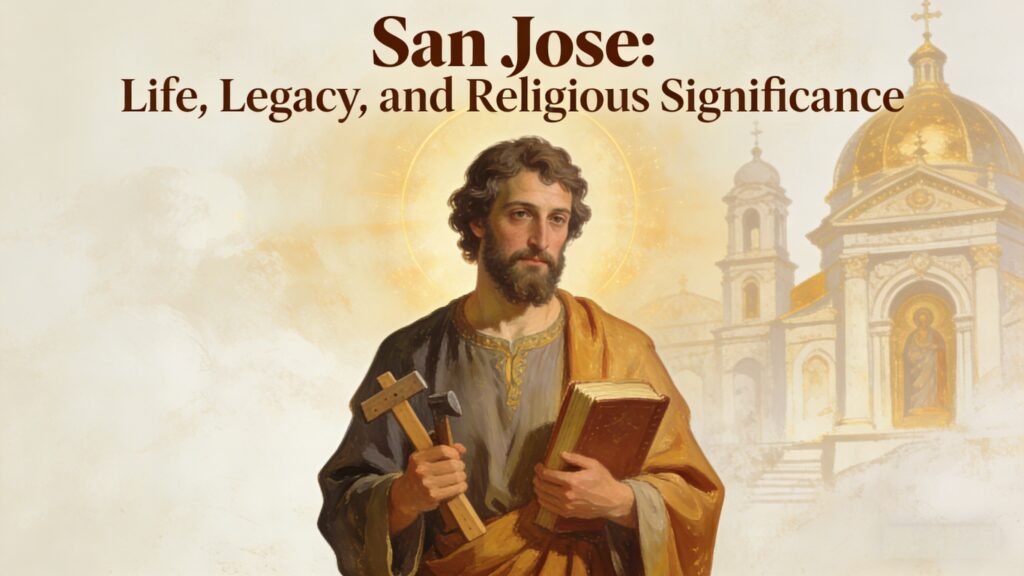
San Jose: Life, Legacy, and Religious Significance
1. The Identity and Historical Context of San Jose
San Jose, recognized throughout Christian tradition as Saint Joseph, stands as one of the most revered figures in religious history. This comprehensive analysis examines the life, legacy, and religious significance of this remarkable individual who served as the earthly father of Jesus Christ and husband of the Virgin Mary. The name “San Jose,” derived from Spanish and Portuguese, translates directly to “Saint Joseph” in English, reflecting his universal importance across diverse Christian denominations .
1.1 Identifying San Jose: The Man Behind the Name
The figure of San Jose, also known as St. Joseph, holds a significant place in the Christian faith as the husband of the Virgin Mary and the earthly father of Jesus . Historical records indicate that Joseph was originally from Bethlehem but lived and worked as a carpenter in Nazareth . He is described in the Gospel of Matthew as being a “righteous” man and a descendant of King David . When his betrothed Mary became pregnant through the Holy Spirit, Joseph initially planned to divorce her quietly to spare her from disgrace, but an angel appeared to him in a dream, revealing the divine nature of the child .
The biblical accounts provide limited direct information about Joseph’s life, with the Gospels of Matthew and Luke revealing the most details about his character and role . After Jesus’s birth, Joseph acted as his adoptive father and protected the Holy Family from King Herod’s wrath by fleeing with Mary and Jesus to Egypt . The last biblical mention of Joseph occurs when the twelve-year-old Jesus remained behind in the Temple of Jerusalem, causing great concern to both Joseph and Mary .
1.2 Historical Background and Biblical Context
San Jose’s historical significance is deeply rooted in first-century Palestine, a period marked by Roman occupation and religious fervor. As a descendant of King David, Joseph belonged to a distinguished lineage that carried messianic expectations . His role as a carpenter placed him within the working class of his society, yet his spiritual significance far exceeded his social standing.
The biblical narrative reveals Joseph’s exceptional character through his response to extraordinary circumstances. When confronted with Mary’s pregnancy, his initial reaction was one of righteous consideration for her welfare . The angel’s intervention in his dream redirected his path, leading him to accept his divinely appointed role as the guardian of the Holy Family . This narrative demonstrates Joseph’s qualities of obedience, faith, and selflessness that would later characterize his legacy in Christian tradition.
1.3 Religious Denominations and the Veneration of San Jose
San Jose is venerated across multiple Christian denominations, including the Catholic Church, Eastern Orthodox Church, Oriental Orthodox Church, Anglicanism, and Lutheranism . This widespread veneration reflects his universal appeal as a model of virtue and faithfulness. In Catholic traditions, Joseph is regarded as the patron saint of workers and is associated with various feast days .
The Eastern Orthodox Church maintains a particularly rich tradition of devotion to Saint Joseph, recognizing him as the righteous man chosen by God for a significant role in His salvation plan . Orthodox churches throughout the world, including those in the United States, maintain the true faith and holy tradition handed down from generation to generation regarding Joseph’s importance .
2. The Life and Ministry of San Jose
2.1 Early Life and Family Background
San Jose’s early life was marked by his humble origins and righteous character. Born in Bethlehem, he was a descendant of the house of King David, placing him in a prestigious lineage with messianic connections . His family later settled in Nazareth, where Joseph established himself as a skilled carpenter . The biblical account provides few details about his childhood or early adulthood, focusing instead on his pivotal role in the life of Jesus.
Historical traditions suggest that Joseph may have been a widower with children from a previous marriage at the time of his betrothal to Mary, though this remains a matter of scholarly debate . The 2nd-century Protevangelium of James and the 4th-century History of Joseph the Carpenter present him as having children from a prior marriage, contributing to discussions about Jesus’ siblings .
2.2 Joseph’s Role in the Holy Family
San Jose’s most significant role was as the head of the Holy Family, a position that carried profound spiritual and practical responsibilities. The biblical narrative emphasizes his role as the legal and spiritual father of Jesus, even though the conception was through the Holy Spirit . This unique relationship established Joseph as a crucial figure in the divine plan of salvation.
Joseph’s role extended beyond mere guardianship to encompass active participation in the upbringing of Jesus. After the family’s return from Egypt following Herod’s death, they settled in Nazareth, where Joseph taught his carpentry trade to Jesus . This apprenticeship provided Jesus with both practical skills and a model of responsible, faithful living.
The Holy Family’s life in Nazareth was characterized by simplicity and obedience to God’s will. Joseph’s role as the family’s provider and protector demonstrated his faithfulness in fulfilling his divinely appointed responsibilities. His quiet strength and steadfast devotion would later serve as a model for Christian fathers and families worldwide.
2.3 The Flight to Egypt and Return to Nazareth
One of the most significant episodes in San Jose’s life was the flight to Egypt, undertaken to protect the infant Jesus from King Herod’s murderous intentions. An angel appeared to Joseph in a dream, warning him of the danger and instructing him to flee to Egypt . Joseph immediately obeyed, demonstrating his characteristic trust in divine guidance.
The family’s time in Egypt lasted until Herod’s death, after which Joseph received another angelic message instructing him to return to Israel . However, upon learning that Herod’s son Archelaus ruled in Judea, Joseph was warned in a dream to avoid that region and instead settled in Nazareth in Galilee . This journey demonstrates Joseph’s continued obedience to divine guidance and his commitment to protecting the Holy Family.
The return to Nazareth marked the beginning of Jesus’s formative years under Joseph’s care. The family’s life in this Galilean village provided a stable environment for Jesus’s growth and development, with Joseph serving as both father and teacher. This period established the foundation for Jesus’s later ministry and provided the world with a model of family life centered on faith and obedience to God.
3. San Jose in Catholic and Orthodox Traditions
3.1 Catholic Church’s Teachings on San Jose
The Catholic Church has developed a rich theological tradition surrounding San Jose, recognizing him as a model of virtue and faith. The Church teaches that Joseph’s primary role was as the spouse of the Blessed Virgin Mary and the legal father of Jesus Christ . His importance extends beyond his biological role to encompass his participation in the divine economy of salvation.
Pope Pius IX’s declaration of Joseph as the patron saint of the universal church in 1870 marked a watershed moment in Catholic devotion to San Jose . This proclamation, made through the decree Quemadmodum Deus, recognized Joseph’s unique role as the custodian of the very seed of the Church—the Holy Family of Nazareth . The Church teaches that Joseph’s faithfulness in protecting and providing for Mary and Jesus makes him a fitting patron for the entire Christian community.
The Catholic Church has established several feast days in honor of San Jose, including the principal feast on March 19, celebrating him as the spouse of Mary, and May 1, honoring him as St. Joseph the Worker . These celebrations reflect the Church’s recognition of Joseph’s roles as both a spiritual leader and a model of Christian work ethic.
3.2 Orthodox Church’s Perspective on San Jose
The Orthodox Church maintains a profound reverence for San Jose, viewing him as a righteous man chosen by God for a unique role in salvation history. In Orthodox tradition, Joseph is remembered as the righteous one who was chosen to be the husband of Mother Mary and to protect both Mary and the child Jesus . The Orthodox Church emphasizes Joseph’s role as the guardian of the Holy Family and his faithfulness to God’s will.
Orthodox devotion to San Jose includes specific liturgical celebrations and theological teachings that highlight his importance. The Orthodox Church recognizes Joseph as the patron saint of workers, the homeless, and families . This broad patronage reflects the Orthodox understanding of Joseph’s universal relevance and his role as a protector and provider.
The Orthodox Church also maintains unique traditions regarding Joseph’s death, believing that Mary and Jesus were present at his bedside, which has led to his invocation for assistance at the hour of death . This belief has made Joseph particularly venerated as the patron saint of a happy death.
3.3 Doctrinal Differences and Common Ground
While the Catholic and Orthodox Churches share a fundamental reverence for San Jose, there are some doctrinal differences in their understanding of his role and significance. The Catholic Church has developed a more extensive devotional tradition around Joseph, including the establishment of his role as patron of the universal church and various specific patronages .
The Orthodox Church, while maintaining deep respect for Joseph, tends to focus more on his role within the Holy Family and his relationship to Mary and Jesus. Orthodox theology emphasizes Joseph’s humanity and his role as a model of faith and obedience, while Catholic devotion often highlights his intercessory role and protective functions.
Despite these differences, both traditions recognize Joseph as a figure of profound spiritual significance. Both churches celebrate his feast day on March 19 and recognize his role as the earthly father of Jesus and spouse of Mary. The common ground between these traditions reflects the universal appeal of Joseph’s character and his importance in Christian salvation history.
4. San Jose’s Theological Significance and Symbolism
4.1 San Jose as a Model of Virtue
San Jose’s theological significance extends far beyond his historical role to encompass his function as a model of Christian virtue. The Church presents Joseph as a paragon of humility, obedience, and faithfulness. His response to the angel’s message in his dream—immediate obedience despite the potential difficulties and social stigma—demonstrates his exceptional character .
Joseph’s virtue is particularly evident in his response to Mary’s pregnancy. Rather than reacting with anger or suspicion, he chose to act righteously, initially planning to divorce Mary quietly to spare her from disgrace . This decision reflects his compassionate nature and his commitment to doing what was best for Mary, even at personal cost. His subsequent obedience to the angel’s revelation demonstrates his openness to God’s will and his willingness to accept extraordinary responsibilities.
The Church teaches that Joseph’s virtues—including his humility, obedience, chastity, and devotion to family—make him an ideal model for Christian life. His quiet strength and steadfast faith provide a template for how believers should respond to God’s call, even when that call involves challenges and sacrifices.
4.2 Joseph’s Role in Salvation History
San Jose occupies a unique position in Christian salvation history as the earthly father of Jesus Christ. While not directly involved in the redemptive act itself, Joseph’s role was crucial to the incarnation of God in human form. His willingness to accept Mary as his wife and Jesus as his son made possible the human life of Jesus and the establishment of the Holy Family .
Joseph’s role in salvation history extends beyond his physical relationship to Jesus. His obedience to God’s will, demonstrated through his responses to the angelic messages, established a pattern of faithfulness that would characterize the Christian life. His role as the head of the Holy Family provided Jesus with the human context necessary for his ministry and his sacrifice on the cross.
Theological reflection on Joseph often emphasizes his role as a “hidden” saint—one whose importance lies not in public ministry or dramatic miracles, but in faithful service to God’s will. This aspect of Joseph’s character makes him particularly relevant as a model for ordinary Christians who may not have opportunities for public ministry but can demonstrate their faith through faithful living.
4.3 Marian Devotion and Joseph’s Relationship to Mary
San Jose’s relationship with the Virgin Mary is central to his theological significance. As the spouse of Mary, Joseph was entrusted with the care of the mother of God, a responsibility that carried profound spiritual implications. The Church teaches that Joseph’s role as Mary’s spouse was one of protection, provision, and support, reflecting God’s plan for the Holy Family .
Joseph’s relationship with Mary demonstrates the importance of mutual respect and support within Christian marriage. His willingness to accept Mary despite the unusual circumstances of her pregnancy shows his faith in God’s plan and his commitment to fulfilling his responsibilities. The Church presents their relationship as a model of Christian marriage, characterized by faith, obedience, and mutual support.
Marian devotion often includes special attention to Joseph as the spouse of Mary. Many Catholic and Orthodox prayers and devotions honor Joseph alongside Mary, recognizing their shared role in the divine plan. This joint veneration reflects the theological understanding that Joseph’s role was inseparable from Mary’s and that their cooperation was essential to God’s redemptive purposes.
5. San Jose’s Cultural Impact and Global Influence
5.1 San Jose’s Patronage Across Nations
San Jose’s influence extends far beyond his religious significance to encompass widespread cultural and national patronage. He serves as the patron saint of numerous countries, including Mexico, Canada, Belgium, Austria, Bohemia, Peru, and southern Vietnam . This extensive patronage reflects the universal appeal of Joseph’s character and the diverse ways in which different cultures have adopted him as their protector.
In Mexico, San Jose holds particular significance as the patron saint of the nation, with the “Día de San José” involving elaborate celebrations that include the creation of altars adorned with flowers and food offerings . These celebrations demonstrate the deep cultural significance of Joseph in Mexican society and his role as a protector of the Mexican people.
Canada also recognizes San Jose as its patron saint, with St. Joseph’s Oratory in Montreal hosting annual novenas and special masses that draw thousands of pilgrims . The oratory’s prominence in Canadian religious life reflects Joseph’s importance in the spiritual and cultural life of the nation.
5.2 Architectural and Artistic Legacy
San Jose’s cultural impact is evident in the numerous churches, cathedrals, and religious buildings dedicated to him throughout the world. The Cathedral Basilica of St. Joseph in San Jose, California, serves as the seat of the Roman Catholic Diocese of San Jose and holds the distinction of being a minor basilica . This magnificent building, named for Saint Joseph, patron saint of the universal church, stands as a testament to Joseph’s enduring influence .
Artistic depictions of San Jose have played a significant role in Christian art and culture. Renaissance and Baroque artists frequently portrayed Joseph alongside Mary and the infant Jesus, with works by artists such as Raphael and Murillo depicting the Holy Family in various settings . These artistic representations have helped to shape popular understanding of Joseph’s character and his role within the Holy Family.
The architectural and artistic legacy of San Jose reflects his universal appeal across different cultures and time periods. From grand cathedrals to simple parish churches, from elaborate paintings to humble statues, Joseph’s image appears throughout the Christian world, serving as a reminder of his spiritual significance and cultural importance.
5.3 Popular Devotions and Traditions
San Jose’s popularity as a saint has generated numerous devotional practices and traditions across different cultures. The Feast of St. Joseph, celebrated on March 19, is marked by special masses, processions, and other religious ceremonies throughout the world . In many countries, this feast day has become a time for family gatherings and community celebrations.
One of the most distinctive aspects of San Jose’s devotion is the variety of patronages associated with him. Beyond his role as patron of the universal church, Joseph is also venerated as the patron saint of workers, carpenters, fathers, families, the dying, and numerous other groups and professions . This diversity of patronages reflects the comprehensive nature of his intercessory role and his relevance to various aspects of human life.
Special devotions to San Jose include the wearing of St. Joseph medals, the saying of St. Joseph prayers, and the celebration of St. Joseph novenas. Many families have special traditions associated with Joseph, including the practice of “St. Joseph tables” in Italian-American communities, where elaborate feasts are prepared in his honor . These traditions demonstrate the deep personal and communal significance that Joseph holds for many believers.
6. San Jose’s Modern Relevance and Contemporary Applications
6.1 San Jose in Modern Christian Life
San Jose’s relevance to modern Christian life extends across multiple dimensions of faith and practice. His role as a model of fatherhood has particular significance in contemporary society, where the importance of responsible fatherhood is increasingly recognized. Joseph’s example of providing for and protecting his family while remaining obedient to God’s will offers a template for Christian fathers today.
The modern Church continues to emphasize San Jose’s role as a patron of workers, particularly in the celebration of St. Joseph the Worker on May 1 . This feast day, established by Pope Pius XII in 1955, highlights Joseph’s dignity as a laborer and his importance as a patron for all who work. In an era of economic uncertainty and changing work patterns, Joseph’s example of honest, faithful work provides a valuable model.
Joseph’s intercessory role also remains relevant in modern Christian practice. Many believers turn to St. Joseph for help in various situations, including finding employment, protecting families, and obtaining spiritual guidance. His reputation as a powerful intercessor reflects the Church’s teaching on the communion of saints and the role of the saints in supporting and guiding the faithful.
6.2 Social and Ethical Implications
San Jose’s life and example carry significant social and ethical implications for contemporary society. His role as a protector of the vulnerable, particularly his care for Mary and the infant Jesus, provides a model for social responsibility and concern for the welfare of others. Joseph’s willingness to take on the responsibility of caring for Mary, even when it meant accepting social stigma, demonstrates the importance of standing by those in need.
The Church’s teaching on San Jose as a patron of families has particular relevance in contemporary discussions about family values and social policy. Joseph’s role as the head of the Holy Family provides a model for family life that emphasizes love, respect, and mutual support. His example challenges modern society to prioritize family relationships and to provide support for families facing 困难.
Joseph’s example also has implications for social justice issues, particularly those related to workers’ rights and economic justice. As the patron saint of workers, Joseph’s life as a carpenter who provided for his family through honest labor offers a perspective on the dignity of work and the importance of fair treatment for all workers.
6.3 Ecumenical and Interfaith Perspectives
San Jose’s universal appeal makes him a significant figure in ecumenical and interfaith dialogue. His recognition across multiple Christian denominations provides a common ground for Christian unity and cooperation. The fact that both Catholic and Orthodox churches venerate Joseph as a saint of great importance offers opportunities for dialogue and mutual understanding between these traditions.
Beyond Christian denominations, San Jose’s role as a figure of moral and spiritual significance may also have relevance in interfaith contexts. His example of faithfulness, obedience, and service to others transcends denominational boundaries and offers universal values that can be appreciated by people of various religious backgrounds.
The ecumenical significance of San Jose is evident in the various international organizations and movements dedicated to promoting devotion to him. These organizations often include members from different Christian traditions, working together to promote understanding and appreciation of Joseph’s spiritual importance. This cooperation demonstrates the unifying potential of devotion to a common spiritual figure.
7. Comparative Analysis: San Jose and Other Religious Figures
7.1 Similarities with Other Biblical Patriarchs
San Jose shares several important characteristics with other biblical patriarchs, particularly in terms of his role as a faithful servant of God who received divine revelations. Like Abraham, Joseph was called by God to undertake a journey of faith that involved leaving familiar surroundings and trusting in divine guidance. The parallels between Joseph’s flight to Egypt and Abraham’s call to leave Ur demonstrate the biblical pattern of faithful obedience to God’s commands.
Similar to other patriarchs such as Isaac and Jacob, San Jose was chosen by God for a special role in His redemptive plan. His lineage from King David connects him to the messianic expectations that characterized the Hebrew tradition, and his role as the earthly father of the Messiah establishes him as a crucial link in the chain of salvation history.
Joseph’s relationship to Jesus also parallels the relationships between other biblical patriarchs and their famous descendants. Like Noah, who was chosen to preserve humanity through the flood, Joseph was chosen to preserve the Messiah through his protective care. These parallels demonstrate the continuity of God’s saving actions throughout biblical history and highlight Joseph’s importance in the larger narrative of salvation.
7.2 Contrasts with Other Saints and Religious Leaders
While San Jose shares characteristics with other biblical figures, he also presents unique features that distinguish him from other saints and religious leaders. Unlike many other saints who achieved prominence through public ministry, miracles, or martyrdom, Joseph’s significance lies primarily in his faithful service within the context of family life. His holiness is characterized by quiet obedience rather than dramatic public actions.
Joseph’s relationship to Jesus also distinguishes him from other religious figures. Unlike John the Baptist, who was specifically called to prepare the way for Jesus, or the apostles who witnessed His ministry and spread His teachings, Joseph’s role was primarily one of earthly fatherhood and protection. This unique position gives Joseph a special place in Christian devotion as the only human to have served as Jesus’s father during His childhood and early adulthood.
The contrast between Joseph’s life and the lives of other saints also extends to his death. Unlike many martyrs who died for their faith, Joseph is believed to have died peacefully in the presence of Mary and Jesus, making him the patron saint of a happy death. This peaceful death, combined with his role as a protector and provider, gives Joseph a unique position in Christian spirituality.
7.3 Distinctive Characteristics of San Jose’s Veneration
San Jose’s veneration exhibits several distinctive characteristics that set it apart from the devotion given to other saints. One of the most notable features of Joseph’s devotion is its universality across different Christian traditions. While many saints are primarily venerated within specific denominations or regions, Joseph’s importance is recognized throughout the Christian world.
The diversity of Joseph’s patronages also distinguishes him from other saints. His roles as patron of the universal church, patron of workers, patron of families, patron of the dying, and numerous other patronages create a comprehensive intercessory role that few other saints can match. This diversity reflects the comprehensive nature of Joseph’s life and his relevance to various aspects of human experience.
Another distinctive feature of Joseph’s veneration is its emphasis on his role as a father and provider. While many saints are venerated for their asceticism or their spiritual achievements, Joseph is particularly honored for his domestic virtues and his role within family life. This emphasis on the sanctity of family life and the importance of domestic virtues makes Joseph’s devotion particularly relevant to contemporary concerns about family values and the challenges of modern life.
8. Frequently Asked Questions About San Jose
8.1 Who is San Jose in the Bible?
San Jose is the Spanish and Portuguese name for Saint Joseph, who is identified in the Bible as the husband of the Virgin Mary and the earthly father of Jesus Christ . The biblical accounts of Joseph appear primarily in the Gospels of Matthew and Luke, which provide information about his lineage, his marriage to Mary, and his role in protecting the Holy Family .
According to the biblical narrative, Joseph was a righteous man from the house of David who lived in Nazareth as a carpenter . When Mary, his betrothed, became pregnant through the Holy Spirit, Joseph initially planned to divorce her quietly to spare her from disgrace, but an angel appeared to him in a dream, revealing the divine nature of the child . Joseph obeyed the angel’s instruction and took Mary as his wife.
The biblical accounts describe Joseph’s role in protecting Jesus from King Herod by fleeing with Mary and the infant Jesus to Egypt . After Herod’s death, Joseph was instructed by an angel to return to Israel, and the family settled in Nazareth, where Joseph taught his carpentry trade to Jesus .
8.2 What is the significance of San Jose in Christianity?
San Jose holds profound significance in Christianity as the earthly father of Jesus and the spouse of Mary. His role in the incarnation of God in human form makes him a crucial figure in Christian theology and salvation history. The Church teaches that Joseph’s obedience to God’s will and his faithfulness in protecting the Holy Family demonstrate his importance in the divine plan of salvation.
The significance of San Jose extends beyond his historical role to encompass his function as a model of Christian virtue. His humility, obedience, faithfulness, and devotion to family make him an ideal example for Christian life. The Church presents Joseph as a paragon of fatherhood, providing a model for Christian fathers in their roles as providers and protectors of their families.
Pope Pius IX’s declaration of Joseph as the patron saint of the universal church in 1870 established his role as a special intercessor for the entire Christian community . This recognition reflects the Church’s understanding of Joseph’s unique position in salvation history and his continued importance in the life of the Church.
8.3 How is San Jose celebrated in different countries?
San Jose is celebrated with great enthusiasm in numerous countries throughout the world, with celebrations varying according to local customs and traditions. In Mexico, the “Día de San José” involves elaborate celebrations that include the creation of ornate altars adorned with flowers, candles, and food offerings . These celebrations often include processions, special masses, and community gatherings.
In Canada, San Jose is recognized as the patron saint of the nation, with St. Joseph’s Oratory in Montreal hosting annual novenas and special masses that attract thousands of pilgrims . The oratory’s prominence in Canadian religious life reflects the deep devotion that Canadians have for St. Joseph.
In Italy and Italian-American communities, St. Joseph’s Day celebrations often include the tradition of “St. Joseph tables,” where elaborate feasts are prepared and shared with the community . These celebrations are particularly common in Sicily, where San Jose is considered the patron saint and is credited with protecting the island from famine during the Middle Ages.
In many countries, the Feast of St. Joseph on March 19 is marked by special religious services, processions, and other celebrations. These celebrations often include the blessing of bread and other foods, as well as special devotions to St. Joseph as the patron of workers and families.
9. Conclusion: The Enduring Legacy of San Jose
San Jose’s legacy as Saint Joseph stands as one of the most enduring and universally recognized in all of Christianity. His life, characterized by humility, obedience, and faithfulness, provides a timeless model for Christian living that transcends cultural boundaries and denominational differences. As the earthly father of Jesus Christ and the spouse of the Virgin Mary, Joseph occupies a unique position in salvation history that continues to inspire believers worldwide.
The significance of San Jose extends far beyond his historical role to encompass his function as a spiritual guide and intercessor. His numerous patronages—including his role as patron of the universal church, patron of workers, and patron of families—reflect the comprehensive nature of his spiritual influence and his relevance to various aspects of human experience. Whether providing guidance for fathers, offering protection for families, or serving as a model for workers, Joseph’s example continues to offer valuable lessons for modern Christian life.
The global impact of San Jose’s devotion is evident in the numerous churches, cathedrals, and religious institutions dedicated to him throughout the world. From the magnificent Cathedral Basilica of St. Joseph in San Jose, California, to the humble parish churches in rural communities, Joseph’s presence is felt in the architectural and spiritual landscape of Christianity. His image appears in countless works of art, from Renaissance masterpieces to contemporary religious paintings, serving as a visual reminder of his spiritual significance.
The contemporary relevance of San Jose’s life and example continues to manifest in various ways. His role as a model of fatherhood provides important guidance for modern families, while his identity as a patron of workers offers perspective on the dignity of labor and economic justice. His reputation as a powerful intercessor continues to inspire prayers and devotions from believers seeking guidance, protection, and spiritual support.
Looking forward, San Jose’s legacy will likely continue to evolve as the Church and society face new challenges and opportunities. His example of faithful obedience to God’s will, even in the face of difficult circumstances, provides a timeless message of hope and trust that remains relevant regardless of changing social and cultural contexts. As the world continues to grapple with issues of family, work, and social responsibility, Joseph’s life offers valuable insights and spiritual guidance.
In conclusion, the enduring legacy of San Jose reflects the universal human need for spiritual models who demonstrate faithfulness, courage, and devotion to God’s will. His quiet strength and steadfast commitment to serving God through his family and community provide a model that transcends time and culture, offering hope and inspiration to believers throughout the world. As the Church continues to proclaim the message of salvation through Jesus Christ, the role of San Jose as the earthly father of the Savior remains an integral part of the Christian story, serving as a bridge between the divine and human aspects of the incarnation.
The life and legacy of San Jose remind us that holiness can be found in the ordinary circumstances of daily life, in faithful service to family and community, and in obedience to God’s will even when that obedience requires sacrifice. His example challenges us to seek God’s will in our own lives and to remain faithful to our responsibilities, trusting that our efforts, however modest, can contribute to God’s redemptive purposes in the world. In this way, the legacy of San Jose continues to inspire and guide believers on their spiritual journeys, offering a vision of Christian life that is both attainable and transformative.