St Thomas: The Apostle
1. Introduction: The Enigmatic Figure of St Thomas
1.1 Who Was St Thomas?
St Thomas, also known as Thomas the Apostle or “Doubting Thomas,” stands as one of the most complex and compelling figures in Christian history. Born in the 1st century AD in Galilee, Roman Empire, he was one of the twelve disciples chosen by Jesus Christ to spread his message throughout the world. St Thomas’s name in Aramaic (Teʾoma) and Greek (Didymos) both mean “twin,” earning him the designation “Thomas, called the Twin” in the Gospel of John. This disciple, who initially doubted Christ’s resurrection but later became one of his most ardent followers, has left an indelible mark on Christian tradition through his journey from skepticism to faith, his missionary labors in India, and his ultimate martyrdom. He is more than just a historical figure; he is a symbol of honest faith, one who refused to accept truth without personal encounter, making his story resonate with believers across millennia.
St Thomas’s life presents a fascinating paradox. While he is most famously remembered for his moment of doubt when he refused to believe in Christ’s resurrection without physical proof, he later became known as one of the most courageous missionaries in the early church. According to historical tradition, he traveled to India, where he established Christian communities that continue to thrive today, nearly two millennia after his arrival. His story offers profound insights into the nature of faith, doubt, and the transformative power of encountering the risen Christ. His journey reminds us that faith is not the absence of doubt, but the willingness to seek truth even when questions linger.
1.2 Historical Context and Biblical References
He appears in all four Gospel lists of the twelve apostles (Matthew 10:3; Mark 3:18; Luke 6:15; Acts 1:13), but the Gospel of John provides the most detailed account of his personality and his relationship with Jesus. The biblical narrative reveals a man of deep emotions and honest questions, someone who was not afraid to express his doubts or to make profound declarations of faith. St Thomas’s presence in the Gospel accounts is a testament to his importance among the early disciples, as his interactions with Jesus offer unique glimpses into the nature of discipleship.
The historical context of his life was one of great upheaval and change. The Roman Empire dominated the Mediterranean world, while Judaism awaited the coming of the Messiah. Against this backdrop, Jesus of Nazareth emerged, gathering disciples who would carry his message forward after his death and resurrection. He was part of this select group, chosen not despite his doubts but perhaps because of his honest and questioning nature. In a time when blind adherence was often expected, his willingness to ask “why” and “how” made him a relatable figure for future generations of Christians.
Christian tradition holds that he was the first missionary to India, where he founded what is now known as the Church of the Syrian Malabar Christians, or St Thomas Christians. This ancient Christian community, with a history spanning nearly two thousand years, represents one of the earliest instances of Christian evangelization outside the Mediterranean world. St Thomas’s mission to India is a crucial part of his legacy, as it demonstrates the universal reach of the Gospel message he was called to proclaim.
1.3 The Significance of St Thomas in Christian Tradition
He holds a unique position in Christian tradition as both the “doubter” and the “believer.” St Thomas’s famous declaration, “My Lord and my God!” (John 20:28), stands as one of the clearest affirmations of Christ’s divinity in the entire New Testament. This moment of recognition has made him a symbol of how honest questioning can lead to profound faith. His story teaches us that doubt is not a sin, but a stepping stone to deeper understanding of God’s truth.
Beyond his biblical significance, he has become the patron saint of several groups and professions. He is recognized as the patron saint of architects, builders, and stoneworkers, due to traditions that describe him as a skilled craftsman. He is also the patron saint of India, Pakistan, and Sri Lanka, as well as of blind people and those seeking to strengthen their faith. St Thomas’s patronage reflects the diverse ways in which his life and witness have touched people across cultures and centuries.
The feast day of this apostle is celebrated on different dates by various Christian denominations. The Roman Catholic Church and many other Western churches observe it on December 21, though since 1969, the Roman Catholic Church has also recognized July 3 as a feast day. Eastern Orthodox churches celebrate the feast on October 6. This diversity in celebration dates reflects the widespread influence of him across different Christian traditions, as believers around the world honor his life and legacy.
2. St Thomas in the Bible: From Doubt to Faith
2.1 Early Life and Calling as an Apostle
The biblical accounts provide limited information about his early life before he became an apostle. We know that he was from Galilee and was a fisherman by trade, like several of the other apostles. St Thomas’s calling to follow Jesus is not specifically narrated in the Gospels, but we can infer from the biblical text that he, like the other disciples, responded to Jesus’ invitation with faith and commitment. His decision to leave his livelihood and follow Jesus is a testament to his initial trust in the Messiah, even before he fully understood the implications of that choice.
What makes his calling particularly interesting is the glimpse we get of his character even before the resurrection. In John 11:16, when Jesus announced his intention to return to Judea to raise Lazarus from the dead, the disciples warned him about the danger, noting that the Jews had recently tried to stone him. It was this apostle who responded with remarkable courage, saying to the other disciples, “Let us also go, that we may die with him.” This statement reveals a man of deep loyalty and willingness to face danger for the sake of his master. St Thomas’s courage in this moment stands in contrast to his later doubt, showing the complexity of his personality.
The name “St Thomas” itself carries significance. In Aramaic, it means “twin,” and in the Gospel of John, he is often referred to as “Thomas (also called Didymus).” Some traditions suggest that he may have had an actual twin brother, while others interpret the name symbolically, perhaps suggesting a dual nature or a capacity for both doubt and faith. Regardless of the literal meaning, this name has become synonymous with honest questioning and eventual faith, thanks to his life story.
2.2 The Famous Doubt and the Road to Faith
The most well-known episode in his life is undoubtedly his moment of doubt following Jesus’ resurrection. According to John 20:24-25, he was not with the other disciples when Jesus first appeared to them after rising from the dead. When the disciples told him, “We have seen the Lord,” he famously replied, “Unless I see the nail marks in his hands and put my finger where the nails have been, and put my hand into his side, I will not believe.” This moment of doubt has earned him the enduring nickname “Doubting St Thomas,” yet it also reveals a man of intellectual integrity who would not accept second-hand testimony about something as extraordinary as the resurrection.
St Thomas’s demand for physical evidence reflects a rational approach to faith that many believers can relate to—the need for personal encounter and proof. In a world where claims of miracles and divine intervention were common, his skepticism was a sign of his commitment to truth. He did not want to believe blindly; he wanted to know for himself that Jesus had truly risen from the dead. His doubt was not a rejection of faith, but a desire for a faith rooted in reality.
Eight days later, Jesus appeared again to the disciples, and this time he was present. Jesus graciously invited him to examine his wounds, saying, “Put your finger here; see my hands. Reach out your hand and put it into my side. Stop doubting and believe.” The apostle’s response was immediate and profound: “My Lord and my God!” This declaration represents one of the most explicit acknowledgments of Jesus’ divinity in all of Scripture. St Thomas’s doubt had been transformed into unshakable faith, a journey that continues to inspire believers today.
2.3 Biblical Accounts and Key Scriptures
The biblical accounts of him are concentrated primarily in the Gospel of John, which provides the most detailed portrait of his character and his relationship with Jesus. In addition to the resurrection account, John’s Gospel records several other significant interactions between him and Jesus. These moments offer a deeper understanding of his personality and his growing faith in Jesus.
In John 14:1-7, during the Last Supper, Jesus spoke to his disciples about going to prepare a place for them, saying, “You know the way to the place where I am going.” It was this apostle who asked the question that has resonated with believers throughout history: “Lord, we don’t know where you are going, so how can we know the way?” Jesus’ response—”I am the way and the truth and the life. No one comes to the Father except through me”—has become one of the most famous passages in the Bible. St Thomas’s question led to a profound revelation about Jesus’ identity, showing that his willingness to ask questions was a gift to the entire community of believers.
He is also mentioned in the post-resurrection appearance at the Sea of Tiberias, recorded in John 21:2, where he is listed among the disciples who had returned to fishing after Jesus’ death. This brief mention reminds us that the apostles were ordinary men who returned to their former occupations when their world was turned upside down by the death of their master. St Thomas’s return to fishing is a humbling reminder that even the closest followers of Jesus can struggle with uncertainty, yet God continues to work in their lives.
The biblical accounts of this apostle present a complex and multifaceted character. He is neither simply a doubter nor merely a believer, but rather a human being who experienced the full range of emotions—fear, doubt, loyalty, and finally, profound faith. St Thomas’s story reminds us that faith is not about the absence of questions but about the willingness to engage honestly with those questions and to trust in the God who meets us in our doubt. His biblical legacy is one of honesty, courage, and transformative faith.
3. The Life and Ministry of St Thomas
3.1 From Galilee to India: The Apostle’s Journey
Following the resurrection and ascension of Jesus, the apostles were commissioned to spread the gospel throughout the world. While the biblical accounts are relatively silent about the later ministries of most apostles, tradition and historical evidence provide compelling information about his missionary journey to India. St Thomas’s decision to travel to such a distant land is a testament to his commitment to the Great Commission, as he left behind the familiarity of his homeland to proclaim the Gospel to people he had never met.
According to the Acts of St Thomas, an early Christian apocryphal work, he was initially reluctant to accept the mission to India. The text tells a fascinating story of how Jesus appeared to him in a vision and “sold” him to an Indian merchant named Abbanes for twenty pieces of silver, directing him to go to India to preach the gospel. This dramatic narrative, while not part of the biblical canon, reflects the early church’s understanding of his calling to the Indian subcontinent. St Thomas’s reluctance, followed by his obedience, mirrors the struggle many believers face when called to step out of their comfort zones.
Historical records indicate that he arrived in India around 52 AD, landing at Muziris (modern-day Kodungallur) on the Malabar Coast of present-day Kerala. The written records of St Thomas Christians confirm that Christianity was introduced to the Indian subcontinent by this apostle, who sailed to the Malabar region in 52 AD. This date is significant as it places his arrival in India within just two decades of Jesus’ resurrection, making the Indian Christian community one of the oldest in the world. St Thomas’s journey to India was a remarkable feat of courage and faith, as he traveled thousands of miles by sea to fulfill his mission.
3.2 Missionary Activities in India
Once in India, he began an extensive ministry that would have lasting impact. He is believed to have traveled throughout the Indian subcontinent, establishing churches and converting people to Christianity. According to tradition, he founded seven churches in different parts of India, including Kodungallur, Kollam, Niranam, Chayal, Kokkamangalam, Palayur, and Thiruvithamcode. These churches became centers of Christian worship and community, laying the foundation for the St Thomas Christian tradition that continues today.
The apostle’s missionary strategy appears to have been multifaceted. He preached in synagogues, as was the custom of Jewish missionaries of that time, and also engaged with the local population through acts of healing and miracle-working. Historical accounts suggest that he encountered both receptive audiences and fierce opposition. The Acts of St Thomas records that he converted several members of the royal court, including the wife and brother of King Gondophares. St Thomas’s ability to reach people from all social classes—from royalty to commoners—demonstrates the universal appeal of the Gospel message he proclaimed.
One of the most significant aspects of his ministry in India was his approach to evangelization. He did not merely impose a foreign religion on the Indian people but rather sought to understand and engage with their culture. This approach resulted in a unique form of Christianity that blended biblical teachings with Indian philosophical and cultural elements, creating a distinct tradition known as St Thomas Christianity. St Thomas’s cultural sensitivity is a model for modern missionaries, showing that the Gospel can be proclaimed in a way that honors local traditions and values.
3.3 Establishing the Church in India
St Thomas’s work in India was not limited to preaching and conversion; he also established a structured ecclesiastical organization. He ordained local leaders, established liturgical practices, and created a framework for Christian community life that would sustain the church for centuries. This early organization was crucial to the survival of Indian Christianity through periods of political upheaval and religious persecution. His foresight in establishing a local leadership structure ensured that the church would continue to thrive even after his departure.
The community that he established was remarkably diverse, including people from various social strata. Historical records mention that he converted two sisters, Tertiana and Migdonia, both wives of Indian princes. These conversions, though they caused significant social disruption, demonstrate his ability to transcend social boundaries in his missionary work. St Thomas’s ministry was inclusive, welcoming people from all walks of life into the Christian community, regardless of their social status or background.
The theological foundation that he established in India emphasized the incarnation, the resurrection, and the teachings of Jesus about love and justice. He is said to have particularly emphasized the importance of living a life of faith that was integrated with daily activities and social responsibilities. This practical approach to Christianity helped the Indian Christian community maintain its identity while adapting to the cultural context. St Thomas’s theological teachings continue to shape the faith of millions of St Thomas Christians today, who look to him as their spiritual father.
3.4 The Apostle’s Martyrdom and Legacy
The end of his life came through martyrdom, which occurred around 72 AD in Mylapore, near present-day Chennai. According to tradition, he was killed with a spear at St Thomas Mount in Chennai on July 3, 72 AD, and his body was interred in Mylapore. The manner of his death—being pierced with a lance—mirrors the wound that Jesus received on the cross, symbolizing his unwavering faith to the end. St Thomas’s martyrdom was a testament to his commitment to the Gospel, as he was willing to give his life rather than renounce his faith in Jesus.
The circumstances of his martyrdom reveal the intensity of opposition he faced in his later years. Historical accounts indicate that he was martyred under the orders of the local king, who was threatened by the growing influence of Christianity. The apostle’s death, rather than extinguishing the church he had founded, served to strengthen it, as his martyrdom became a powerful witness to the truth of the Christian faith. St Thomas’s martyrdom inspired the early Indian Christian community to remain faithful, even in the face of persecution.
St Thomas’s legacy in India is profound and enduring. The Christian community he established, now known as the St Thomas Christians or Syrian Malabar Christians, has survived for nearly two thousand years, making it one of the oldest continuous Christian communities in the world. This community has preserved many ancient traditions and practices that provide valuable insights into early Christianity. His legacy is not just historical; it is a living legacy that continues to shape the faith and life of millions of believers in India and around the world.
4. St Thomas in History and Tradition
4.1 Early Church Writings and Apocryphal Accounts
The historical understanding of him extends beyond the biblical accounts to include various early church writings and apocryphal texts that provide additional details about his life and ministry. These sources, while not canonical, offer valuable insights into how the early church remembered and interpreted his legacy. His influence in the early church is evident in the number of texts written about him, which reflect the high regard in which he was held by early Christians.
The most significant apocryphal work concerning him is the Acts of St Thomas, which was originally composed in Syriac and dates back to the 2nd century AD. This text provides a detailed account of his journey to India, his missionary activities, and his martyrdom. The Acts of Thomas includes dramatic narratives such as the story of Jesus “selling” him to an Indian merchant, his encounter with King Gondophares, and his miraculous deeds in India. While some elements of the text are legendary, it offers valuable insights into the early church’s understanding of his mission and character.
Another important apocryphal text is the Gospel of St Thomas, discovered in 1945 near Nag Hammadi in Egypt as part of the Nag Hammadi Library. Unlike the canonical gospels, the Gospel of Thomas does not provide a narrative of Jesus’ life, death, or resurrection. Instead, it contains 114 sayings attributed to Jesus, presented in the voice of “Didymus Judas Thomas.” This text, which scholars date to the early 2nd century, offers a unique perspective on early Christian thought and the role of this apostle as a transmitter of Jesus’ teachings. St Thomas’s association with this text highlights his reputation as a disciple who had special insight into Jesus’ words.
The Infancy Gospel of St Thomas, though not directly about this apostle, is another apocryphal work that mentions him. It contains stories about the childhood of Jesus and includes episodes where the young Jesus performs miracles that involve him in various ways. While these texts are not considered authoritative by the mainstream church, they provide important insights into the early Christian imagination and the evolving traditions surrounding him. These apocryphal accounts complement the biblical narrative, offering a more complete picture of how he was remembered in the early church.
4.2 The St Thomas Christians of India
The St Thomas Christians of India represent one of the most remarkable continuities in Christian history. This ancient community, numbering more than six million believers today, traces its origins directly to this apostle and has preserved traditions and practices that provide a window into early Christianity. St Thomas’s influence on this community is profound, as they look to him as their founding father and spiritual guide.
The St Thomas Christian community has a complex history marked by periods of growth, persecution, and division. In the 4th century, the community came under the jurisdiction of the Assyrian Church of the East, which provided bishops and liturgical oversight. This relationship continued for over a thousand years, during which time the Indian church developed its own unique characteristics while maintaining ties to the broader Christian tradition. St Thomas’s vision of a church rooted in local culture and tradition was preserved through this relationship, allowing the community to thrive.
The arrival of the Portuguese in the late 15th century brought significant changes to the St Thomas Christian community. Initially welcomed as fellow Christians, the Portuguese soon began to impose Latin Church practices and authority on the Indian Christians. This led to the Synod of Diamper in 1599, where many traditional practices were suppressed. The controversy culminated in the Coonan Cross Oath of 1653, when a large group of Thomas Christians declared their independence from Portuguese control. This event marked a turning point in the history of the community, as they fought to preserve their unique identity as followers of this apostle.
Today, the heirs of this apostle are divided among seven ecclesial jurisdictions, including the Syro-Malabar Catholic Church, the Syro-Malankara Catholic Church, the Jacobite Syrian Christian Church, the Malankara Orthodox Syrian Church, the Mar Thoma Syrian Church, the Malabar Independent Syrian Church, and the Chaldean Syrian Church. Despite this division, these communities share a common heritage and continue to honor him as their spiritual founder. St Thomas’s legacy unites them, even as they differ in some theological and liturgical practices.
4.3 The Acts of St Thomas and Other Historical Sources
The Acts of St Thomas provides a rich source of information about his life and ministry that complements the biblical accounts. This text, though apocryphal, reflects the early church’s understanding of his journey to India and his impact there. The Acts describe how he was initially reluctant to go to India but was eventually persuaded by a vision of Jesus. This account of his calling highlights his humanity, as he struggled with fear and uncertainty before obeying God’s call.
According to the Acts of St Thomas, he traveled to India with a merchant named Abbanes and first arrived at the court of King Gondophares. The text describes how he was commissioned to build a palace for the king but instead used the funds to help the poor, declaring that he was building a “palace in heaven.” This story, while legendary, reflects his commitment to social justice and his understanding of wealth and material possessions. St Thomas’s actions demonstrate that his faith was not just theoretical but practical, as he lived out the teachings of Jesus by caring for the poor and marginalized.
The Acts of St Thomas also provides details about his martyrdom. It describes how he was killed by a spear in Mylapore and how his body was buried there. The text includes accounts of miracles performed at his tomb and the conversion of many people as a result. These stories, whether historical or legendary, demonstrate the early church’s belief in the continuing power of his witness even after his death. St Thomas’s martyrdom was seen as a source of spiritual power, drawing people to faith in Jesus.
4.4 The Gospel of St Thomas: A Different Perspective
The Gospel of St Thomas, discovered in 1945, offers a unique perspective on his figure and early Christian thought. This text, which contains 114 sayings attributed to Jesus, presents him as a special disciple who had unique insight into Jesus’ teachings. The gospel begins with the statement: “These are the secret sayings that the living Jesus spoke and Didymus Judas Thomas wrote down.” This opening line emphasizes his role as a trusted witness to Jesus’ words, suggesting that he was privy to teachings not recorded in the canonical gospels.
Unlike the canonical gospels, the Gospel of St Thomas contains no narrative of Jesus’ birth, life, death, or resurrection. Instead, it focuses on sayings that emphasize spiritual knowledge and inner understanding. Many of these sayings are similar to those found in the canonical gospels, but others are unique and often cryptic. For example, saying 7 states: “Blessed is the lion that the man will eat, so that the lion becomes man; and cursed is the man whom the lion will eat, and the lion becomes man.” This saying, like many others in the Gospel of Thomas, invites readers to seek deeper spiritual understanding, a theme that aligns with his own journey of questioning and discovery.
The Gospel of St Thomas has been the subject of much scholarly debate regarding its origins and significance. Some scholars believe it represents an early form of Christian tradition that predates the canonical gospels, while others view it as a Gnostic text that reflects later theological developments. Regardless of its origins, the Gospel of Thomas provides valuable insights into the diversity of early Christian thought and the importance of him as a figure in early Christian tradition. St Thomas’s association with this text adds another layer to his legacy, showing that he was remembered as a disciple who valued spiritual insight and personal encounter with God.
5. The Death and Martyrdom of St Thomas
5.1 The Circumstances of St Thomas’s Death
The martyrdom of this apostle represents the culmination of his life of faith and witness. According to historical tradition, he was martyred around 72 AD in Mylapore, which is now part of Chennai, India. The exact circumstances of his death have been preserved through various historical and traditional sources, though some details vary between accounts. St Thomas’s martyrdom was a fitting end to a life of courage and faith, as he gave his life for the Gospel he had spent decades proclaiming.
The most widely accepted account describes how he was killed with a spear on St Thomas Mount in Chennai on July 3, 72 AD. According to this tradition, he had been preaching in the region and had attracted both followers and fierce opposition. The local king, threatened by the growing influence of Christianity, ordered his death. The manner of his death—being pierced with a lance—has symbolic significance, as it mirrors the wound that Jesus received in his side during the crucifixion. This symbolism connects his martyrdom to Christ’s sacrifice, emphasizing his role as a faithful disciple who followed in his master’s footsteps.
Some accounts suggest that he was martyred while praying on a hill, which later became known as St Thomas Mount. Historical records indicate that he was killed by order of the local king, though the specific reasons for his execution vary in different traditions. Some sources suggest it was due to his successful evangelization efforts, while others mention conflicts with local religious authorities or opposition from the king’s court. Regardless of the specific reasons, his martyrdom was a direct result of his commitment to preaching the Gospel, making him a true witness for Christ.
5.2 The Place of Martyrdom: Mylapore
Mylapore, the site of his martyrdom, holds great significance in Christian history. The name “Mylapore” is derived from the Tamil words “mail” (peacock) and “apuram” (town), though it is also associated with his name in Christian tradition. The area was an important center of trade and religion in ancient India, making it a significant location for his ministry. Mylapore’s strategic location allowed him to reach a diverse audience, but it also made him a target for those who opposed his message.
After his death, his body was buried in Mylapore, and a church was built over his tomb. This church became a significant center of Christian pilgrimage and devotion. Historical records indicate that the original church was destroyed during a period of persecution in the 7th century, but the site continued to be venerated by Christian pilgrims. St Thomas’s tomb in Mylapore became a symbol of hope and faith, drawing believers from all over India to honor his memory.
Today, the San Thome Basilica stands on the site of his tomb in Mylapore. This magnificent structure was originally built by the Portuguese in the 16th century and was later rebuilt in Gothic style in 1893. The basilica serves as the cathedral of the Roman Catholic Archdiocese of Madras-Mylapore and continues to be a major pilgrimage site for Christians from around the world. St Thomas’s legacy is preserved in this sacred place, where believers come to pray, seek intercession, and remember his faithful witness.
5.3 Burial and Relics
The burial of his body in Mylapore marked the beginning of a complex history of relics and pilgrimage. According to tradition, his body was laid to rest in the house where he had lived and which had served as a place of worship. This location became a site of veneration and pilgrimage from the earliest days of the Indian Christian community. St Thomas’s tomb was seen as a holy place, where God’s presence was manifested through miracles and answered prayers.
The history of his relics is particularly fascinating. According to ancient traditions, a portion of his remains was taken to Edessa in Mesopotamia (modern-day Turkey) by Christian traders from Persia in the early centuries after his death. These Edessene relics were later moved to the Greek island of Chios in 1258, and from there, a significant portion was transferred to Ortona, Italy, in the 13th century. The movement of his relics reflects the widespread veneration of this apostle throughout the Christian world, as believers sought to honor his memory by preserving his remains.
The transfer of his relics to Ortona has an interesting history. According to legend, in 1258, a Genoese admiral named Leone Acciaioli visited the island of Chios with three galleys. While in a local church, he experienced a spiritual vision and felt compelled to take the relics of this apostle. He reportedly removed a bone from the tomb, which was surrounded by a halo of light, confirming to him that he had found the apostle’s remains. The next night, he returned and took the rest of the relics and the tombstone. Today, the Basilica of St Thomas in Ortona houses these relics, drawing pilgrims from all over Europe to venerate them.
5.4 The Legacy of St Thomas’s Martyrdom
St Thomas’s martyrdom had profound and lasting effects on the development of Christianity in India and throughout the world. His death served as a powerful witness to the truth of the Christian faith and inspired countless others to follow in his footsteps. The blood of the martyrs, as the early church fathers often said, became the seed of the church. His martyrdom was no exception, as it led to the growth and spread of Christianity in India and beyond.
In India, his martyrdom did not extinguish the Christian community he had established but rather strengthened it. The memory of his courage and faith became a central part of the community’s identity. The annual commemoration of his martyrdom on July 3 became an important feast day, celebrated with great devotion by the St Thomas Christians. This feast day is a time for believers to reflect on his life, renew their faith, and commit themselves to following his example of courage and witness.
The relics of this apostle, scattered across different parts of the world, have become powerful symbols of his global mission. The basilica in Ortona, Italy, which houses the major portion of his relics, has become an important pilgrimage site. The shrine in Chennai, India, where his original tomb is located, continues to attract pilgrims from all over the world. St Thomas’s relics serve as a tangible connection to him, reminding believers of his faithful witness and the transformative power of the Gospel.
St Thomas’s martyrdom also serves as a powerful theological witness. His willingness to die for his faith, following in the footsteps of his master Jesus, demonstrates the transformative power of the Christian message. His life, from doubt to faith to martyrdom, provides a model for Christian discipleship that emphasizes both intellectual honesty and spiritual commitment. His martyrdom reminds us that faith is not always easy, but it is always worth it, as we follow the one who gave his life for us.
6. St Thomas in Modern Christianity
6.1 Feast Days and Celebrations
The commemoration of this apostle in modern Christianity reflects the universal significance of him across various denominations and traditions. Different Christian communities observe his feast day on different dates, reflecting both historical developments and liturgical preferences. St Thomas’s feast day is a time for believers to honor his life, celebrate his witness, and reflect on the lessons his story offers for their own faith journeys.
The Roman Catholic Church traditionally celebrated the feast of this apostle on December 21, which is also the winter solstice in the Northern Hemisphere. However, since 1969, the Roman Catholic Church has also recognized July 3 as a feast day for him, which is believed to be the date of the transfer of his relics. This dual celebration allows Catholics to honor him both on the traditional date and on the date associated with his martyrdom. St Thomas’s feast day is marked by special Masses, prayers, and reflections on his life and legacy.
The Eastern Orthodox Church celebrates the feast of this apostle on October 6, or 13 days later where the Julian calendar is used. This date is significant in the Orthodox tradition as it falls shortly after the feast of the Exaltation of the Holy Cross, creating a theological connection between his doubt and the saving power of the cross. Orthodox believers honor him with special liturgical services, hymns, and fasting, as they remember his faithful witness and his role in the early church.
Other Christian denominations have their own traditions regarding the celebration of his feast day. The Syro-Malabar Catholic Church, the Syro-Malankara Catholic Church, the Jacobite Syrian Christian Church, the Malankara Orthodox Syrian Church, the Anglican Communion, and the Mar Thoma Syrian Church all celebrate his feast on July 3. This unity among various Eastern Christian traditions reflects their common heritage as St Thomas Christians. For these communities, his feast day is a major celebration, marked by gatherings, worship services, and cultural events that honor their apostolic founder.
6.2 St Thomas in Different Christian Denominations
He holds a special place in the hearts of Christians across different denominations, though his significance may be emphasized differently in various traditions. In the Roman Catholic Church, he is venerated as one of the twelve apostles and is often invoked as a patron saint for those seeking to overcome doubt and strengthen their faith. St Thomas’s story is taught in Catholic schools and parishes, as it offers a powerful example of how honest questioning can lead to deeper faith.
The Eastern Catholic Churches, particularly the Syro-Malabar and Syro-Malankara Churches, have a special relationship with him as their founding apostle. These churches preserve many ancient traditions and liturgical practices that date back to his time. The Syro-Malabar Church, which numbers over three million members, traces its origins directly to his ministry in India. For these churches, he is not just a historical figure but a living presence, guiding their faith and life.
In the Eastern Orthodox tradition, he is revered as a great apostle and martyr. The Orthodox Church emphasizes his role as a witness to the resurrection and his profound declaration of faith. The kontakion (hymn) for his feast day in the Orthodox Church celebrates him as “the most wise apostle” and praises his journey from doubt to faith. Orthodox believers often invoke him in their prayers, seeking his intercession to overcome doubt and grow in faith.
The Anglican Communion also honors him as one of the twelve apostles. The Book of Common Prayer includes prayers and readings for his feast day that emphasize his role as a witness to the resurrection and his importance in the early church. Some Anglican churches in India have special connections to the St Thomas Christian tradition, reflecting his enduring influence in that region. His story is a reminder to Anglicans of the importance of honest questioning and faithful witness.
6.3 Patron Saint of Various Groups
He has been designated as the patron saint of several groups and professions, reflecting the diverse aspects of his life and ministry. He is recognized as the patron saint of architects, builders, and stoneworkers, which relates to traditions that describe him as a skilled craftsman. This patronage likely stems from the story in the Acts of St Thomas where he was commissioned to build a palace for King Gondophares. St Thomas’s patronage of these professions reminds believers of the importance of using their talents and skills for God’s glory.
He is also the patron saint of India, Pakistan, and Sri Lanka, reflecting his historic role as the apostle who brought Christianity to the Indian subcontinent. In India, he is particularly venerated as the patron of the St Thomas Christian community, which has preserved his memory for nearly two thousand years. St Thomas’s patronage of these countries is a reminder of his global mission and the universal reach of the Gospel.
This apostle is also the patron saint of blind people, which may relate to his spiritual journey from spiritual blindness (doubt) to spiritual sight (faith). This patronage has led to the establishment of numerous hospitals, schools, and charitable institutions named after him that serve people with visual impairments. St Thomas’s patronage of the blind is a symbol of hope, reminding believers that God can bring light to darkness and sight to those who are blind, both spiritually and physically.
Additionally, he is considered the patron saint of theologians, philosophers, and scholars who seek truth through rational inquiry. This patronage reflects his intellectual honesty and his willingness to ask difficult questions, making him a model for those who seek to reconcile faith and reason. St Thomas’s example encourages scholars to pursue truth with humility and openness, trusting that God will reveal himself to those who seek him.
6.4 Modern Devotions and Practices
In modern times, devotion to this apostle continues to manifest in various forms across different Christian traditions. Many churches dedicated to him can be found throughout the world, particularly in India, Italy, and other countries with significant Christian populations. These churches serve as centers of worship, pilgrimage, and community activity. St Thomas’s name is a source of inspiration for these communities, reminding them of his faithful witness and the transformative power of the Gospel.
Pilgrimage to sites associated with him remains a popular practice among Christians. The San Thome Basilica in Chennai, India, attracts thousands of pilgrims each year who come to venerate his tomb and seek his intercession. Similarly, the Basilica of St Thomas in Ortona, Italy, which houses his relics, is a major pilgrimage destination. These pilgrimage sites allow believers to connect with his legacy in a tangible way, deepening their faith and commitment to following Christ.
Devotional practices associated with him include the recitation of prayers and novenas seeking his intercession. One popular prayer to him asks for his help in overcoming doubt and strengthening faith. The prayer begins: “St Thomas, apostle of faith and doubt, you who sought truth even in your uncertainty…” and asks for his intercession in helping believers grow in faith. St Thomas’s prayers are a source of comfort and strength for many believers, who look to him as a model of honest faith.
His legacy also lives on in various religious orders and institutions named after him. There are numerous seminaries, colleges, hospitals, and charitable organizations around the world that carry on his mission of service and evangelization. These institutions often emphasize his commitment to both intellectual inquiry and spiritual devotion. His example guides the work of these institutions, as they seek to proclaim the Gospel and serve others in his name.
6.5 St Thomas in Art, Literature, and Culture
St Thomas’s figure has inspired countless works of art, literature, and music throughout the centuries. His dramatic story—from doubt to faith, from Galilee to India, from life to martyrdom—provides rich material for artistic expression. His image has been depicted in countless paintings, sculptures, and other works of art, each capturing a different aspect of his life and witness.
In Christian art, he is most famously depicted in scenes related to his doubt and subsequent faith. The most iconic image is Caravaggio’s “Doubting St Thomas,” which shows him reaching out to touch the wound in Jesus’ side. This painting, completed in 1602, captures the moment of his encounter with the risen Christ with remarkable realism and emotional intensity. Caravaggio’s portrayal of him emphasizes his humanity, as he struggles with doubt yet ultimately finds faith.
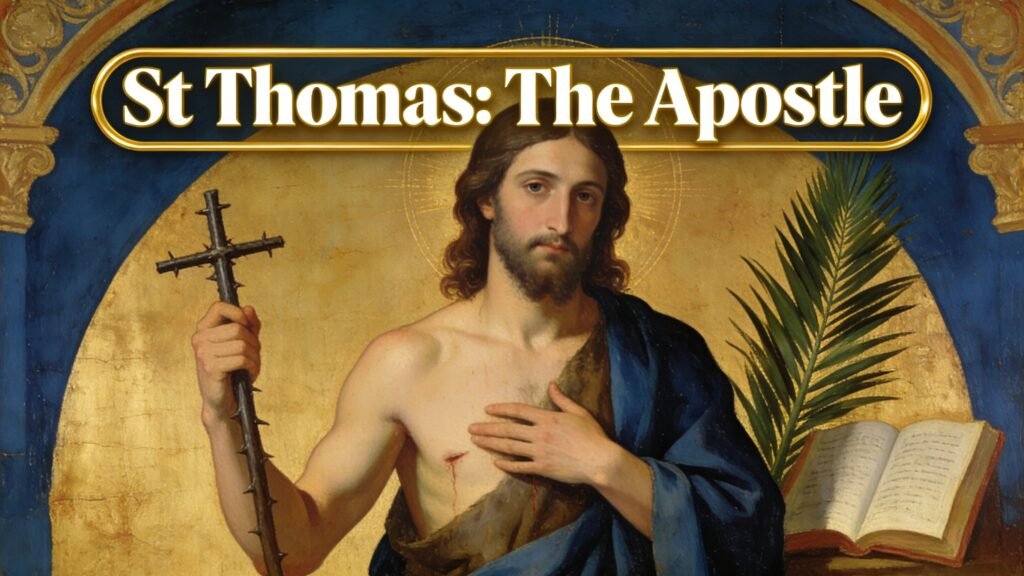
Other famous artistic depictions of him include sculptures, frescoes, and stained glass windows in churches throughout the world. Many of these images emphasize his role as a witness to the resurrection or his missionary activities in India. Some artistic traditions show him holding a spear, symbolizing his martyrdom, while others depict him with a builder’s square, reflecting his patronage of architects and builders. These artistic representations of him serve as a visual reminder of his life and legacy, inspiring believers to follow his example.
In literature, he has been the subject of numerous hagiographies, plays, and poems. The medieval “Golden Legend” by Jacobus de Voragine includes a detailed account of his life and martyrdom. Modern literature has also explored his character, with some authors focusing on his journey from doubt to faith as a metaphor for spiritual growth. St Thomas’s story continues to inspire writers, who find in his life a powerful narrative of faith, doubt, and transformation.
St Thomas’s influence extends beyond Christian culture. In popular culture, the phrase “doubting St Thomas” has become a common expression for someone who is skeptical or needs proof before believing something. This cultural reference demonstrates how deeply his story has penetrated Western consciousness. His legacy is not just religious but cultural, as his name has become synonymous with honest questioning and eventual faith.
7. Conclusion: The Enduring Legacy of St Thomas
7.1 Summary of St Thomas’s Life and Impact
St Thomas’s life presents a remarkable journey from skepticism to profound faith, from the shores of Galilee to the mission fields of India, and from ordinary fisherman to martyred saint. His story, preserved in biblical accounts, early church traditions, and historical records, offers profound insights into the nature of faith, doubt, and discipleship that continue to resonate with believers today. His life is a testament to the transformative power of encountering Jesus Christ, as he went from a doubting disciple to a courageous missionary willing to give his life for the Gospel.
Born in the 1st century AD in Galilee, he was chosen by Jesus to be one of his twelve apostles. St Thomas’s name, meaning “twin” in Aramaic, may have referred to an actual twin brother or symbolized his dual nature as both doubter and believer. The biblical accounts reveal a man of deep emotions and honest questions, someone who was not afraid to express his doubts yet was also capable of profound declarations of faith. His willingness to ask questions and seek truth made him a unique and relatable figure among the apostles.
St Thomas’s moment of doubt following Jesus’ resurrection has become his most famous episode, earning him the nickname “Doubting St Thomas.” When the other disciples told him they had seen the risen Lord, he famously declared that he would not believe unless he could see and touch the wounds of Christ. This honest skepticism, rather than disqualifying him from discipleship, led to one of the most powerful affirmations of faith in the New Testament when he declared, “My Lord and my God!” upon encountering the risen Jesus. His doubt was not a weakness but a strength, as it led him to a deeper, more personal faith.
Following the resurrection, he became one of the most courageous missionaries in the early church. He traveled to India around 52 AD and established Christian communities that continue to thrive today, nearly two thousand years later. St Thomas’s ministry in India was marked by both remarkable success and fierce opposition, ultimately leading to his martyrdom around 72 AD in Mylapore. His mission to India was a testament to his commitment to the Great Commission, as he brought the Gospel to a land far from his homeland.
7.2 Theological Significance
St Thomas’s theological significance extends far beyond his role as one of the twelve apostles. His journey from doubt to faith provides a powerful model for Christian discipleship that emphasizes intellectual honesty, spiritual growth, and the transformative power of encountering the risen Christ. His story teaches us that faith is not about blind adherence but about honest questioning and personal encounter with God.
St Thomas’s declaration “My Lord and my God!” stands as one of the clearest affirmations of Jesus’ divinity in the entire New Testament. This moment of recognition demonstrates how doubt, when honestly engaged, can lead to deeper faith. Jesus’ response to him—”Because you have seen me, you have believed; blessed are those who have not seen and yet have believed”—extends a blessing to all subsequent generations of believers. His encounter with the risen Christ reminds us that faith is rooted in personal experience of God’s presence.
St Thomas’s ministry in India also has profound theological implications. His success in establishing thriving Christian communities in a non-Western context demonstrates the universal nature of the gospel message. The St Thomas Christian tradition, which has preserved ancient practices and teachings, provides valuable insights into the early church and the diversity of Christian expression. His ministry in India shows that the Gospel is not limited to any culture or region but is meant for all people.
St Thomas’s martyrdom, with its symbolic parallel to Christ’s crucifixion, illustrates the call to discipleship that involves following Christ even to death. His willingness to give his life for the faith he had come to embrace wholeheartedly serves as a powerful witness to the truth and transforming power of the Christian message. His martyrdom reminds us that discipleship may require sacrifice, but the reward of knowing Christ is worth it.
7.3 Lessons for Modern Believers
St Thomas’s life offers several important lessons for believers in the modern world. First and foremost, his journey from doubt to faith reminds us that honest questioning is not incompatible with strong faith. In an age of scientific inquiry and intellectual skepticism, his example encourages believers to engage honestly with their questions and doubts rather than suppressing them. His doubt was not a rejection of faith but a desire for a faith that was real and personal.
St Thomas’s experience also demonstrates the importance of personal encounter with Christ. While he initially demanded physical proof, his encounter with the risen Jesus transformed his life completely. This reminds us that faith ultimately rests not on intellectual arguments alone but on personal experience of the living Christ. His story encourages us to seek a personal relationship with Jesus, one that is rooted in encounter rather than just knowledge.
St Thomas’s missionary work in India provides a model for cross-cultural evangelization that respects local customs and traditions while maintaining the essential message of the gospel. In a globalized world where cultural sensitivity is increasingly important, his approach offers valuable insights for contemporary mission work. His example shows that the Gospel can be proclaimed in a way that honors local cultures and values, rather than imposing a foreign way of life.
Finally, his martyrdom challenges modern believers to consider what they are willing to sacrifice for their faith. While few are called to martyrdom in the literal sense, his example encourages us to live lives of integrity and witness that honor Christ in every circumstance. St Thomas’s life reminds us that faith is not just a private matter but a public witness, and that we are called to stand firm in our beliefs even when it is difficult.
7.4 Final Reflections
As we conclude this comprehensive examination of this apostle, we are left with a profound appreciation for this complex and compelling figure. St Thomas’s life story—from doubt to faith, from fear to courage, from ordinary fisherman to world-changing missionary—offers a powerful narrative that continues to inspire and challenge believers today. His legacy is one of honesty, courage, and transformative faith, a legacy that continues to shape the Christian church around the world.
St Thomas’s legacy extends far beyond the pages of history. In India, the St Thomas Christian community continues to thrive, preserving ancient traditions and bearing witness to his enduring influence. In churches throughout the world, his feast days are celebrated, his name is invoked in prayer, and his example is held up as a model of faithful discipleship. His story is not just a historical curiosity but a living witness to the power of the Gospel to transform lives.
St Thomas’s journey from skepticism to faith reminds us that faith is not a static possession but a dynamic journey of growth and discovery. His willingness to ask difficult questions and seek honest answers makes him a patron saint for all who seek to reconcile faith with reason, doubt with certainty, and questioning with belief. His example encourages us to embrace our doubts and questions, knowing that God is big enough to handle them and that he will meet us in our uncertainty.
As we reflect on his life, we are challenged to examine our own faith journeys. Like him, we may experience moments of doubt and uncertainty. Like him, we may long for clearer answers to our spiritual questions. And like him, we may one day experience the transforming power of encountering the risen Christ in ways we never imagined. St Thomas’s story is a reminder that God meets us where we are, even in our doubt, and leads us to a deeper faith.
St Thomas’s story invites us to embrace our questions, pursue our doubts with honesty, and trust that the God who met him in his skepticism will meet us in ours. In the end, it is this God—the God who transforms doubters into believers, skeptics into saints, and ordinary people into world changers—who is the true subject of his story and the source of our hope. His life is a testament to the power of God’s grace to transform even the most doubting heart into a heart of unshakable faith.
As we honor his memory, let us be inspired by his journey and challenged by his example. May we have the courage to ask honest questions, the humility to seek truth, and the faith to follow where it leads. And may we, like him, one day be able to declare with all our hearts, “My Lord and my God!” in response to the living Christ who meets us in our doubt and transforms us by his grace. St Thomas’s legacy is a call to authentic faith—faith that does not shy away from uncertainty, that dares to seek personal encounter with the divine, and that compels us to share the hope of the Gospel with the world, just as he did two millennia ago in the distant lands of India.
St Thomas’s story is a timeless reminder that God uses ordinary people with imperfect faith to accomplish extraordinary things. He was not a perfect disciple; he struggled, he doubted, he hesitated—but he was willing to be honest with himself, with his fellow disciples, and with God. In that honesty, he found a faith that was unshakable, a purpose that was eternal, and a legacy that has endured through the ages. For believers today, his life offers both comfort and challenge: comfort in knowing that doubt is not a barrier to faith, but a bridge to deeper understanding; challenge in remembering that faith without action is empty, and that true discipleship requires courage, obedience, and a willingness to step beyond our comfort zones.
Across cultures, denominations, and centuries, he remains a unifying figure—a testament to the universal power of the Gospel and the transformative work of God in human hearts. St Thomas’s missionary spirit, his intellectual integrity, his unwavering loyalty, and his ultimate martyrdom all point to the truth he came to proclaim: that Jesus Christ is Lord and God, the way, the truth, and the life. As we close this exploration of his life and legacy, may we carry forward his spirit—doubting yet believing, questioning yet faithful, ordinary yet called—to live lives that honor God, bless others, and continue the work he began so long ago. In doing so, we too become part of his enduring legacy, joining the countless believers who have been inspired by the apostle once known as “Doubting St Thomas,” now remembered as a saint who teaches us what it means to trust God, even when we cannot see.