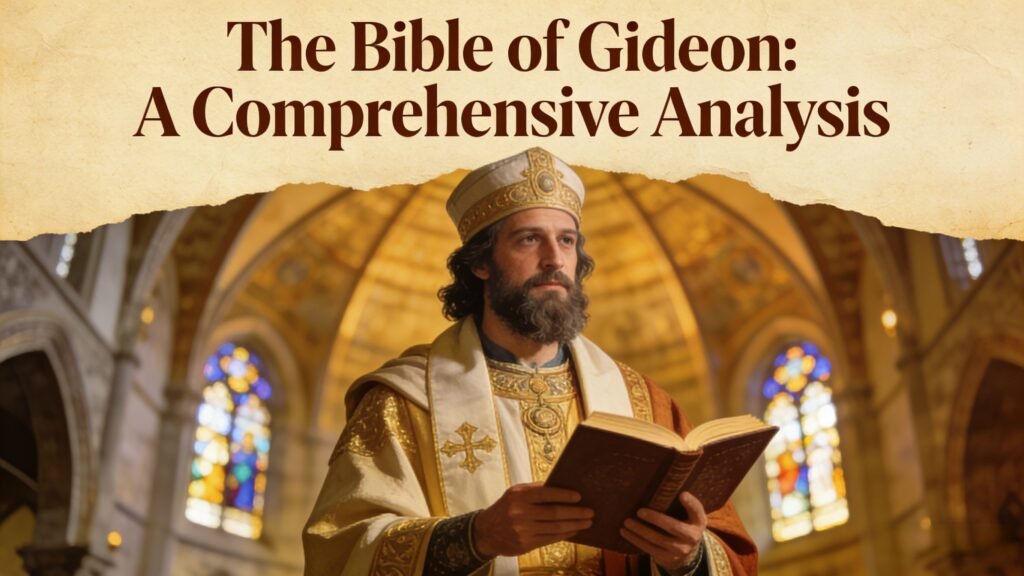
The Bible of Gideon: A Comprehensive Analysis
The bible of Gideon represents one of the most compelling narratives in the Old Testament, spanning from Judges 6 through 8. This comprehensive analysis examines the life, times, and enduring significance of Gideon, also known as Jerubbaal, a biblical figure who served as a judge and deliverer of Israel during a period of profound national crisis . The story of Gideon is remarkable not only for its dramatic military exploits but also for its profound theological implications regarding faith, obedience, and divine intervention.
Gideon’s narrative emerges during an era characterized by Israel’s recurring cycle of sin, oppression, repentance, and deliverance . As a divinely appointed leader, Gideon exemplifies how God works through unlikely individuals to accomplish His purposes, transforming a fearful farmer into a mighty warrior who led Israel to victory against overwhelming odds . The bible of Gideon encompasses not only his biblical story but also his modern-day legacy through the international organization known as The Gideons International, which has distributed billions of Bibles worldwide since its founding in 1899 .
This analysis explores the historical context, literary development, theological themes, and contemporary relevance of the bible of Gideon, examining how this ancient narrative continues to impact both Christian and Jewish traditions while maintaining its relevance in the modern world. Through careful examination of biblical texts, archaeological evidence, and scholarly interpretations, we seek to provide a thorough understanding of Gideon’s role in salvation history and his enduring influence on religious thought and practice.
1. Historical Context and Biblical Setting of Bible of Gideon
1.1 The Era of the Judges
The bible of Gideon unfolds against the backdrop of the Judges period, a critical phase in Israel’s history that scholars date approximately from 1380 to 1050 BC . This era witnessed a tribal confederation structure in Canaan, where no single tribe held dominant control over the others . The period was characterized by a consistent pattern of spiritual decline and divine intervention: the Israelites would turn away from God, face oppression from neighboring nations, cry out for deliverance, and then be rescued by a divinely appointed judge .
The Book of Judges demonstrates this cyclical pattern through multiple narratives, establishing a framework that sets the stage for the eventual establishment of the monarchy . The judges served not as judicial figures in the modern sense but as military leaders and deliverers raised up by God during times of national crisis . Gideon’s story emerges during one particularly severe period of oppression when the Midianites, Amalekites, and other eastern peoples invaded Israel for seven consecutive years, devastating the land and impoverishing the Israelites .
1.2 The Midianite Oppression
The bible of Gideon begins with a description of Israel’s dire circumstances under Midianite oppression. For seven years, these eastern invaders crossed the Jordan River annually, destroying crops, stealing livestock, and leaving the land in ruins . The Israelites were reduced to hiding in caves and strongholds, while their agricultural economy collapsed under the constant raids . This oppression served as divine discipline for Israel’s apostasy, following a forty-year period of peace that had resulted from Deborah’s victory over the Canaanites .
The bible of Gideon specifically identifies that during this time, Gideon was threshing wheat in a winepress—a location chosen to hide his meager harvest from the Midianite raiders . This detail not only establishes the severity of the oppression but also introduces Gideon as an ordinary individual thrust into an extraordinary role. His initial appearance as a fearful farmer hiding from his enemies contrasts sharply with his later designation as a “mighty warrior” by the angel of the Lord .
1.3 Gideon’s Family and Origins
According to the bible of Gideon, he was the son of Joash, from the tribe of Manasseh, and lived in Ophrah . His clan, the Abiezrites, was considered one of the least significant families within the tribe of Manasseh . Gideon’s humble origins are emphasized throughout the narrative, with the text noting that he was “the least in his father’s house” . This emphasis on his lowly status serves to highlight the divine nature of his calling and the extraordinary nature of the transformation he undergoes.
The bible of Gideon also records that his father Joash was an idolater, with Baal worship being common among the entire clan . This family background creates additional complexity for Gideon’s story, as his first act of obedience involves destroying his father’s altar to Baal—a dramatic confrontation with his own family’s religious practices. The tension between his family’s pagan traditions and his divine calling establishes one of the central conflicts in the narrative.
2. Bible of Gideon’s Divine Call and Commission
2.1 The Angelic Encounter
The pivotal moment in the bible of Gideon occurs when the angel of the Lord appears to him at his home in Ophrah . The angel’s greeting—”The Lord is with you, O mighty warrior”—immediately establishes the paradoxical nature of Gideon’s calling . Gideon’s response reveals his doubt and confusion: “If the Lord is with us, why has all this happened to us?” . This exchange illustrates the tension between God’s perspective and human understanding.
The bible of Gideon records that despite his misgivings, Gideon receives a promise of divine empowerment: “Go in this might of yours and save Israel from the hand of the Midianites; do not I send you?” . This commissioning sets in motion a series of events that will transform Gideon from a fearful farmer into a courageous military leader. The narrative emphasizes that God’s call precedes Gideon’s demonstration of faith, establishing an important theological principle about the nature of divine election.
2.2 The Altar of Baal Incident
One of the most dramatic episodes in the bible of Gideon involves Gideon’s destruction of his father’s altar to Baal. Acting under divine command, Gideon takes ten men and, under cover of darkness, demolishes the pagan altar and cuts down the Asherah pole beside it . In its place, he builds an altar to the Lord and offers a sacrifice using one of his father’s bulls . This act represents not only obedience to God but also a dramatic break with his family’s religious traditions.
The bible of Gideon records that when the townspeople discover what Gideon has done, they demand that his father put him to death. Joash’s response provides a memorable defense: “Will you contend for Baal? Will you save him? Whoever contends for him shall be put to death by morning. If he is a god, let him contend for himself, because his altar has been broken down” . This response earns Gideon the nickname “Jerubbaal,” meaning “Let Baal contend,” which becomes an important element of his identity throughout the narrative .
2.3 The Fleece Test
The bible of Gideon includes a fascinating account of Gideon’s request for divine confirmation through a series of tests involving a fleece of wool. Desiring assurance that God’s promise is genuine, Gideon asks that the fleece be wet with dew while the ground remains dry, and then the opposite—the fleece dry while the ground is wet with dew . These tests, recorded in Judges 6:36-40, reveal both Gideon’s human doubt and God’s patience in responding to his requests for confirmation .
The bible of Gideon emphasizes that God graciously 应允 s both requests, providing the miraculous signs that Gideon seeks. This episode underscores an important theological principle: God is willing to meet us in our doubt and provide the assurance we need to step forward in faith. The fleece test has become a well-known biblical illustration of how believers can seek confirmation of God’s will while maintaining a posture of humility and dependence on divine guidance.
3. Bible of Gideon Military Campaign and Miraculous Victory
3.1 The Reduction of the Army
One of the most famous episodes in the bible of Gideon involves the dramatic reduction of his army from 32,000 men to just 300 . This reduction serves a specific theological purpose: to ensure that the victory would be attributed to God alone rather than human strength . The process begins with God’s instruction to dismiss all who are fearful, which reduces the army to 10,000 men .
The bible of Gideon then describes a second test at the water’s edge, where Gideon separates those who drink by lapping water with their tongues like dogs from those who kneel down to drink. Only 300 men lap the water, and these are the ones God chooses to keep . This selection method, while seemingly arbitrary, serves to emphasize that God’s ways are not human ways and that He often chooses the unexpected to accomplish His purposes.
3.2 The Battle Strategy
The bible of Gideon details Gideon’s innovative battle plan, which relies more on psychological warfare than conventional military tactics. Each man is equipped with a trumpet, a clay jar, and a torch hidden inside . The army is divided into three companies, which surround the Midianite camp at night . At Gideon’s signal, they break their jars, sound their trumpets, and shout, “A sword for the Lord and for Gideon!” .
The bible of Gideon records that this strategy creates immediate confusion and panic among the Midianites, who begin to fight among themselves in the darkness . The narrative emphasizes that God “set every man’s sword against his fellow and against all the army,” turning the Midianite forces against each other . This miraculous intervention ensures that the victory is clearly attributable to divine power rather than human military skill.
3.3 The Pursuit and Aftermath
Following the victory, the bible of Gideon describes Gideon’s pursuit of the fleeing Midianite kings, Zebah and Zalmunna. The pursuit leads eastward across the Jordan River, where Gideon encounters additional challenges from the towns of Succoth and Penuel, which refuse to provide supplies for his army . Gideon’s response to these refusals—threatening to punish the towns when he returns victorious—reveals a more complex side of his character .
The bible of Gideon records that Gideon successfully captures Zebah and Zalmunna and, upon his return, fulfills his promise to punish Succoth and Penuel. He commands the elders of Succoth to be beaten with desert thorns and briers and destroys the tower of Penuel while slaying its council members . These actions, while harsh by modern standards, reflect the ancient Near Eastern context and the severity of the circumstances.
4. Bible of Gideon’s Theological Themes and Spiritual Significance
4.1 Faith and Obedience
The bible of Gideon presents profound theological insights into the nature of faith and obedience. Gideon’s journey from doubt to faith illustrates how God works with human weakness to accomplish His purposes. His initial response to the angelic visitation—expressing doubt and confusion—reveals a genuine human reaction to the divine call . Yet through a series of experiences and confirmations, Gideon grows in faith until he is able to lead his small band of 300 men to victory.
The bible of Gideon emphasizes that faith is not the absence of doubt but rather the willingness to act on God’s promises despite uncertainty. Gideon’s request for the fleece tests demonstrates that God is patient with our questions and doubts, willing to provide the assurance we need to move forward in obedience . This theme has resonated throughout Christian history, providing comfort to believers who struggle with questions about God’s will and ways.
4.2 Divine Sovereignty and Human Agency
The bible of Gideon presents a complex interplay between divine sovereignty and human responsibility. While God clearly orchestrates the victory over the Midianites, Gideon must still take action—destroying the altar, gathering an army, and implementing the battle plan. This balance between divine initiative and human response illustrates a fundamental theological principle that appears throughout Scripture .
The narrative emphasizes that God often chooses the weak and unlikely to accomplish His purposes, as seen in the dramatic reduction of Gideon’s army from 32,000 to 300 men . This reduction serves to eliminate any possibility that Israel could attribute the victory to human strength: “Lest Israel vaunt themselves against me, saying, Mine own hand hath saved me” . The bible of Gideon thus establishes an important principle about the nature of divine glory and human humility.
4.3 The Problem of Idolatry
Another central theological theme in the bible of Gideon is the persistent problem of idolatry and its consequences. Gideon’s first act of obedience involves destroying his father’s altar to Baal, symbolically rejecting the pagan worship that had infiltrated his own family . This act represents a fundamental choice between serving the true God and following the gods of the surrounding nations.
The bible of Gideon also records a troubling incident where Gideon constructs an ephod from gold taken as spoil from the Midianites. While initially intended as an act of worship, this ephod becomes a snare for Israel, leading to spiritual prostitution . This episode serves as a warning about the subtle nature of idolatry and how even well-intentioned religious practices can become sinful when they divert worship away from God alone.
5. Literary Analysis and Textual Development
The Composition History
Scholars have identified multiple layers in the composition of the bible of Gideon, revealing a complex literary development. The earliest traditions appear to have been oral stories that were eventually written down, possibly in the first half of the 8th century BC . These stories were initially local in nature, representing the Abiezer clan’s traditions before being incorporated into the broader Israelite narrative .
The bible of Gideon has undergone several stages of redaction, including the work of the “Book of Saviors” author, Deuteronomistic editors, and post-Deuteronomistic additions . Each layer has added theological perspectives and narrative elements that contribute to the final form of the text. For example, the section in Judges 6:7-10, where God sends a prophet to rebuke Israel, was identified by Julius Wellhausen as a late addition and has been confirmed as missing in the Qumran manuscript 4QJudga .
5.1 Narrative Structure and Themes
The bible of Gideon follows a typical heroic narrative structure, including a hero, an enemy, a geographical setting, and a specific confrontation . The story begins with the hero’s humble origins, describes his divine calling, recounts his preparation for battle, and concludes with his victory and its consequences. This structure serves both to entertain and to instruct, providing a model of faith and obedience for subsequent generations.
The narrative employs several literary devices to emphasize its theological themes. The contrast between Gideon’s initial fear and his later courage creates a dramatic arc that illustrates spiritual growth. The use of irony is evident in the naming of Jerubbaal (“Let Baal contend”), which becomes prophetic when Baal’s altar is destroyed . The repeated emphasis on numbers—particularly the reduction from 32,000 to 300 men—serves to highlight the miraculous nature of the victory.
5.2 Archaeological Evidence
While direct archaeological evidence of Gideon is limited, excavations in the region of Ophrah (traditionally identified near the Jezreel Valley) have revealed settlements from the period of the Judges . The discovery of a 3,100-year-old pottery fragment in southern Israel with five ink letters possibly representing the name “Jerubbaal” or “Yeruba’al” has intrigued scholars as a potential archaeological link to the biblical figure .
The bible of Gideon references several geographical locations that have been identified through archaeological research. Tel Jezreel and Megiddo excavations have confirmed the agricultural wealth that made the region attractive to Midianite raiders . The cities of Succoth and Penuel, where Gideon encountered resistance, have also been identified through archaeological surveys of Transjordan . While these findings cannot definitively confirm the biblical narrative, they establish the historical plausibility of the story’s setting.
6. Bible of Gideon in Christian and Jewish Traditions
6.1 Christian Interpretations and Influence
In Christian tradition, Gideon is regarded as a saint by the Eastern Orthodox and Catholic churches, and he is commemorated alongside other Old Testament figures on the Sunday before Christmas . The bible of Gideon has had a profound impact on Christian theology, particularly in its emphasis on God’s ability to use weak and unlikely vessels to accomplish His purposes.
The New Testament references Gideon in Hebrews 11:32-34, where he is listed among the heroes of faith who “through faith conquered kingdoms, administered justice, and gained what was promised” . This inclusion in the “Hall of Faith” underscores Gideon’s significance in Christian soteriology as an example of how faith leads to victory over impossible circumstances . By late antiquity and the Middle Ages, Byzantine iconography often associated Gideon with Mary, the mother of Jesus, highlighting his role as a type of the Annunciation .
6.2 Jewish Perspectives and Commentary
In Jewish tradition, the bible of Gideon holds significant importance as part of the prophetic and historical literature. The name Gideon (גִּדְעוֹן) derives from the Hebrew word meaning “hewer” or “one who cuts trees,” reflecting his role as a warrior and deliverer . His nickname “Jerubbaal” (יְרוּבְבַּעַל) contains the elements רִיב (quarrel, 争辩) and בַּעַל (Baal), meaning “Let Baal contend with him” or “One who strives against Baal” .
Jewish commentators have interpreted Gideon’s story through various lenses, emphasizing different aspects of his character and actions. Some have focused on his humility, noting that he was “the least in his father’s house” . Others have highlighted his wisdom in dealing with the Ephraimites, as recorded in Judges 8:1-3, where he diffuses their anger through diplomatic speech . The episode of the fleece has been interpreted as an example of how even great prophets require confirmation of God’s will.
6.3 Modern Religious Applications
The bible of Gideon continues to inspire both Christian and Jewish believers in contemporary religious practice. The story’s emphasis on faith in the face of impossible odds provides encouragement for believers facing challenges in their own lives. The principle that “God uses the weak things of this world to confound the wise” finds powerful expression in Gideon’s narrative .
In Christian preaching and teaching, Gideon’s story is often used to illustrate themes of spiritual warfare, the importance of obedience, and the sufficiency of God’s grace. The dramatic contrast between Gideon’s initial fear and his later courage provides a powerful illustration of spiritual transformation. The episode of the 300 men has become a metaphor for how God can accomplish great things through small beginnings or limited resources.
7. Bible of Gideon International: Modern Legacy
7.1 Historical Origins
The modern manifestation of the bible of Gideon extends far beyond the biblical narrative through the work of The Gideons International. This organization was founded in 1899 in Janesville, Wisconsin, following a chance meeting between two traveling salesmen, John H. Nicholson and Samuel E. Hill, who shared a hotel room at the Central House Hotel in 1898 . Recognizing their shared faith in Jesus Christ, they spent the night reading the Bible and praying together, which led to their vision of creating an organization to unite traveling Christian businessmen for fellowship and evangelism .
The bible of Gideon provided the inspiration for the organization’s name. On July 1, 1899, the founders gathered with a third man, Will J. Knights, for their first formal meeting. After praying for guidance, one of them suggested the name “Gideons,” in reference to the biblical leader who had accomplished great things through faith and obedience . The name was particularly fitting because, like the biblical Gideon, the organization’s members would be called to accomplish great things with limited resources.
7.2 Mission and Activities
The primary mission of The Gideons International is to “win men, women, and children to the saving knowledge of Jesus Christ” . This mission is accomplished through three strategic approaches: associating together for service, personal testimony and work, and the placement and distribution of God’s holy word . The organization’s focus on Bible distribution has made it one of the most recognized Christian organizations worldwide, particularly through their practice of placing Bibles in hotel rooms.
The bible of Gideon finds practical expression in the organization’s distribution strategy. Since 1908, when they placed their first Bibles in the Superior Hotel in Montana, The Gideons have expanded their efforts to include hospitals, schools, prisons, military bases, and other public institutions . Their Bibles are typically New Testaments or complete Bibles without notes or references, designed to be accessible to people from various backgrounds and denominations .
7.3 Global Impact
The bible of Gideon has had an extraordinary global impact through the work of The Gideons International. By the 1950s, the organization had established branches on every continent, and today they operate in over 200 countries and territories . Their distribution efforts have reached billions of people, with the organization having distributed over 2.5 billion Bibles and New Testaments worldwide .
The bible of Gideon continues to be distributed in over 100 languages, adapting to the linguistic and cultural diversity of the global population . The organization’s commitment to free distribution ensures that financial barriers do not prevent anyone from accessing the Scriptures. This practice reflects the biblical principle that God’s word is a free gift, available to all who seek it.
8. Bible of Gideon’s Contemporary Significance and Challenges
8.1 Relevance in the Digital Age
The bible of Gideon faces new challenges and opportunities in the digital age. While traditional print Bibles remain central to the organization’s mission, The Gideons have also developed digital platforms, including the Gideon Bible App, which provides access to Scripture through mobile devices . This technological adaptation ensures that the message of the bible of Gideon remains accessible to younger generations who increasingly rely on digital media.
The digital revolution has created new possibilities for Bible distribution and engagement. The Gideon Bible App offers features such as offline reading, verse highlighting, and note-taking capabilities, enhancing the user’s experience with Scripture . These technological innovations complement rather than replace traditional Bible distribution, recognizing that different people engage with religious texts through various media.
8.2 Cultural and Religious Plurality
In an increasingly pluralistic world, the bible of Gideon faces questions about its relevance and approach. The organization’s commitment to evangelical Christianity has sometimes created tensions in secular or multi-religious contexts. However, The Gideons have maintained their focus on making the Bible available to all people, regardless of their religious background, trusting that the message of Scripture will speak for itself .
The bible of Gideon continues to find relevance in addressing contemporary social issues. The biblical themes of justice, compassion, and human dignity resonate with modern concerns about poverty, inequality, and human rights. The story of Gideon’s deliverance of an oppressed people offers hope and inspiration for those seeking to address injustice in the world today.
8.3 Academic and Critical Perspectives
The bible of Gideon has undergone extensive scholarly analysis, with academic studies examining its historical reliability, literary development, and theological significance. Archaeological research has provided contextual support for the biblical narrative, though direct evidence of Gideon remains elusive . The discovery of ancient manuscripts, including fragments from the Dead Sea Scrolls, has confirmed the textual integrity of the biblical text .
Modern biblical scholarship has identified multiple sources and redactional layers in the Gideon narrative, revealing how different theological perspectives have shaped the final form of the text . While these critical approaches have sometimes challenged traditional interpretations, they have also enriched our understanding of the text’s complexity and the multiple ways in which it has been understood throughout history.
Conclusion
The bible of Gideon represents a profound and multifaceted narrative that continues to resonate across cultures and generations. From its origins in ancient Israel to its modern expression through global Bible distribution, the story of Gideon embodies enduring themes of faith, obedience, and divine intervention that remain relevant in our contemporary world.
The biblical account of Gideon’s life demonstrates how God works through ordinary people to accomplish extraordinary purposes. His transformation from a fearful farmer to a mighty warrior illustrates the power of divine calling and the sufficiency of God’s grace in human weakness. The dramatic reduction of his army from 32,000 to 300 men serves as a timeless reminder that God’s strength is made perfect in weakness and that He often chooses the unexpected to accomplish His will .
The modern legacy of the bible of Gideon through The Gideons International demonstrates how ancient biblical narratives continue to inspire contemporary mission and evangelism. Their distribution of billions of Bibles worldwide represents a remarkable extension of the biblical story’s impact, bringing the message of hope and salvation to people across the globe.
As we reflect on the bible of Gideon, we are challenged to examine our own lives and consider how God might be calling us to step out in faith, even in the face of seemingly impossible circumstances. The story reminds us that faith is not the absence of doubt but the willingness to trust God’s promises and obey His commands, even when we cannot see the full picture.
The bible of Gideon ultimately points beyond itself to the larger narrative of God’s redemptive work in human history. Like Gideon, we are all called to be instruments of God’s grace in our own time and place. Whether through acts of courage in the face of adversity or through the simple sharing of God’s word with others, we are invited to participate in the ongoing story of God’s love and salvation for the world.
In an age of uncertainty and challenge, the bible of Gideon offers timeless wisdom and encouragement. It reminds us that God is faithful to His promises, that His strength is sufficient for every task, and that even the most unlikely of individuals can be used by God to accomplish great things. As we continue to explore and share this ancient story, we participate in a legacy that spans thousands of years and continues to transform lives around the world.